


Few recent articles have captured the evolving transmission policy debate as thoughtfully and constructively as Devin Hartman’s “The Missing Transmission Voices Emerge,” published by R Street Institute. At a time when the electricity industry is increasingly strained by rising demand, aging infrastructure, political polarization, and mounting affordability concerns, Hartman succeeds in reframing transmission policy around something both practical and bipartisan: delivering reliable electricity to consumers at the lowest reasonable cost.
That achievement should not be understated.
For years, transmission policy discussions have largely been dominated by two groups: incumbent utilities and climate-focused organizations. Hartman correctly identifies how this imbalance has often distorted the broader conversation, making transmission expansion appear primarily as a renewable energy agenda rather than what it truly is: a foundational economic, reliability, industrial competitiveness, and national infrastructure issue.
Perhaps most importantly, the article recognizes the growing emergence of consumer advocates and center-right voices in transmission reform discussions. That shift matters enormously. Transmission policy cannot succeed long-term if it is perceived as ideologically partisan. Durable reform requires broad political legitimacy, economic rigor, and demonstrable consumer value.
Yet while Hartman’s article makes a critically important contribution to the policy discussion, it also opens the door to an equally important next phase of the conversation: the physical realities of the transmission grid itself.
Because beyond governance structures, market rules, planning reforms, and cost allocation debates lies an unavoidable engineering reality: the North American transmission system is running out of capacity.
And it is happening faster than many policymakers fully appreciate.
Over the past several decades, electricity demand growth remained relatively modest. Utilities and regulators became accustomed to incremental load increases and localized infrastructure upgrades. That era is ending rapidly. Today, electricity demand forecasts are accelerating at a pace not seen in generations, driven by artificial intelligence, hyperscale data centers, domestic manufacturing expansion, electrification, and population growth in major regions.
Large data centers alone are now requesting power levels equivalent to small cities. In some areas, utilities are confronting requests for several gigawatts of new load concentrated within a single service territory. Meanwhile, electrification initiatives involving transportation, industrial processes, and building systems continue expanding electricity dependency across the economy.
This load growth is colliding with a transmission system that was largely designed decades ago under very different assumptions.
Across much of the United States, existing transmission infrastructure is already constrained by thermal limits, congestion bottlenecks, stability requirements, and aging assets. Interconnection queues continue growing at unprecedented levels, with many generation projects facing delays measured not in months, but in years. Importantly, these delays are not solely the result of bureaucratic inefficiency. In many cases, the grid quite literally lacks the physical transfer capability necessary to accommodate additional power flows.
This distinction matters.
Transmission policy discussions often become consumed by procedural issues - who pays, who plans, who approves, who benefits. Those questions are important. But ultimately, no amount of regulatory reform can substitute for actual transmission capacity.
At some point, steel, aluminum, composite materials, towers, substations, and conductors must carry more electricity.
This is where the next stage of transmission modernization becomes critically important - and where the industry must place far greater emphasis on upgrading the existing grid itself.
Hartman appropriately highlights Advanced Transmission Technologies (ATTs) as part of the solution. However, the transmission industry increasingly needs to move beyond merely “considering” advanced technologies and toward deploying them systematically at scale.
Among the most impactful opportunities is reconductoring existing transmission lines using advanced high-capacity composite core conductors – like CTC Global’s ACCC® Conductor
This may be one of the most underappreciated infrastructure solutions available today.
For decades, expanding transmission capacity generally meant constructing entirely new lines - a process often requiring years of permitting, environmental review, land acquisition, litigation, and public opposition. In today’s environment, new greenfield transmission corridors are becoming increasingly difficult, expensive, and politically contentious to develop.
Reconductoring changes that equation.
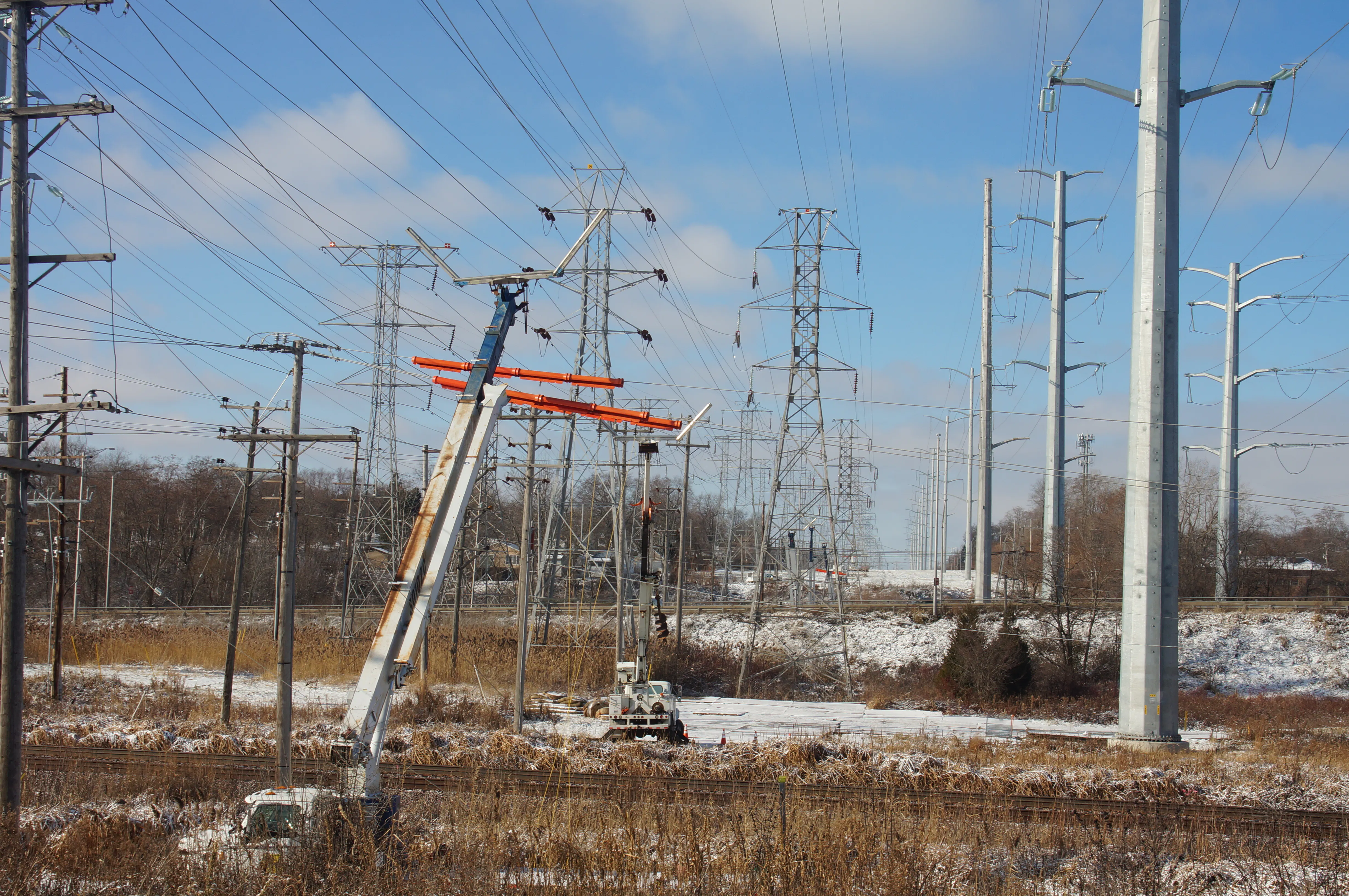
By replacing legacy steel core conductors with advanced high-capacity composite core conductors on existing rights-of-way, utilities can dramatically increase transmission capacity while avoiding many of the challenges associated with new line construction, ore extensive rebuilds. In many cases, existing structures and corridors can remain in service while line capacity increases substantially.
This is not theoretical technology. ACCC Conductor has already been deployed to more than 1,500 projects in 30 U.S states and 70 countries since 2005.
Advanced composite-core conductors can often provide:
significantly higher ampacity,
lower line losses,
reduced sag,
improved thermal performance,
enhanced reliability,
and faster deployment timelines
compared to conventional steel core conductor technologies.
Most importantly, these upgrades can frequently be implemented in a fraction of the time required for entirely new transmission projects.
That timing advantage is becoming extraordinarily important.
The grid does not have the luxury of waiting fifteen years for every major transmission expansion project. AI growth, manufacturing reshoring, and electrification are occurring now. Utilities increasingly require scalable solutions that can be deployed within existing infrastructure corridors and within realistic regulatory timelines.
This is why the future transmission conversation must increasingly become a discussion about optimization - not simply expansion.
The lowest-cost megawatt of transmission capacity is often the capacity that can be unlocked from infrastructure already in the ground.
This also aligns remarkably well with the consumer-centered framework Hartman advocates.
Consumers do not particularly care whether transmission capacity comes from a new 500 kV greenfield corridor or from reconductoring an existing line. What consumers ultimately care about is affordability, reliability, speed of deployment, and avoidance of unnecessary cost burdens.
In many situations, optimizing existing infrastructure may provide the best balance of all four.
This is especially true as wildfire risks, extreme weather events, and infrastructure resilience become central utility concerns. Modern transmission upgrades increasingly must accomplish multiple objectives simultaneously:
increase capacity,
improve reliability,
reduce operational risk,
minimize environmental impacts,
and contain customer costs.
The transmission system can no longer be viewed solely as an energy delivery network. It is becoming the central enabling infrastructure of the modern digital economy.
That reality also changes the political calculus.
As Hartman correctly observes, transmission modernization is increasingly aligning with conservative economic priorities. Reliable, abundant, and affordable electricity is fundamental to industrial competitiveness, domestic manufacturing, national security, and technological leadership. AI infrastructure alone may reshape electricity demand forecasts for decades.
In that environment, transmission investment should not be viewed narrowly through the lens of renewable integration. It should be viewed as core economic infrastructure akin to interstate highways, ports, pipelines, rail systems, and telecommunications networks.
At the same time, Hartman is also correct to warn against excessive central planning and politically driven infrastructure allocation. The transmission sector must avoid creating inefficient investment mandates disconnected from economic value.
But there is an equally important danger in underinvestment.
For too long, transmission expansion has often been deferred because the system continued functioning “well enough.” That margin is disappearing. Congestion costs are rising. Reserve margins are tightening. Reliability risks are increasing. Interconnection delays are slowing generation development. Electricity affordability is becoming a growing public concern.
The industry now faces a narrow window to modernize the grid before these pressures compound further.
That modernization effort will require multiple solutions:
improved planning,
better cost allocation,
increased transparency,
enhanced competition,
regulatory reform,
advanced grid technologies,
and strategic new transmission construction.
But perhaps most importantly, it will require far more aggressive modernization of the infrastructure already in service.
The future of transmission may not primarily belong to entirely new networks. In many cases, it may belong to transforming the enormous network that already exists.
That is why Hartman’s article is so important. It helps move the transmission debate toward broader political and consumer alignment. The next step is ensuring the discussion fully embraces the physical engineering realities now reshaping the electric grid.
Because ultimately, transmission policy is no longer simply an energy policy discussion.
It is an economic growth discussion.
An industrial competitiveness discussion.
A national resilience discussion.
And increasingly, an affordability discussion for every electricity consumer in America.