


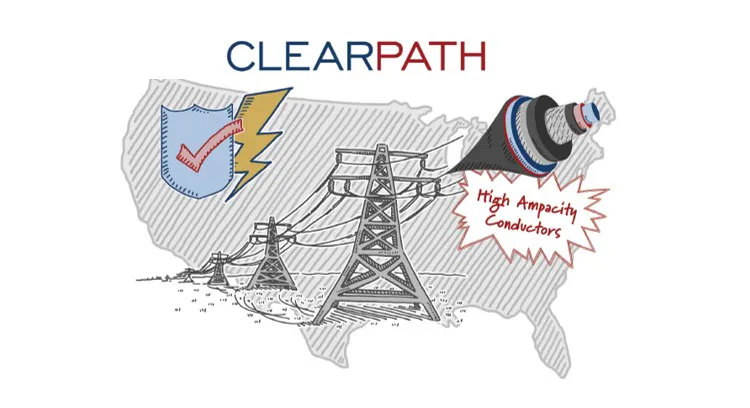
America's transmission challenge is increasingly becoming a race against time. Electricity demand is growing, new generation and large loads are waiting to connect, and many of the transmission projects needed to support that growth can take a decade or longer to plan, permit and build. Against that backdrop, a new report from ClearPath offers an important and timely contribution to the discussion about how we can get more out of the grid we already have while continuing to build the new infrastructure we will unquestionably need.
Amping Up the Grid: The Role of High Ampacity Conductors in Transmission Expansion, authored by Casey Kelly and Will Bryant of ClearPath, with technical modeling performed by Ryan Jones, Ben Preneta, Jeremy Hargreaves, Ben Haley, Alexandra von Meier and Jim Williams of Evolved Energy Research, deserves attention from utilities, regulators, policymakers and transmission planners.
What makes the report particularly valuable is that it moves the advanced conductor discussion beyond a simple comparison of conductor specifications. Instead, the researchers developed a proof-of-concept integrated transmission model that combines capacity expansion and power-flow modeling to examine where different transmission investments actually make economic and engineering sense.
Using ERCOT as the test bed, the analysis asks an increasingly important question: When demand is growing rapidly, what is the cost-optimal combination of reconductoring existing transmission corridors and building entirely new transmission infrastructure?
The answer is refreshingly pragmatic.
We need both.
Reconductoring and New Transmission Are Complements, Not Competitors
One of the most useful aspects of the ClearPath analysis is that it avoids the temptation to present reconductoring as a substitute for building new transmission.
The researchers conclude that cost-optimal grid expansion requires both reconductoring and new greenfield transmission. A reconductoring-only strategy eventually runs into limitations created by network topology and reliability requirements. Conversely, relying exclusively on new transmission is too slow and, in many cases, unnecessarily expensive and land intensive.
That distinction matters.
Greenfield transmission creates new pathways. Reconductoring increases the productivity of pathways we already have. The most effective grid strategy is therefore not an either/or decision, but an engineering exercise in determining where each approach creates the greatest value.
The scale of that opportunity identified by the report is remarkable. Under its High Demand Growth scenario, allowing reconductoring avoids roughly 6,500 miles of additional greenfield transmission. By 2040, the modeling indicates that reconductoring can reduce transmission investment by approximately $20 billion compared with a greenfield-only approach.
Perhaps even more striking is what happens in the near term. Under the High Demand Growth case with all technologies available, approximately 75% of the capacity added to the grid by 2030 comes from reconductoring.
That is an important finding because 2030 isn't very far away.
Composite-Core Conductors Emerge as the Workhorse
ClearPath's second major conclusion is stated quite directly:
"Composite Core Conductors are the workhorse of near-term grid expansion."
That is a significant statement, but the modeling behind it is even more interesting.
Across the scenarios examined, composite-core conductors were deployed most frequently because their performance advantage outweighed their somewhat higher upfront cost. The report found them particularly well positioned to relieve thermal constraints on existing transmission lines.
The researchers also found that ACSS was not selected for reconductoring in any of the modeled scenarios. Higher-capacity superconducting technology found a potential niche in extremely constrained applications, while composite-core technology emerged as the broadly applicable high-ampacity solution.
There is a larger lesson here for our industry.
For decades, conductor selection has frequently occurred relatively late in the transmission planning process. Planners first identify the need, establish the project and determine the corridor, and only later ask what conductor should be installed.
The ClearPath report challenges that sequence.
If conductor technology can substantially change the capacity, cost, land requirements and future headroom of a transmission project, then conductor performance should be considered much earlier in the planning process.
From Modeling to the Real World
This is where the findings become particularly interesting from my perspective.
I have spent much of my career working with advanced conductors, and one of the encouraging things about this report is that its modeling results increasingly resemble what utilities have been discovering in the field.
CTC Global's ACCC® Conductor is one example of a composite-core conductor that has moved well beyond the demonstration stage. ACCC Conductor has now been deployed on more than 1,600 projects in 30 U.S. states and 70 countries.
That deployment experience matters.
ACCC replaces the conventional steel core with a lightweight, high-strength carbon composite core. The lighter core creates room for more conductive aluminum without necessarily increasing conductor diameter or weight, while its very low coefficient of thermal expansion substantially reduces thermal sag.
The practical result is the ability, depending on the application, to substantially increase transmission capacity while using existing structures and rights-of-way.
That capability is especially valuable where obtaining a new corridor may take many years, where structures have limited loading capacity, where clearance requirements constrain conventional conductors, or where growing loads need additional capacity much sooner than a new transmission project can reasonably be completed.
But ACCC's deployment history also illustrates another point raised by ClearPath: composite-core conductors should not be thought of exclusively as reconductoring technologies.
They can also improve the performance of new transmission lines.
If we are going to spend years permitting a new corridor and billions of dollars building new transmission infrastructure expected to serve customers for 50 years or more, it makes sense to consider how much capacity, efficiency, resilience and future headroom that infrastructure can provide over its entire service life.
The Existing Grid Is Also an Infrastructure Resource
One of the most important shifts occurring in transmission planning today is the growing recognition that existing rights-of-way, towers, poles and substations are valuable infrastructure assets in their own right.
Obtaining them was difficult the first time.
Reconductoring allows utilities to increase the productivity of those existing assets. In many applications, substantially greater capacity can be created without acquiring a new corridor or rebuilding an entire transmission line.
ClearPath's modeling helps quantify the system-level value of doing so.
It also makes an important observation about where reconductoring works best. Existing meshed networks with redundant transmission paths were particularly strong candidates. As network redundancy increased, the likelihood that reconductoring became the cost-effective solution increased dramatically.
That suggests we should become much more systematic about identifying these opportunities rather than waiting for individual lines to become overloaded.
Better Planning Tools May Be Just as Important as Better Conductors
Another important contribution from ClearPath is its focus on transmission planning tools.
The authors point out that today's planning processes often separate long-term capacity expansion from detailed power-flow and reliability analysis. That makes it difficult to evaluate advanced transmission technologies alongside conventional solutions on an equal footing.
The proof-of-concept model developed by Evolved Energy Research attempts to bridge that gap.
This may ultimately be one of the report's most consequential recommendations.
Technology cannot be selected if the planning tools don't adequately represent it.
As FERC, DOE, state regulators, utilities and regional transmission organizations increasingly require consideration of advanced transmission technologies, simply adding another checkbox to a planning process will not be enough. Engineers need analytical tools capable of comparing capacity, reliability, cost, timing and network effects across different technologies.
ClearPath also proposes that regulators consider establishing rebuttable presumptions favoring high-performance composite conductors where system conditions make them the best available technology, while allowing utilities to demonstrate when another solution is preferable.
Whether regulators ultimately adopt that particular approach or something different, the underlying principle deserves consideration: transmission technology should compete on total system value rather than simply on initial equipment cost.
Building Faster — and Building Smarter
Perhaps the strongest message from Amping Up the Grid is that America's transmission challenge is too large for any single solution.
We need new high-voltage transmission. We need faster and more predictable permitting. We need better planning tools. We need grid-enhancing technologies. And we need to extract substantially greater capability from the infrastructure already standing.
High-ampacity composite-core conductors can play an important role in that portfolio.
For those of us who have worked with this technology for many years, it is encouraging to see sophisticated transmission modeling beginning to quantify something that field experience has been demonstrating for some time: advanced conductors are no longer simply an interesting alternative to conventional wire.
In many applications, they can fundamentally change the economics and timing of transmission expansion.
ClearPath and the Evolved Energy Research team deserve considerable credit for advancing this discussion. Their work helps move the conversation away from asking whether we should reconductor or build new transmission and toward the much more productive question:
Where should we reconductor, where should we build, and how can we use the best available technology to get the greatest possible value from both?
With electricity demand accelerating and transmission development timelines measured in years rather than months, that is exactly the question our industry should be asking.