


Conventional wisdom suggests using residential demand response (DR) to help offset growing electricity demand from data centers. We wanted to test that assumption - and also examine the impact of rapidly growing EV ownership.
Our analysis produced two surprising results:
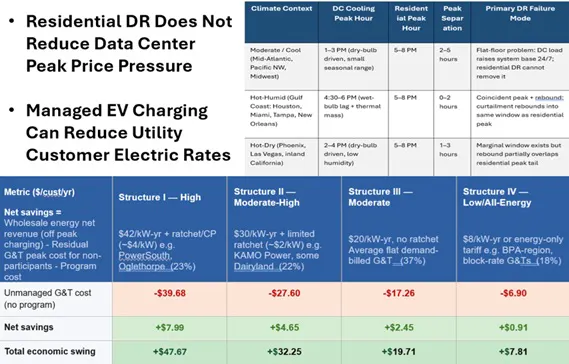
• Residential DR does not reduce the utility peak associated with data center growth because residential and data center peak loads occur at different times. Rebound effects largely offset temporary residential load reductions.
• Managed EV charging produces the opposite result. Under every G&T cost structure evaluated, the program generated net savings after program costs—and in some cases reduced annual residential electric costs by nearly $8/residential customer base while avoiding $40/residential customer base in unmanaged EV costs.
For example, an electric cooperative with rate Structure II serving a suburban residential customer base of 20,000 with 10% EV ownership could increase annual revenue/reduce customer prices by $93,000.
Study results are based on the MAISY® Utility Customer Database, Grid Impact Model analysis and industry EV data. Our paper includes the complete methodology, assumptions, and example calculations for four representative G&T cost structures and is available at https://maisy.com/dcevrates.htm