


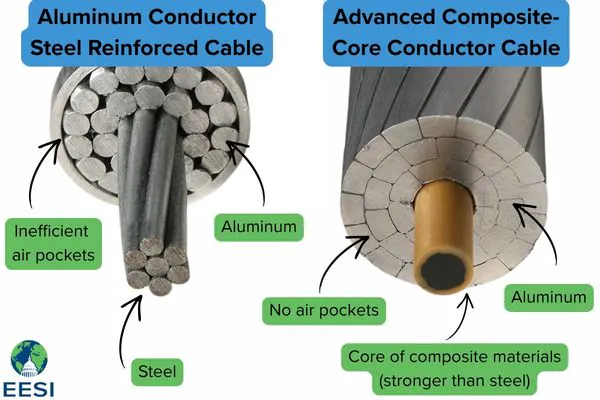
Over the years, I’ve read countless articles about transmission constraints, grid congestion, and the growing interconnection backlog. But every so often, a piece stands out - not just for what it says, but for how clearly and accurately it captures both the challenge and the solution.
A recent article by Aastha Singh at the Environmental and Energy Study Institute does exactly that.
Her piece, “Reconductoring: The Path of Least Resistance to Fixing the U.S. Energy Grid,” offers one of the most concise and well-supported explanations I’ve seen of why reconductoring is emerging as a critical tool for modernizing the grid.
What makes this article particularly compelling is its balance of policy, economics, and engineering reality.
She highlights the staggering scale of the problem - thousands of gigawatts of generation waiting to connect, rising demand from electrification and data centers, and a transmission system that simply isn’t expanding fast enough.
But more importantly, she focuses on a solution that can be deployed now.
Reconductoring.
From my perspective - and from the vantage point of more than two decades working CTC Global and the ACCC Conductor with utilities around the world - her conclusions are not just directionally correct. They are proven.
Utilities that have adopted advanced conductors have consistently demonstrated that existing transmission corridors can carry significantly more power - often two to three times more - without the need for new rights-of-way. Projects that would otherwise take a decade or more can be completed in a fraction of the time.
The article also correctly points out something that is often overlooked in policy discussions: improving the efficiency of the grid is just as important as expanding it.
Reducing line losses is not an abstract benefit. It translates directly into:
lower generation requirements
reduced emissions
lower system costs over time
And as noted in the article, these benefits are already being realized at scale.
I would add one additional dimension that deserves even greater attention: resilience.
Advanced conductors are not just about capacity. Their mechanical strength and low thermal expansion characteristics significantly reduce sag, improve clearances, and enhance performance under extreme weather conditions. In regions facing wildfire risk, extreme heat, or severe storms, these attributes are becoming just as important as capacity itself.
It is also worth noting that while reconductoring is sometimes described as a “new” approach, it is anything but. The technology has been deployed globally for more than 20 years and is supported by a substantial and growing body of operational experience.
What is new is the level of urgency - and the growing recognition among policymakers, regulators, and utilities that we cannot build our way out of today’s transmission constraints fast enough using traditional approaches alone.
That is why this article matters.
It reflects a broader shift in thinking - one that recognizes that upgrading what we already have may be the fastest, most cost-effective, and most scalable way to meet the energy demands of the future.
My compliments to Aastha Singh and the team at EESI for bringing clarity to an issue that is too often misunderstood or overlooked.
The conversation is changing - and this is exactly the kind of thoughtful, well-grounded analysis that helps move it forward.