


A Region at an Energy Crossroads
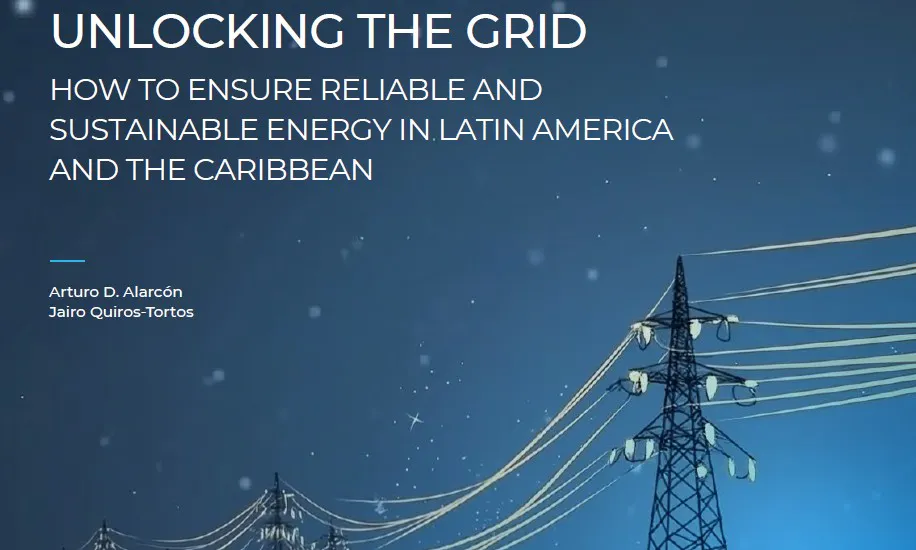
In November 2025, the Inter-American Development Bank (IDB) released one of the most consequential energy reports in recent memory: Unlocking the Grid: How to Ensure Reliable and Sustainable Energy in Latin America and the Caribbean. Produced under the leadership of the IDB’s Energy Division, the document is far more than a technical assessment. It is a candid diagnosis of a region whose economic ambitions, climate commitments, and social progress now hinge on the strength and modernization of its transmission networks.
The IDB, long regarded as the premier development institution guiding infrastructure investment and policy across Latin America and the Caribbean, positioned this report as both a warning and a roadmap. Its authors - Arturo D. Alarcón, a seasoned power system planner within the Bank, and Jairo Quirós-Tortós, an internationally respected scholar and practitioner in sustainable power systems - bring together decades of experience in planning, regulation, resilience, and energy transition. Their voices lend the report not only academic credibility but also a deep understanding of how institutional realities shape what a region can or cannot build.
The Grid Bottleneck Holding Back the Energy Transition
What emerges from their work is a portrait of a power system under unprecedented stress. Renewable energy has surged, with solar and wind proliferating at remarkable speed. Industrial and digital loads - from mining to data centers - are expanding. And climate-driven extreme events are testing the limits of grid resilience. Yet while generation is transforming rapidly, transmission has not kept pace. Development cycles for solar and wind are measured in months, while planning, permitting, and construction of transmission lines frequently require five to seven years. The result is widespread congestion, rising curtailment, and stalled economic potential. In 2024 alone, the region curtailed 53,000 GWh of renewable energy - an amount equivalent to meeting the annual electricity demand of several countries - at a financial cost exceeding USD 7 billion.
The report’s message is unambiguous: transmission is no longer a supporting asset. It is the backbone of the energy transition, the arbiter of reliability, and increasingly the foundation of economic development. Without a modern and expanded grid, countries cannot integrate renewable resources, electrify transportation and industry, attract energy-intensive investment, or shield their economies from climate and geopolitical volatility. The authors call for a new generation of transmission planning - anticipatory rather than reactive, resilient rather than brittle, and capable of turning long-term visions into executable projects supported by coherent regulation and innovative financing.
Grid-Enhancing Technologies: Delivering Capacity When Time Is Short
Perhaps one of the report’s most hopeful insights is that Latin America does not need to wait a decade to resolve its most urgent bottlenecks. The IDB dedicates an entire chapter to Grid-Enhancing Technologies (GETs) - innovations such as Advanced Conductors, dynamic line rating, advanced monitoring systems, and flow controllers - that can unlock significant transmission capacity in a fraction of the time required for new infrastructure. These tools are not speculative or futuristic; they are essential solutions for a region struggling with congestion, curtailment, and prolonged permitting cycles.
Among these technologies, Advanced Conductors stand out for their ability to dramatically increase the capacity of existing lines without requiring new rights-of-way. This is where the contribution of CTC Global’s ACCC® Conductor becomes especially relevant. The ACCC® Conductor’s ability to double the ampacity of existing corridors offers a proven, rapid path to capacity expansion. It allows utilities to bypass the multi-year delays associated with new line construction - precisely the bottleneck the IDB identifies as one of the region’s most costly vulnerabilities.
ACCC® Technology also addresses the resilience challenges highlighted in the report. Traditional steel-reinforced conductors lose strength and sag under high temperatures, increasing the risk of outages or wildfire ignition during extreme conditions. The carbon-fiber composite core of the ACCC® Conductor avoids thermal annealing and exhibits extremely low thermal expansion, reducing sag and enabling higher operating limits during emergencies. These attributes align directly with the resilience strategies the IDB urges utilities and regulators to adopt.
A Practical Path Toward the Grid Latin America Needs
The report further emphasizes the need to support new industrial loads and strengthen regional interconnections - both of which depend on increasing transfer capability and reducing electrical losses. The ACCC® Conductor’s lower resistance cuts line losses significantly, improving system efficiency and enabling longer, higher-capacity interties between regions and countries. This is particularly important where renewable resources are concentrated far from consumption centers and where cross-border electricity exchanges represent an untapped opportunity.
Ultimately, the IDB’s findings point toward a grid that must be not only larger and stronger, but more flexible. The coming decades will bring fluctuating supply profiles, new forms of demand, and deeper electrification. A conductor that can safely operate at higher temperatures, carry more power, and offer greater efficiency gives system operators the flexibility needed to navigate this uncertainty.
In this sense, the ACCC® Conductor does more than address a technical limitation - it supports a strategic shift toward a dynamic, resilient, and sustainable transmission network. It delivers immediate capacity relief, enhances resilience, accelerates renewable integration, and helps utilities accomplish more within existing corridors. As countries across Latin America and the Caribbean pursue the vision laid out in Unlocking the Grid, technologies like ACCC® Conductor will play a defining role: practical, proven, and ready to deploy today.