


By Peter Asmus
As demand for electricity continues to rise, utilities are embracing innovative approaches to meet the evolving needs of their customers — both current and future — in affordable, resilient and sustainable ways. During this week’s D-TECH conference in San Diego, discussions about how U.S. utilities — and their private sector partners —can meet the challenge of rising demand and resiliency during a time of market reconfiguration will no doubt generate buzz and, hopefully, fresh thinking. One theme emerging from these conversations is a growing reassessment of how onsite and distributed energy resources can support reliability and resilience as the grid evolves.
Rather than viewing onsite distributed generation (DG) as a challenge, many utilities now see it as a strategic asset. Microgrids are being increasingly recognized for their ability to operate independently during outages as well as their role in enhancing grid reliability and energy security. Against this backdrop, recent outages during Winter Storm Fern further illustrate the need for microgrid fleets to operate in areas facing increased risks from storms, heat waves, wildfires, and a rising demand for power.
This shift marks a departure from the traditional focus on centralized power plants and economies of scale. Today’s utilities are exploring more flexible, customer-centric solutions that complement the grid, empower communities, and support long-term energy goals.
Today, utilities are operating in a different world: large customers are seeking power quickly, and critical facilities like hospitals are seeking resiliency without relying on traditional diesel generation. As a result, utilities are reinventing themselves through creative partnerships. Whether its launching new virtual power plant (VPP) programs, tapping customer-owned distributed energy resource (DER) assets, or owning or contracting for services from on-site generators, utilities are adapting through innovation and turning many past assumptions about their role in energy markets upside down.
While states like California and New York are often seen as leaders in the distributed energy resources (DER) space, exciting new partnerships are also emerging across the South and Texas — regions that are rising to the challenge of extreme weather like hurricanes and ice storms by embracing innovative energy solutions.
Entergy and Power Through
Entergy is a large investor-owned utility whose service territory spans parts of Texas, Arkansas, Mississippi and Louisiana. The utility has received regulatory approval across most of its footprint to offer commercial and industrial customers a program called “Power Through,” whereby it deploys front-of-the-meter natural gas generators that provide backup power. The program was launched in Louisiana in 2022, Mississippi in 2023, Arkansas in 2024 and then finally Texas in 2025.
If a facility takes advantage of the Power Through program experiences an outage, an automatic transfer switch activates, seamlessly shifting the power source from the grid to an on-site generator to maintain uninterrupted service.
While each state’s program has nuanced differences, the program typically provides 100 kW to 10 MW systems. When not supplying backup power to participating customers, the Power Through program — and its associated generators — can contribute additional power to the grid during periods of high demand, supporting the utility’s commitment to delivering reliable service.
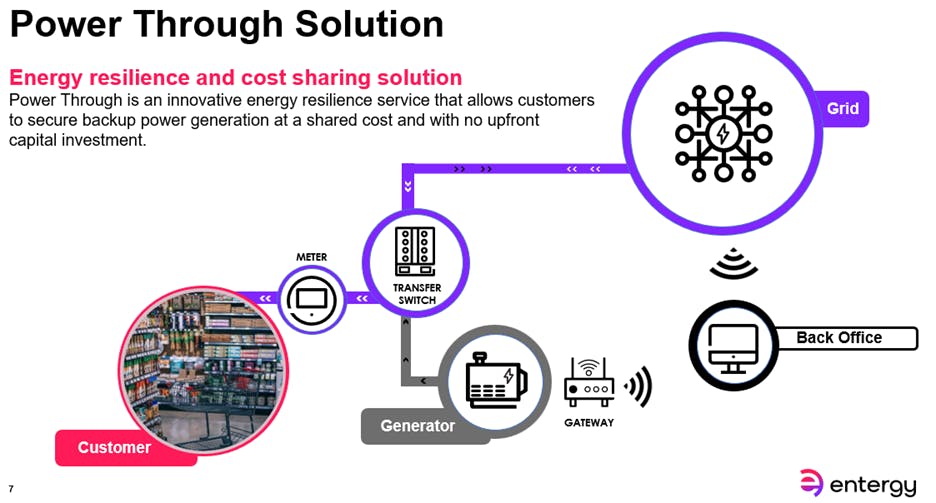
“At Entergy, we’re always looking for creative ways to serve our customers with exceptional service and reliable power,” said Frank Magee, Entergy senior manager of Power Through. “The Power Through program is a great example of that commitment — it not only strengthens resiliency for critical facilities like hospitals but also supports the grid during peak demand. It’s a win-win for our customers and the communities we serve.” Magee pointed to a recent Power Through project with Baton Rouge General’s (BRG) Bluebonnet and Mid City campuses as an example of how Power Through is supporting the community in Southeast Louisiana. Supported in part by state funding, both BRG campuses now have full-facility power, including emergency rooms, intensive care units, surgical suites, inpatient services and critical life-saving equipment. Enchanted Rock supplied natural gas-fired generators that deliver 3.6 MW and 5.8 MW of backup power during outages.
An Alternative Utility Microgrid Approach
Utilities can provide resiliency in other ways as well. For example, another major municipal utility in the Southwest is partnering with Enchanted Rock on a Resiliency-as-a-Service (RaaS) microgrid program. The program was launched in response to Texas state legislation (Senate Bill 398), which was passed after Winter Storm Uri caused widespread power outages in February 2021.
Unlike the Entergy approach, this utility is relying upon Enchanted Rock to lead the way, with the resiliency provider owning and operating the assets. The utility offers incentives that will reduce the cost to customers by as much as 60%. The utility will, under certain circumstances, conduct feasibility studies to determine if any grid upgrades would be required to integrate the microgrids into its network.
An Alternative Resiliency-as-a-Service Microgrid Program
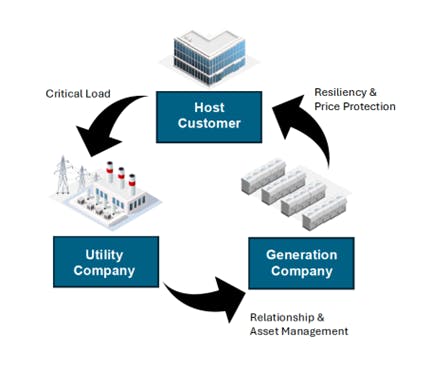
This behind-the-meter, resiliency-as-a-service offering provides customers with reliable, cost-effective backup generation managed by a third party, ensuring power continuity, price protection, and operational stability without requiring upfront investment or maintenance responsibilities.
These natural gas generator-based microgrids reduce emissions when compared to traditional backup diesel generators and have historically helped balance wholesale wind power in the Electric Reliability Council of Texas (ERCOT), which features more wind capacity than any other U.S. state market.
Pathways to Utility Partnerships
Both utilities, which are located in the southern part of the country, have chosen different pathways to partner with the private sector to get the same result: a more resilient and sustainable power grid, with special attention on critical facilities. Similar solutions are now coming forward for large load customers such as data centers.
The energy market is changing, and bigger is not always better. The onsite generation solutions featured in this article show that creative problem solving does not have to wait for tomorrow; they’re confidently moving forward today.