


Thoughts to Contemplate at This Year’s D-TECH
By Tad Piper and Peter Asmus
Can utilities, grid operators, and regulators keep pace with speed of demand growth? The sheer scale of investment raises some thought-provoking questions. Solutions are available, but can they be marshaled in a timely fashion to meet the moment? It is time for all energy stakeholders to start thinking outside of the box.
Historically, the electric utility sector has measured progress in years or as part of a 5-year integrated resource plan (IRPs). This deliberate and step-by-step approach offers a stark contrast to private sector technology companies, which weigh progress in months or perhaps a year or two. This highlights the difference in a regional or local monopoly approach versus companies which operate in a globally competitive market where speed to market is often the key to success.
Here is another way to frame the difference in perspective. Developers, hyperscalers, and data center operators think of risk taking versus potential returns. On the other hand, utilities manage risk but have a known rate of return based on assets deployed. It is a fair assumption to wonder how these opposite perspectives can come together to foster innovation in the global race toward the AI finish line.
Data centers' demand for power, as we all know by now, has ramped up dramatically over the last several years. After only 0.1% annual electricity demand growth across the U.S. between 2005 and 2020, indications are it could exceed 2.5% from this year through 2030.
Capital is Flowing To Meet the Challenge.
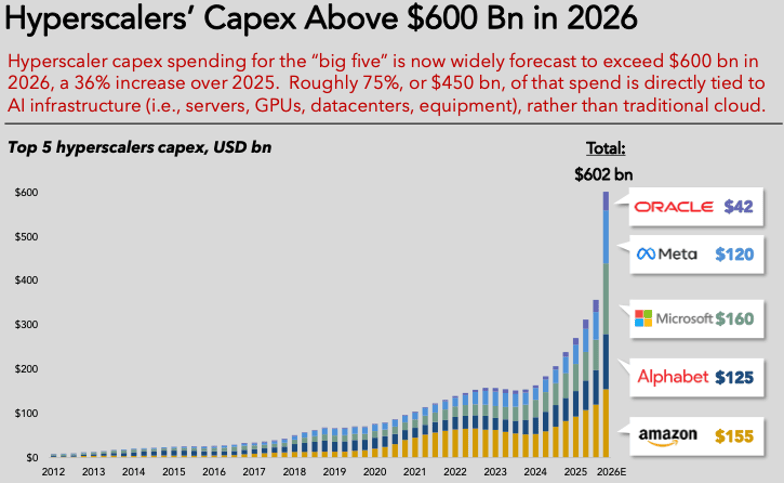
Utilities collective infrastructure spend is estimated at a non-significant sum: $280 billion annually (“$1.4 trillion from 2025 to 2030, double the amount invested in the prior 10 years”). Nevertheless, this amount is dwarfed by the estimates of $600 billion in hyperscaler capital expenditure for 2026. Strikingly, these numbers compare just five hyperscalers – the biggest of the big data center companies -- versus estimates for all electric utilities in the US. The $600 billion is not just earmarked for power infrastructure, but power infrastructure is a critical path item and underpins their broader AI infrastructure investments. In short, they are super motivated to get this done.
Hyperscalers and all data center developers continually ask themselves: What is the fastest path to power? Is it through the regional grid operator – an independent system operator (ISO) or regional transmission organization (RTO) -- or the local utility -- or just going around them? Some have already decided. As Michael Thomas of Cleanview highlighted in a recent post up to 33% of the large load projects they track, representing 48 gigawatts (GW) of new load, will be served by dedicated onsite generation and fully islanded microgrids.
ISOs/RTOs Cannot Repeat the Reforms Pace of the Past
FERC Order 2222 was released in September of 2020, which seems like ages ago. It allowed distributed energy resources (DERs) to “participate alongside traditional resources in the regional organized wholesale markets through aggregations, opening U.S. organized wholesale markets to new sources of energy and grid services.” At the time they called for grid operators to make compliance filings within about 9 months. As of today, only the California Independent System Operator (CAISO) has achieved final implementation. Other wholesale markets will follow suit in the coming years:
New York ISO (NYISO) by the end of 2026;
ISO New England (ISO-NE) by November 2026;
Pennsylvania-New Jersey-Maryland Interconnection (PJM) by February of 2028 (after a 3-year delay in 2023);
Midcontinent ISO (MISO) by June 1, 2029; and
Southwest Power Pool (SPP) in the second quarter of 2030.
In other words, initial compliance milestones will not be reached by most organized wholesale markets in the U.S., with the most extreme case being nearly 9 years behind schedule!
In late 2025, FERC issued a new “Advance Notice of Proposed Rulemaking (ANOPR) focused on the timely and orderly interconnection of large loads to the interstate transmission system.” This proposal seeks to create clearer rules across the country to allow large load customers – such as data centers -- to have a more uniform process and thus reduce the time to access wholesale markets. What this new FERC order demands are flexible interconnections and the ability to of ISOs and utilities to interact and manage these interconnections in new ways. Like FERC 2222, meeting these newly proposed regulations requires ISOs and utilities to rethink grid management and how to manage consumer load flexibility.
The concept of the “prosumer” envisioned under the new proposals is profound. It describes Firm and Non-firm Contract Demand Transmission Service types where a 1 GW data center may have 900 MW of onsite generation and require 100 MW of grid service (the “Firm” contract type). In some situations, the large load may export excess electricity from their onsite capacity – whether generation or load reductions in the form of demand response -- back onto the grid (“Non-firm” service type). In the eyes of the grid operator or utility, the data center would thus serve as a generator.
The Recipes for Success for ISOs and Utilities…
Accelerate deployment of new control and optimization technologies that span the full spectrum of traditional solutions as well as new tools to squeeze more value out of all available grid resources (traditional, load, and behind-the-meter). These solutions include:
Advanced Distribution Management Systems (ADMS),
Distributed Energy Control Systems (DERMS),
Advanced Metering Infrastructure (AMI), and
Microgrid interfaces that can both island and support the surrounding grid with demand response and other load modifying opportunities.
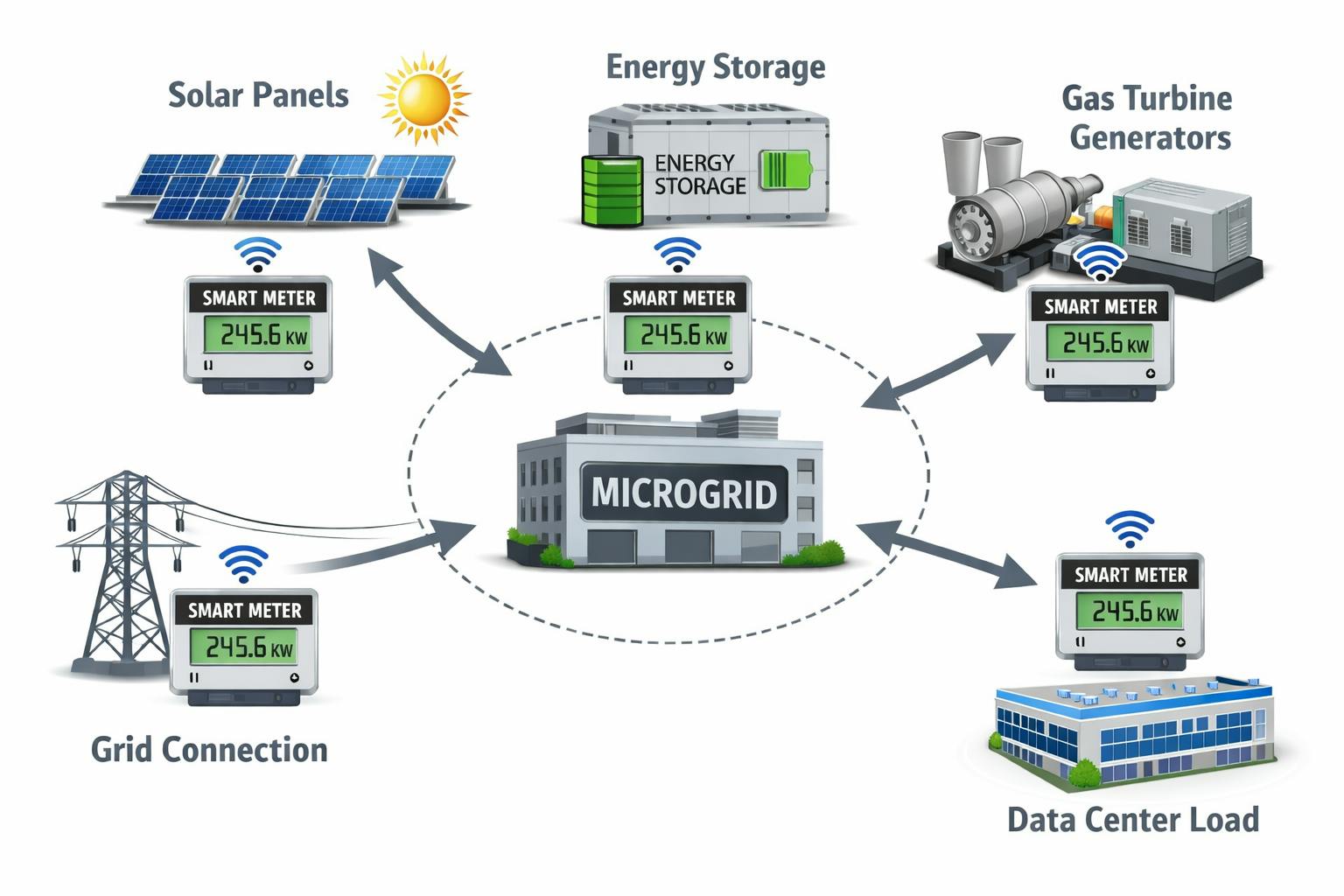
Proactively release best practices for smart meter deployments and microgrid controls for large loads within your ISO or utility service area. The traditional single in-front-of-the meter approach will not be sufficient for the ultimate level of load and behind-the-meter resource dispatch that will define the next stage of growth for large load customers.
Follow the money and partner where it makes sense. Data center developers did not get into the energy business because they wanted to compete with utilities. They are just solving a business and growth challenge. Just a year ago, nearly every data center developer preferred to be grid connected, so the local utility could serve all their power needs. If capital is a constraint, consider broader customer collaboration and look to establish novel partnerships to push progress forward. Momentum can be achieved since all parties have a vested interest in solving these challenges and doing so in a timely manner.
Grid operators want more flexibility options to maintain reliability.
Utilities want to build load and limit defection to maintain an adequate and ideally growing rate base.
Data centers and other large loads want power NOW, and they want to suddenly become part of the solution since they are now seeing the Big Picture.
Control and smart infrastructure providers want to prove they are up to the task of creating a more nimble, affordable and sustainable energy system.
4. All stakeholders (including large load customers) move out of their comfort zones and reconsider:
How to evaluate the approach to risk. We would argue that the risk of standing still trumps the risk of moving into new and unfamiliar territory.
The approach to traditional supply. Resources behind-the-meter – whether generation, load, or energy storage – need to be optimized under programmatic reforms.
The broad umbrella term “flexibility.” Just as utilities and grid operators need to think outside the box, so do data centers and other large loads who traditionally never wanted to participate in load management programs due to an old-fashioned view on resiliency.
Conclusion
Only by facing the needed systems and grid management solutions changes head on can we succeed. In the process, we can enable not only resilience, but a more efficient and cost-effective power grid, freeing up hidden pockets of capacity that would otherwise be squandered. Raising utilization of the grid (from generally under 50% today to something closer to 70%) is the best path to alleviating rising rates across the country. Creative on-site solutions such as microgrids and an even broader pool of flexibility resources than are common today can create hybrid solutions that evolve to the classic win-win-win.
As representatives of ISOs, utilities, regulators, solutions providers, and vendors all converge at D-Tech this week in San Diego, now is the time to lean into this shared sense of urgency, embrace innovation, and step out of our collective comfort zones.
Tad Piper is founder and principal at www.TWPSTRATEGIC.com where he advises data center developers and grid technology providers on utility integration strategies. He previously served as SVP at AutoGrid and has helped develop 700 MW of data center capacity.