


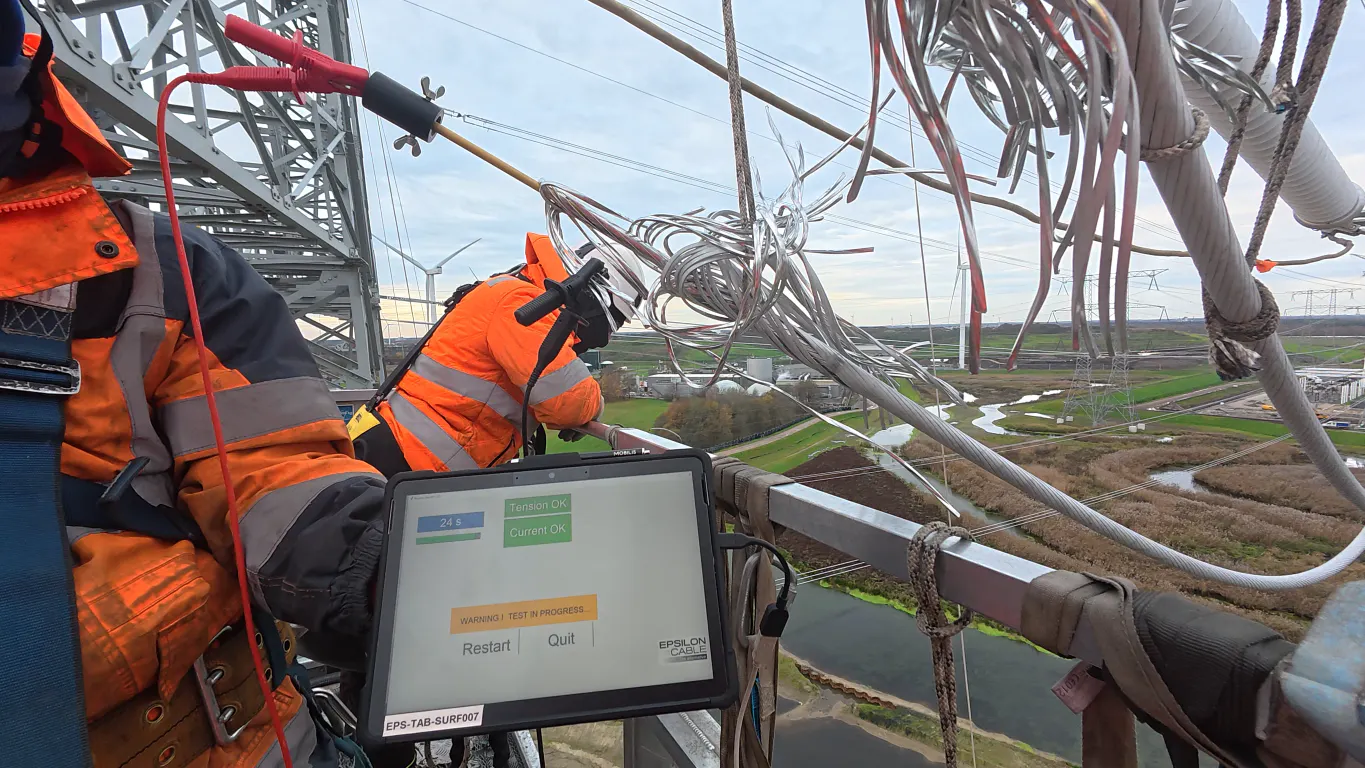
CORECHECK brings a proven and familiar cable testing mindset to composite core conductor and turns the composite core from a passive strength member into a verifiable asset. It uses dielectric non-destructive testing with off the shelf dielectric testing equipment to interrogate the core for structural integrity and to record a clear pass or fail, geomarked, and timestamped report. Field crews and utility managers get certainty in minutes. Utility engineers get a defensible record. Asset owners get a repeatable process that fits commissioning and lifecycle maintenance. And everyone involved gets peace of mind.
A continuous glass dielectric layer beneath the aluminum strands provides electrical isolation between the aluminum and the composite carbon core. CORECHECK places one sensor on the aluminum and one on the carbon path, then applies a controlled dielectric stimulus. When the glass layer is continuous and intact, it remains electrically insulating. Any cracked or delaminated region shows reduced insulation resistance, and the instrument flags it. This method provides a full 360-degree radial assessment of the dielectric isolation layer that separates the carbon composite from the outer aluminum strands and prevents galvanic interaction.
It does not require embedding foreign sensors into the composite: instead, it leverages the core’s intrinsic structure to create a reliable test article. That choice preserves mechanical performance while enabling a reliable verification (with clear, objective pass or fail criteria), and it keeps the toolbox familiar for transmission and distribution organizations that already use dielectric checks in other contexts.
The workflow is designed for utility practice. Crews connect the two leads, run the defined procedure, and the instrument limits test current and exposure by design. The outcome is binary green or red signal, so there is no need for subjective interpretation in the field. The device captures time and location, associates the reading with the span or termination, and pushes the result to a secure log. Supervisors can watch installation progress from a desk and receive confirmation as each section is completed.
CORECHECK supports the entire project lifecycle. You can test on the composite core reel after pultrusion manufacturing. You can test again on the conductor reel after stranding and onsite before stringing, and finally test the conductor after installation. The sequence gives owners a chain of evidence that the asset was healthy at hand off and remained healthy after installation, which simplifies acceptance, supports warranty processes, and shortens investigations.
For risk management, the impact is substantial. Recorded pass or fail results support a safe entry into service, as well as wildfire mitigation plans by proving that energized circuits returned to service with verified structural integrity. The same records aid insurers and regulators by replacing assumptions with objective data.
Adoption is supported by experience. Epsilon’s four decades in introducing composites for critical applications (aerospace, deep offshore oil & gas, OHL..) shape the test protocol, the stimulus parameters, and the procedures that distinguish a lab concept from a field proven solution. The goal is not to infer health from indirect clues but to inspect the conductor core directly and to confirm structural integrity in a way that stands up to technical review. This is why the outputs are binary and the method is designed to be repeated.
CORECHECK is not a substitute for every laboratory test and it does not replace good installation practice. It is a focused integrity check for the composite core and thus the health of the asset. In that role it changes how lines are accepted at delivery, how they are commissioned after stringing, and how they are managed after external events. It brings an underground style assurance step to overhead lines and it does so in a format that fits real crews on real projects.
The result is a new standard of confidence for composite core conductor installation. Utilities can state that critical components have been tested and verified with objective evidence and without field interpretation or human error. Project owners can reduce disputes and schedule risk. Insurers and regulators can anchor decisions in data. The public will see the benefits as safer, more affordable, and more reliable service.