


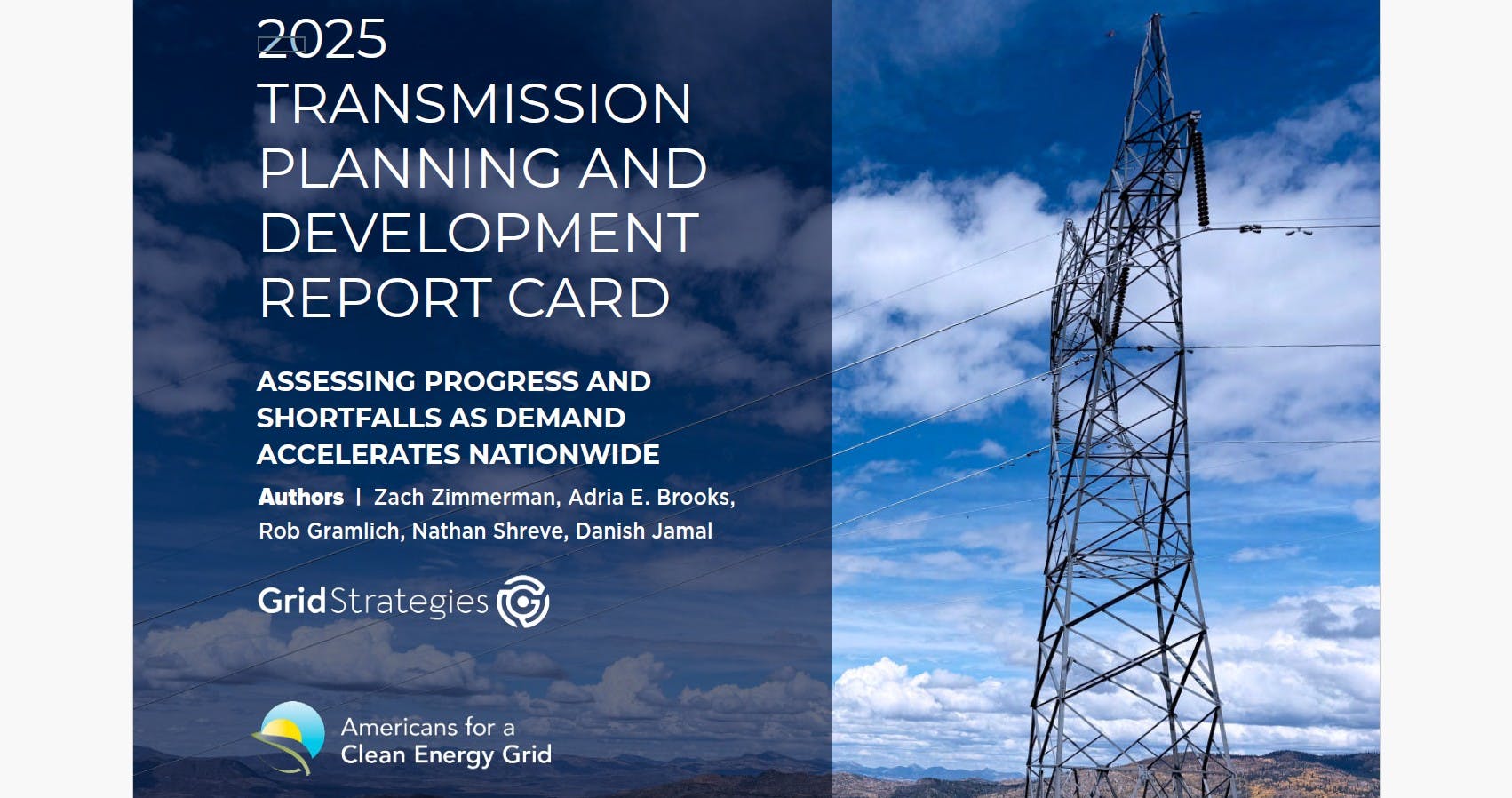
At a moment when the U.S. electric grid is being asked to do more - and do it faster - than at any point in its history, the 2025 Transmission Planning and Development Report Card arrives not just on time, but at exactly the right moment.
Produced by Grid Strategies and published by Americans for a Clean Energy Grid (ACEG), the report offers one of the most comprehensive, clear-eyed assessments available today of where U.S. transmission planning stands - and where it still falls short as electricity demand accelerates across nearly every region of the country. In an environment filled with aspirational targets but often short on accountability, this Report Card provides an essential benchmark for transmission planners, regulators, utilities, policymakers, and other grid stakeholders.
The authors deserve real credit for the rigor, balance, and practicality of the work. Rather than assigning blame or advocating a predetermined solution set, the report evaluates planning quality, process maturity, and outcomes - grading regions against best practices that increasingly reflect federal expectations under FERC Order No. 1920. That framing makes the conclusions hard to dismiss and even harder to ignore.
Equally important, the report treats today’s load growth as a present-day reality, not a distant forecast. Demand driven by data centers, electrification, reshoring of manufacturing, extreme weather, and reliability requirements is already reshaping system needs. The grades reflect that reality. Progress is acknowledged where it exists, but persistent structural gaps - particularly in interregional planning - are clearly exposed.
In short, the Report Card works because it is candid without being cynical, ambitious without being abstract, and grounded in how transmission planning actually functions in the real world.
From Planning Principles to Practical Outcomes
One of the report’s most valuable contributions is its insistence that effective transmission planning remain technology-inclusive. High-performing planning processes are those that evaluate the full range of viable solutions, rather than defaulting to traditional options simply because they are familiar.
Within that framework, the report explicitly calls for the evaluation of Advanced Transmission Technologies, including Grid Enhancing Technologies and High Performance Conductors, alongside conventional transmission solutions. This is not a passing reference. Advanced Conductors are embedded directly in the methodology as a best practice under both regional and interregional planning criteria.
That distinction matters.
By placing high-performance and composite-core conductors alongside tools such as Dynamic Line Ratings, advanced power-flow controls, and topology optimization, the report reflects a growing consensus across the industry: capacity, reliability, and resilience challenges cannot be addressed solely through new rights-of-way. Increasingly, they must also be solved by extracting more performance from existing corridors - quickly, safely, and cost-effectively.
At the same time, the report highlights a familiar implementation gap. In many regions, advanced technologies are still discussed more often than they are deployed. Planning frameworks may acknowledge them, but measurable outcomes often lag.
That gap represents both a challenge and an opportunity.
Advanced Conductors Are Proven, Not Theoretical
Among the technologies referenced in the report’s discussion of Advanced Transmission Technologies, Advanced Conductors stand apart in one important respect: they are neither experimental nor emerging.
Nowhere is this clearer than in the operating record of CTC Global’s ACCC® Conductor.
Since its commercial introduction in 2005, ACCC® Conductor has been installed on nearly 250 transmission projects across 30 U.S. states, and on approximately 1,500 projects in more than 70 countries worldwide. These deployments span voltage classes, climates, loading conditions, terrains, and regulatory environments - from 11 kV distribution upgrades to 1,100 kV ultra-high-voltage transmission.
That history reflects a mature technology with nearly two decades of operational experience on live transmission systems.
ACCC® Conductor has been extensively tested and independently validated, not just in laboratory settings but through long-term utility operation under high temperatures, heavy electrical loading, extreme weather, and long-span applications. Utilities have relied on it to increase capacity, manage thermal sag, preserve clearances, and improve system reliability - all without compromising safety.
Critically, these benefits are delivered within existing rights-of-way, making Advanced Conductors particularly well suited to the siting, permitting, and timeline constraints that the Report Card repeatedly identifies as limiting factors for new transmission development.
Why the Timing Matters
The release of the Report Card is especially consequential as regions move toward compliance with FERC Order No. 1920.
Long-term planning horizons, scenario-based analysis, extreme weather modeling, and multi-value benefit frameworks are increasingly becoming standard expectations rather than optional best practices. In that environment, solutions that can be deployed quickly, scaled broadly, and relied upon operationally take on outsized importance.
Advanced Conductors - and ACCC® Conductor in particular - align directly with those needs. They enable near-term load relief while remaining consistent with long-term system optimization. They reduce the tradeoff between speed and prudence. And they offer planners a way to translate analysis into tangible outcomes: capacity delivered, congestion reduced, and reliability improved.
The Report Card does not prescribe specific technologies, nor should it. But by elevating Advanced Conductors as a planning best practice, it makes clear that future transmission performance will be judged not only by how much infrastructure is planned, but by how effectively available solutions are evaluated and used.
Setting the Bar - and the Agenda
ACEG and the report’s authors have delivered more than a scorecard. They have established a shared reference point for what effective transmission planning looks like under accelerating demand and tightening constraints.
The next step - one the report implicitly invites - is translating planning excellence into execution. Advanced Conductors are already helping utilities do exactly that, at scale and with confidence.
If the Report Card is a measure of readiness, technologies such as ACCC® Conductor demonstrate that the grid is not starting from scratch. Proven tools already exist. The challenge now is deploying them with the urgency, discipline, and foresight the report so clearly calls for.
As regions move from assessment to action under Order No. 1920, the path forward is becoming clearer. Long-term, scenario-based transmission planning is no longer optional - and neither is the obligation to seriously evaluate proven technologies that can deliver capacity, reliability, and resilience within real-world constraints. In that sense, the 2025 Transmission Planning and Development Report Card does more than measure progress: it establishes a durable standard for accountability and provides a foundation that the industry would be well served to revisit as future Report Cards track whether intent is ultimately matched by action.