


Utilities have more fire science than they can act on. The gap isn't information — it's operational intelligence.
Every major utility operating in the western United States now carries wildfire as a top-tier enterprise risk. The liability exposure from ignition events, the regulatory scrutiny following catastrophic losses, and the accelerating cost of vegetation management programs have made fire risk a boardroom concern, not just an operations problem.
Yet the tools available to transmission and distribution operators for managing that risk have not kept pace with its severity.
This is not a data shortage. The United States has invested decades and billions of dollars building one of the most sophisticated wildfire science infrastructures in the world — satellite fire history archives, national fuel mapping programs, daily fire danger indices, physics-based spread simulators. The problem is that none of it was designed to answer the question utilities actually need answered:
On this corridor, in these conditions, where is the ignition risk concentrating right now — and where should we act first?
What Utilities Are Working With Today
The federal wildfire science apparatus is excellent within its domains. LANDFIRE provides national fuel and vegetation mapping at 30-meter resolution. The Monitoring Trends in Burn Severity (MTBS) archive holds four decades of satellite-derived fire perimeters and severity data. The National Fire Danger Rating System (NFDRS) produces daily indices — Energy Release Component, Spread Component, Burning Index — that encode decades of empirical fire behavior research.
Physics-based simulators like FARSITE and FlamMap, developed through the USDA Forest Service and validated at the Missoula Fire Sciences Laboratory, can model spatially explicit fire growth across complex terrain once a fire has started.
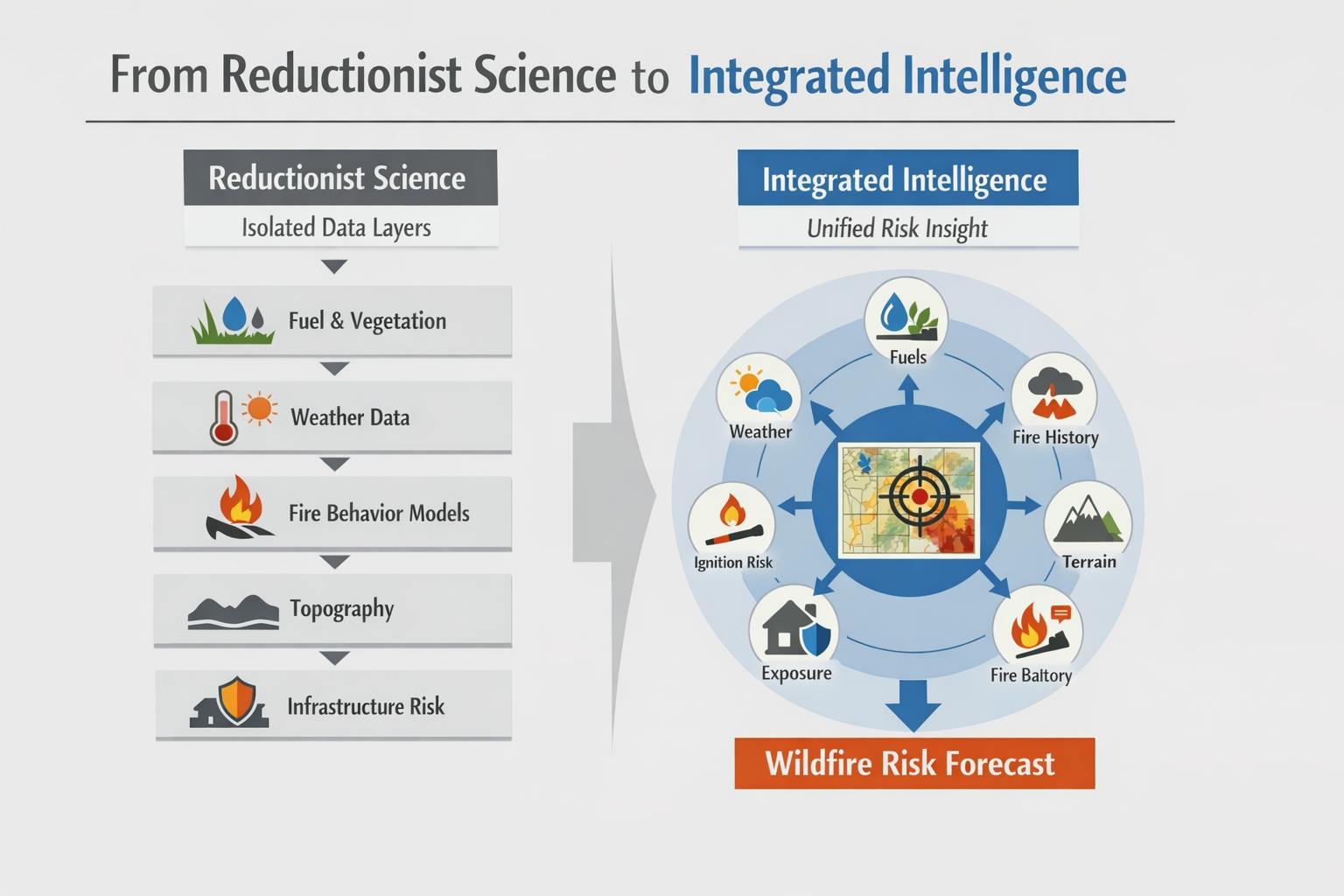
Each of these tools is credible. Each answers important questions. But none of them, individually or in combination as currently deployed, produces a continuously updated, spatially explicit signal that tells a vegetation manager where risk on their system is elevated today relative to baseline — and where it is changing.
That synthesis is the missing layer.
The Vegetation Management Problem
Transmission and distribution corridors run through millions of acres of varying fuel type, topography, and fire history. No utility can treat all of it simultaneously. Every vegetation management program is, implicitly, a prioritization problem.
The conventional approach relies on cycle-based inspection schedules, regulatory clearance requirements, and historical incident data. These are necessary inputs. They are not sufficient ones.
Cycle-based schedules are temporally blind to rapid changes in fire conditions. A corridor cleared 18 months ago may now carry significantly higher risk due to drought-driven fuel moisture decline, post-fire vegetation regrowth in adjacent parcels, or shifts in ignition exposure from new development. The schedule doesn't know this. A multi-factor risk model updated on daily and seasonal cadences does.
The core architecture question is how to integrate the slow variables — fuel accumulation, vegetation type, fire history, terrain — with the fast variables — current fire danger indices, drought trends, weather forecasts — into a single spatially continuous signal. These operate on fundamentally different timescales and cannot be treated as equivalent inputs. Structural and slow-dynamic features set the baseline hazard landscape. Fast-dynamic features determine when that hazard becomes acute risk.
Machine learning systems trained on large historical fire occurrence datasets can learn the empirical relationships between these combined inputs and actual ignition and spread outcomes — relationships that are non-linear, spatially variable, and practically impossible to encode with manual rules.
The output is not another hazard map. It is a prioritization signal: where, across the portfolio of assets, is the marginal risk reduction per treatment dollar highest right now?
Communicating Risk Honestly
One underappreciated dimension of operational fire risk tools is the difference between a risk score and a calibrated probability.
A model that scores locations on a relative scale tells an operator which areas rank higher than others. A probabilistic model tells an operator whether two high-scoring locations are comparable in their uncertainty profiles. For capital allocation decisions — where to deploy crews, where to accelerate inspection cycles, where to pre-position switching equipment — that distinction matters.
Calibrated uncertainty also matters for regulatory and legal contexts. A utility that can demonstrate it made resource allocation decisions based on a documented, auditable, probabilistic risk framework is in a meaningfully different position than one operating on historical cycle schedules alone.
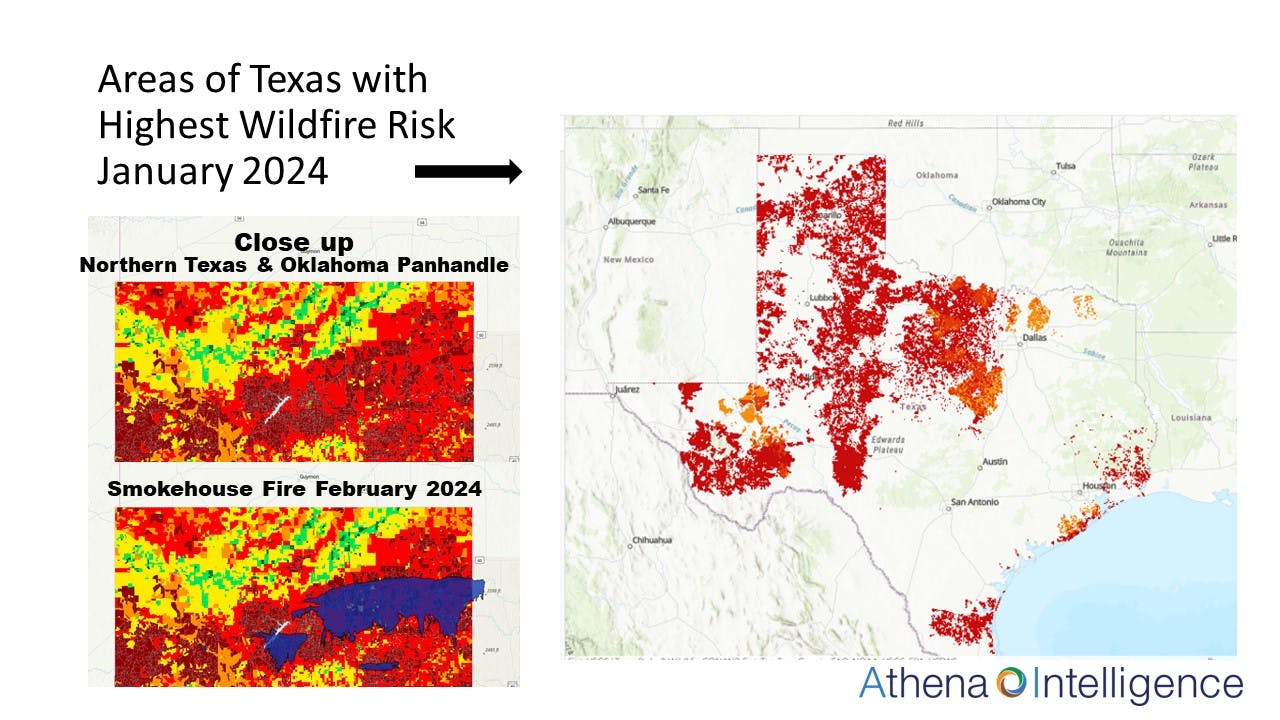
The honest caveat is that geospatial fire risk models carry permanent epistemic limits. Fire occurrence is spatially autocorrelated, nearby locations share fuel history, weather exposure, and ignition patterns, which makes naive model validation overoptimistic. And the statistical relationships between fuel state, weather, and fire outcomes are non-stationary: models trained on historical fire climatology will encounter conditions outside their training distribution as drought regimes intensify and fuel loads accumulate beyond historical ranges. The 2024 Smokehouse Fire, which burned several hundred thousand acres in two days, is an example of an event that stress-tests any historically trained model.
This is not an argument against probabilistic modeling. It is an argument for communication of confidence bounds, and for treating the model score as one input into operator judgment, not a replacement for it. (Athena calls this type of AI, Augmented Intelligence)
From Science to Operations
The wildfire research community — the USDA Forest Service, USGS, the Joint Fire Science Program, academic researchers publishing in the International Journal of Wildland Fire — has produced genuine and hard-won understanding of fire behavior, fuel dynamics, and landscape ecology.
The operational challenge facing utilities is now primarily a systems integration problem: how to pull the best available science into a decision support layer that updates continuously, communicates uncertainty honestly, and is designed around the actual decisions operators and planners need to make.
Athena Intelligence was built around this premise. Rather than adding to the inventory of fire science datasets, Athena integrates the best-in-class into a multi-factor analytical framework that produces quarterly updated, probabilistic risk signals calibrated to infrastructure exposure.
The goal is not to describe where fires have burned. It is to tell operators where risk is concentrating now, at the resolution and cadence that vegetation management and grid operations actually require.
Edward Tufte made the relevant point about information design decades ago: the value of a well-structured display is not that it shows more data. It is that it makes the comparisons that matter impossible to miss. A transmission operations center doesn't need 40 input layers. It needs to see, clearly, where the multi-factor signal is elevated relative to baseline — and where that warrants action today.
That is the translation problem. Solving it is, increasingly, a grid reliability imperative.