

Feb 27, 2026
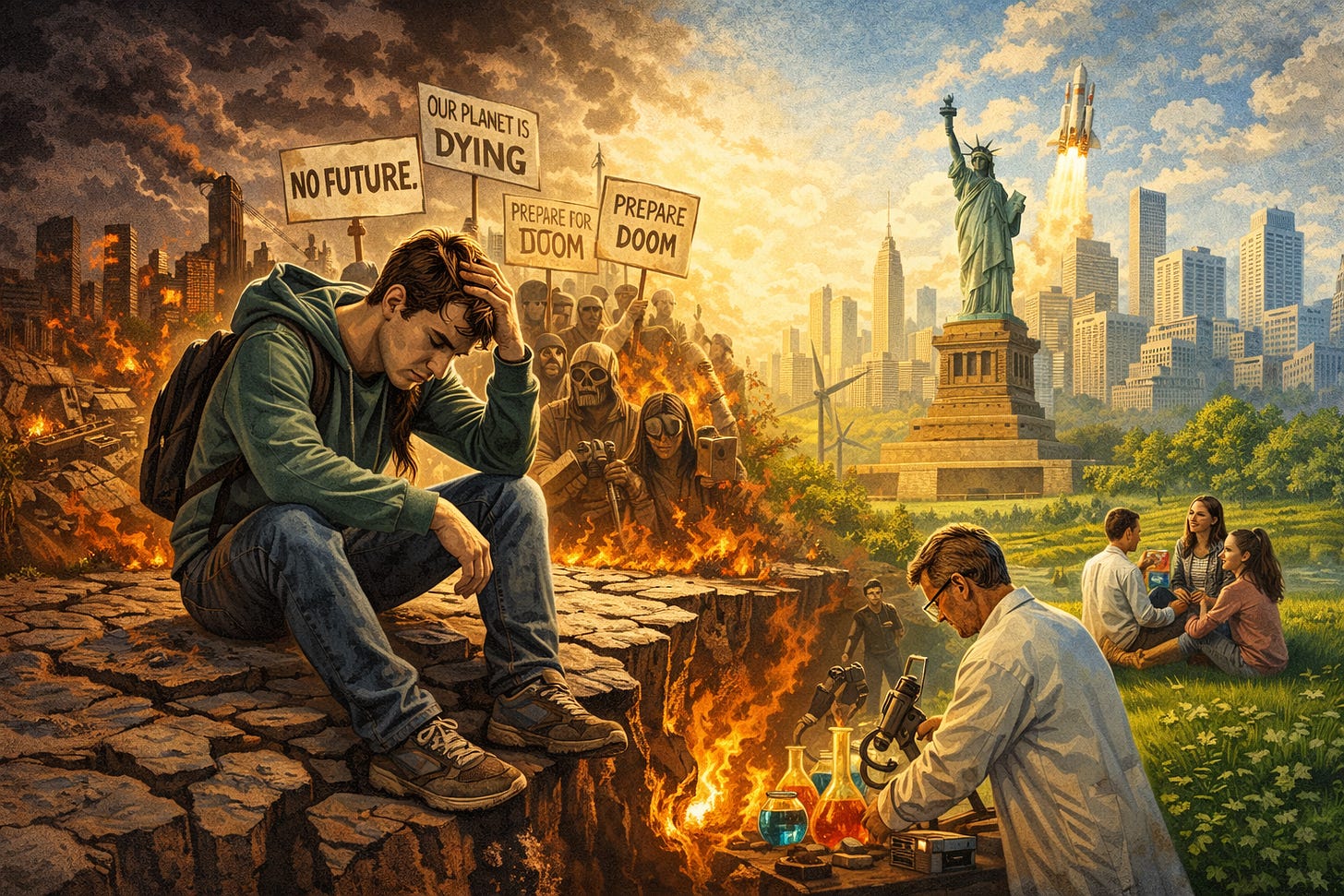
Among the many distortions shaping the modern climate conversation, none may be more corrosive than the deliberate cultivation of despair. A generation is being raised on the premise that collapse is imminent, that catastrophe is inevitable, and that their inheritance is not opportunity but decline. The message is relentless: the planet is dying, time has run out, and the future is foreclosed unless sweeping sacrifices are made immediately. This narrative does more than advance a policy argument; it reshapes the moral imagination of young Americans.
The psychological framing is striking. Anxiety is not treated as a condition to be alleviated but as evidence of enlightenment. The more distressed one feels about the future, the more morally serious one is presumed to be. Pessimism becomes a badge of intellectual sophistication. Optimism, by contrast, is dismissed as naïveté or denial. Students are taught to see themselves less as heirs to a civilization capable of solving problems and more as witnesses to its unraveling. That shift in mindset carries consequences far beyond energy policy.
Every generation confronts genuine challenges. The difference lies not in the existence of difficulty but in how difficulty is framed. The United States has endured civil war, global conflict, economic depression, pandemics, and environmental crises that were immediate and visible. Cities once choked under industrial smog so thick that daylight dimmed. Rivers caught fire. Leaded gasoline poisoned urban air. Yet those crises did not produce a philosophy of civilizational self-repudiation. They produced problem-solving. They produced regulatory reforms, technological innovation, and infrastructural investment. The response was not despair but determination.
During the Second World War, Americans faced a global conflagration that threatened the survival of free societies. The response was not resignation but mobilization on a scale unprecedented in history. Factories were converted, scientific research accelerated, and industrial capacity surged. In the aftermath, that same capacity was redirected toward peacetime growth. The interstate highway system reshaped commerce and connectivity. Rural electrification brought power to isolated communities. The space program carried human beings beyond Earth’s atmosphere within a generation of the Wright brothers’ first flight. These achievements were not born of a culture convinced that humanity was the problem; they emerged from confidence in human ingenuity.
The environmental reforms of the late twentieth century tell a similar story. When smog darkened Los Angeles and acid rain damaged forests, the response was not to abandon industrial society but to improve it. Catalytic converters were developed. Scrubbers were installed on smokestacks. Emissions standards tightened. The Clean Air Act and Clean Water Act established frameworks that reduced pollution while allowing economic growth to continue. American air quality improved dramatically even as the economy expanded. The lesson was clear: environmental challenges could be mitigated through technology and regulation without dismantling the foundations of prosperity.
By contrast, the contemporary climate narrative often bypasses the language of improvement and moves directly to the language of inevitability. Catastrophic imagery dominates headlines. Deadlines are announced with apocalyptic urgency. Young people are encouraged to see themselves as living at the terminus of history, with little reason to expect long-term stability. Surveys increasingly report that significant percentages of young adults hesitate to have children due to climate anxiety. That hesitation is not a trivial sociological footnote; it reflects a profound erosion of hope.
Despair, once normalized, becomes politically useful. A population convinced that catastrophe is unavoidable may be more willing to accept sweeping interventions and concentrated authority. Urgency compresses deliberation. Crisis narratives justify extraordinary measures. In this environment, the space for measured debate narrows. Questions about cost, reliability, and unintended consequences are recast as obstruction. The emotional intensity of fear overwhelms the practical discipline of policymaking.
The American tradition, at its best, rests upon a different premise: that challenges are invitations to innovate rather than signals to surrender. This tradition is not rooted in blind optimism but in empirical experience. Agricultural productivity once seemed constrained by finite land and natural fertility; scientific advances in crop genetics and fertilizer chemistry expanded yields dramatically. Energy scarcity was once predicted as inevitable; new extraction technologies unlocked reserves previously inaccessible. Medical science conquered diseases that once decimated populations. In each instance, dire predictions underestimated the capacity of human creativity.
None of this denies that environmental risks exist or that climate patterns change over time. The issue is not whether problems arise but whether those problems are framed as solvable. The cultivation of despair suggests that solutions are either impossible or morally suspect because they emerge from the same industrial systems blamed for causing harm. Innovation is treated with suspicion. Growth is portrayed as inherently destructive. The result is a paradoxical message: humanity is both powerful enough to doom the planet and incapable of adapting constructively.
Such a message breeds fatalism. If collapse is inevitable, long-term investment loses its appeal. Why build institutions meant to endure if endurance itself is doubted? Why nurture civic engagement if the civic order is presumed temporary? A culture steeped in apocalyptic rhetoric risks weakening the very resilience it will need to confront genuine challenges.
The economic implications are equally significant. Policies driven primarily by fear rather than prudence can destabilize energy systems, increase costs for working families, and erode industrial competitiveness. When energy prices rise sharply, the burden falls most heavily on those least able to absorb it. Yet in a climate of despair, such tradeoffs are often minimized. Sacrifice becomes a moral imperative, even when the distribution of sacrifice is uneven. The assumption that deprivation is virtuous can obscure the practical realities of maintaining reliable power grids and functioning economies.
The broader cultural effect may be more damaging still. A generation taught that its future is defined by decline may internalize that expectation in other domains. Entrepreneurship requires confidence. Family formation requires hope. Civic participation requires belief in continuity. When public discourse relentlessly emphasizes impending doom, it can undermine the psychological foundations of those activities. A society that doubts its future may struggle to act decisively in the present.
The contrast with earlier eras is instructive. During the Cold War, Americans lived under the shadow of nuclear annihilation, a threat as immediate and existential as any climate scenario. Schoolchildren practiced duck-and-cover drills. Missile crises brought the world to the brink. Yet the national narrative did not center upon surrender. It emphasized deterrence, diplomacy, technological competition, and strategic resilience. The same nation that feared nuclear war also invested in scientific education, infrastructure, and economic expansion. Fear existed, but it did not define identity.
Today’s climate discourse often lacks that balance. It amplifies worst-case scenarios while discounting adaptive capacity. It treats projected outcomes as certainties and human agency as secondary. In doing so, it risks transforming legitimate environmental concern into a broader philosophy of pessimism. That philosophy does not strengthen democratic societies; it exhausts them.
Reclaiming confidence does not require complacency. It requires remembering that progress and stewardship are compatible. The same technological dynamism that powered industrial expansion can reduce emissions, improve efficiency, and diversify energy sources. Innovation thrives in environments that value experimentation and economic vitality. Markets, guided by sensible policy frameworks, can incentivize cleaner production without mandating contraction. History suggests that societies confident in their creative capacity are more likely to solve environmental challenges than those mired in self-doubt.
Education plays a pivotal role in shaping this outlook. Students should be taught about environmental risks in proportion to evidence, but they should also learn about the record of problem-solving that defines modern history. They should encounter not only charts of projected warming but case studies of pollution reduction, agricultural innovation, and energy efficiency gains. They should understand that human ingenuity has repeatedly expanded the realm of possibility. An honest curriculum presents both challenges and achievements, cultivating informed concern without despair.
Public leadership matters as well. Leaders who frame every policy debate as a race against extinction may mobilize short-term attention, but they risk long-term fatigue. Sustainable reform requires durable public trust. That trust grows when leaders acknowledge complexity, admit uncertainty, and resist the temptation to dramatize every projection. A confident society can confront risk without succumbing to panic.
The American story has never been one of effortless success. It has been marked by conflict, contradiction, and crisis. Yet again and again, confidence in human capacity has proved justified. The infrastructure that sustains modern life did not appear spontaneously; it was designed, built, and maintained by generations unwilling to concede defeat to circumstance. The environmental improvements achieved over the past half-century did not arise from despair; they arose from deliberate policy, technological progress, and economic strength.
If the current climate conversation is to mature, it must move beyond apocalyptic rhetoric toward disciplined realism. Young Americans deserve honesty about environmental trends, but they also deserve confidence in their ability to respond. To tell them that their inheritance is collapse is to diminish their agency. To tell them that innovation is futile is to contradict centuries of evidence.
Despair is not a strategy. It is a condition that narrows imagination and weakens resolve. A free and prosperous society cannot afford to internalize the belief that its future is foreclosed. The cultivation of pessimism may generate headlines and mobilize activism, but it erodes the civic confidence upon which democratic governance depends.
The choice is not between indifference and alarmism. It is between paralysis and purposeful action. America’s record suggests that purposeful action, grounded in confidence and ingenuity, is the more reliable path. The same nation that overcame war, depression, and pollution is capable of confronting environmental change without surrendering its belief in progress. The task before us is not to accept decline as destiny but to reaffirm the principle that challenges exist to be met, not mourned.
Terry L. Headley, MBA, MA, is a communications and research professional with more than twenty-five years of experience in the American energy sector. A former journalist and longtime industry communications director, he has worked at the intersection of public policy, energy markets, and strategic advocacy throughout his career. Headley has advised major coal and energy organizations, developed statewide public engagement campaigns, and authored multiple books examining the role of traditional energy in American prosperity. His work focuses on energy reliability, economic competitiveness, and the cultural implications of public policy.
The Hedley Company – Communications & Research for Energy is a strategic advisory firm specializing in energy policy analysis, communications strategy, research publications, and advocacy development. The firm provides data-driven intelligence briefs, economic impact studies, policy memoranda, and media strategy for organizations operating in the coal, natural gas, and critical minerals sectors. With a focus on reliability, affordability, and national security, The Hedley Company supports clients seeking rigorous research and disciplined messaging in a rapidly evolving energy landscape.
The Seneca Center for Energy and Critical Minerals Policy is a West Virginia–based public policy research organization dedicated to advancing reliable energy production and strengthening America’s critical mineral supply chains. The Center conducts economic analysis, policy research, and educational outreach focused on traditional energy resources, grid reliability, and the strategic importance of domestic mineral development. Grounded in the belief that energy abundance underpins national strength and human flourishing, The Seneca Center works to inform policymakers and the public through structured, fact-based research and principled analysis.

