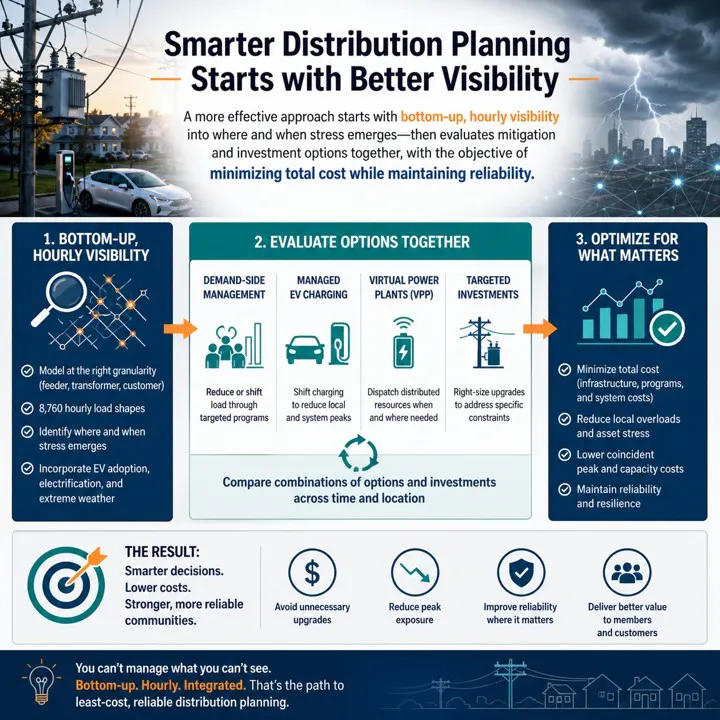
Utilities need customer-level hourly load visibility to manage EV growth, electrification, and rising peak demand. But most don’t have usable AMI data for this purpose - and even those that do often lack the tools and resources to turn it into actionable planning insight.
Utilities increasingly need customer-level hourly load visibility to evaluate the localized impacts of EV adoption, electrification, distributed energy resources, demand response, and virtual power plant (VPP) strategies. The challenge is that most utilities either do not have Advanced Metering Infrastructure (AMI) data available at the customer level, or they lack the software, staffing, and analytical infrastructure needed to transform raw AMI interval data into actionable planning intelligence.
As a result, many utilities continue to rely on top-down forecasting approaches that provide limited visibility into where and when localized grid stress is likely to emerge.
The Grid Impact Model (GIM) addresses this problem by applying AI and machine learning methods to estimate customer-level hourly electric loads without requiring direct AMI access. The model development process combines anonymized utility customer information with large-scale, previously developed MAISY® utility customer databases and forecasting resources representing millions of residential and commercial customer records and associated hourly end-use load shapes.
Using machine learning and probabilistic matching techniques, GIM develops “digital twin” representations of utility customers based on demographic, housing, geographic, and building characteristics. The process estimates hourly end-use loads for individual customers and customer segments, including EV charging, space conditioning, water heating, appliances, and other major end uses.
This bottom-up approach allows utilities to estimate:
Customer-level and block-level 8,760 hourly loads
Localized transformer and feeder stress risks
EV adoption probabilities and clustering behavior
Electrification impacts over time
Managed charging and DSM/VPP mitigation opportunities
System coincident peak impacts
Importantly, the resulting analysis can provide many of the practical planning benefits commonly associated with AMI-based analysis — without requiring a utility to build and maintain a large-scale AMI analytics environment.
Even utilities that have deployed AMI systems often face significant barriers to using the data effectively for forward-looking distribution planning. Raw interval data alone does not automatically provide predictive planning capability. Utilities frequently require additional:
Meter data management systems
Data engineering resources
GIS integration
Customer analytics software
Load disaggregation tools
Specialized engineering and data science staff
These capabilities can require substantial additional investment beyond the AMI deployment itself.
By contrast, the GIM development process leverages hundreds of thousands of dollars of previously developed data resources, end-use load research, statistical modeling systems, and AI/machine learning infrastructure to rapidly generate actionable customer-level hourly load intelligence with minimal burden on utility staff.
The objective is not to replace engineering power-flow tools or AMI systems, but rather to provide a practical and scalable upstream analytical capability that helps utilities:
Identify emerging grid hot spots earlier
Prioritize detailed engineering studies
Evaluate mitigation alternatives
Stress-test electrification scenarios
Reduce coincident peaks and demand costs
Improve capital planning decisions
As electrification accelerates, utilities need practical methods for understanding localized hourly load behavior - not just system-level forecasts.
AI- and machine-learning-based customer load estimation provides a scalable path for utilities that either lack AMI data or lack the resources needed to fully operationalize it for distribution planning and grid modernization applications.