



Why the “AI is drinking America dry” claim gets the story wrong—and the questions every community should still ask before a new project is approved.
By T. L. Headley, MBA, President
Hedley & Company
There is a familiar claim making the rounds whenever a new data center is proposed: artificial intelligence is coming to drink the town dry.
It is usually presented with an arresting number. A proposed facility may use millions of gallons a year. An online calculation may claim that a few questions to a chatbot “consume” a bottle of water. The conclusion is meant to be obvious: data centers are a threat to a community’s water supply.
That conclusion is much too simple.
Data centers do use water in some places and with some cooling systems. A large facility in a dry region can create a serious local issue if it is designed poorly or given a water supply that the community cannot spare. That is a real concern, and residents are right to ask hard questions.
But the broad claim that data centers are somehow “drinking America dry” is not supported by the facts. It takes a complicated engineering question, removes the local details that matter, and turns it into a frightening slogan.
The more useful question is not, “Does a data center use water?” Nearly every kind of modern industry uses water, directly or indirectly. The useful questions are: What kind of cooling will this facility use? Where will its water come from? How much will it use on the hottest days? Can the local system meet that demand without hurting homes, farms, other employers, or streams? And what will the company do if drought arrives?
Those questions lead to sensible decisions. Panic does not.
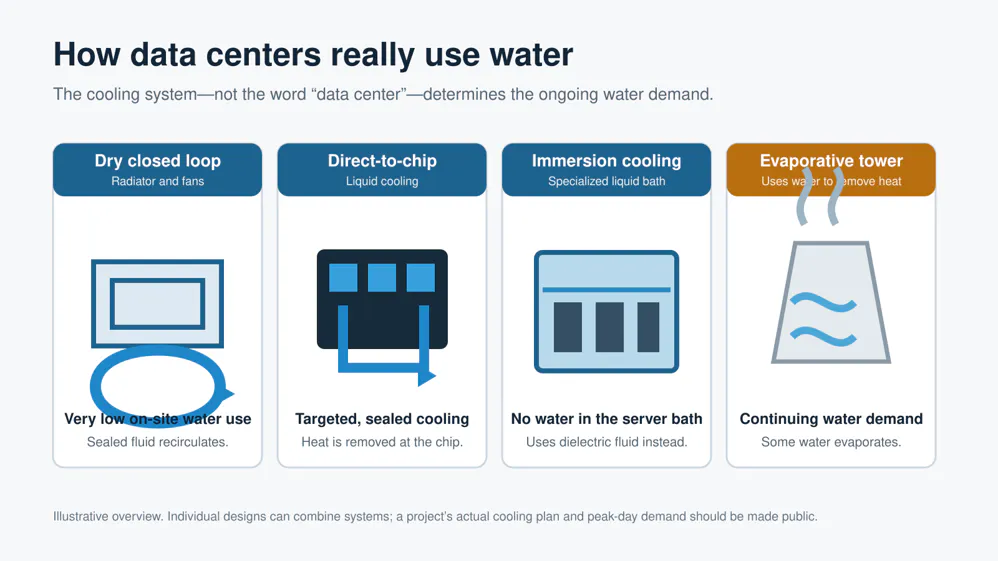
Graphic 1: The words “data center” do not tell a reader how much ongoing water a facility needs. The cooling design does.
First, understand what a data center is...
A data center is a building full of computers. Those computers store photos, process credit-card transactions, run cloud services, support hospitals and 911 systems, move freight, help banks detect fraud, and increasingly power artificial-intelligence tools. They consume electricity and turn much of it into heat.
Getting rid of that heat is the central job of the building’s cooling system.
The simplest comparison is a car radiator. A car engine produces heat. Coolant carries that heat to a radiator, where air carries it away. A data center does the same thing on a much larger scale. The details of how it moves heat determine whether it needs a continuing water supply.
This is why it is misleading to talk about “the water use of data centers” as if every building had one identical design. They do not.
There are several very different ways to cool a data center
One common design uses dry cooling. A liquid—often water mixed with a small amount of antifreeze—is put into sealed pipes. It carries heat from the computers to large outdoor radiators. Fans blow air across those radiators, just as air moves across a car radiator.
That liquid is not constantly poured down a drain. It is put into the system when the facility is built and recirculated. It may need occasional testing, treatment, or replacement during major maintenance, but it is not a daily demand on the town water system. These systems can use very little water at the site.
Another design uses direct-to-chip liquid cooling. Modern AI processors can create far more heat in a small space than older computer chips. In this design, sealed metal plates sit directly on the hottest chips. Coolant runs through the plates and carries heat away. The coolant is again usually part of a closed loop.
Direct-to-chip cooling does not automatically mean “no water anywhere.” The building still has to release the heat somewhere. But it can move heat much more efficiently and can be paired with dry coolers or other low-water equipment. It is one reason a modern AI facility cannot fairly be compared with an older server room.
Then there is immersion cooling. In some specialized systems, servers sit in a non-conductive liquid that does not harm electronics. The liquid carries away heat and is recirculated. The liquid is not drinking water. This approach is still a smaller part of the market, but it shows that the technology is not standing still.
The design that uses the most continuing water is evaporative cooling, often through cooling towers. In plain terms, it works like sweat cooling your skin. When water changes from liquid to vapor, it carries away a great deal of heat. This is an efficient way to cool a large building, especially in hot, dry weather. It can reduce electricity use—but it does so by evaporating water.
That is the important distinction. A closed-loop system mainly uses water as a circulating working fluid. An evaporative system consumes water because some of it becomes vapor and must be replaced.
“Withdrawal” and “consumption” are not the same thing
Much of the confusion comes from using the word “use” for everything.
A water withdrawal means water is taken from a utility, river, or well. A water consumption means water is evaporated, put into a product, or otherwise is not immediately available to the same local water source.
For a closed-loop cooling system, the initial fill may be a withdrawal, but the same fluid can circulate for years. For a cooling tower, water is continuously added because evaporation carries it away.
It is true that evaporated water remains part of Earth’s water cycle. It has not been destroyed or sent into space. But that does not mean local impact is irrelevant. Rain that falls elsewhere or months later does not solve a community’s water problem during a drought. That is why responsible discussion must be local. “The water comes back eventually” is not a sufficient answer for a water-short county.
The opposite error is equally common: treating every gallon that enters a facility as if it disappears forever. It does not.
The national picture is substantial—but not the whole story
The best recent national analysis comes from the U.S. Department of Energy’s Lawrence Berkeley National Laboratory. Its 2024 report estimated that U.S. data centers directly consumed about 66 billion liters of water in 2023—about 17.4 billion gallons. That sounds large, and it is. It works out to roughly 48 million gallons a day across the country.
But it must be put in perspective. America’s wastewater plants process about 34 billion gallons of wastewater every day. EPA also estimates that household leaks alone waste nearly 900 billion gallons of water a year nationwide. Data centers are a growing part of the economy, but they are not the dominant force in American water use.
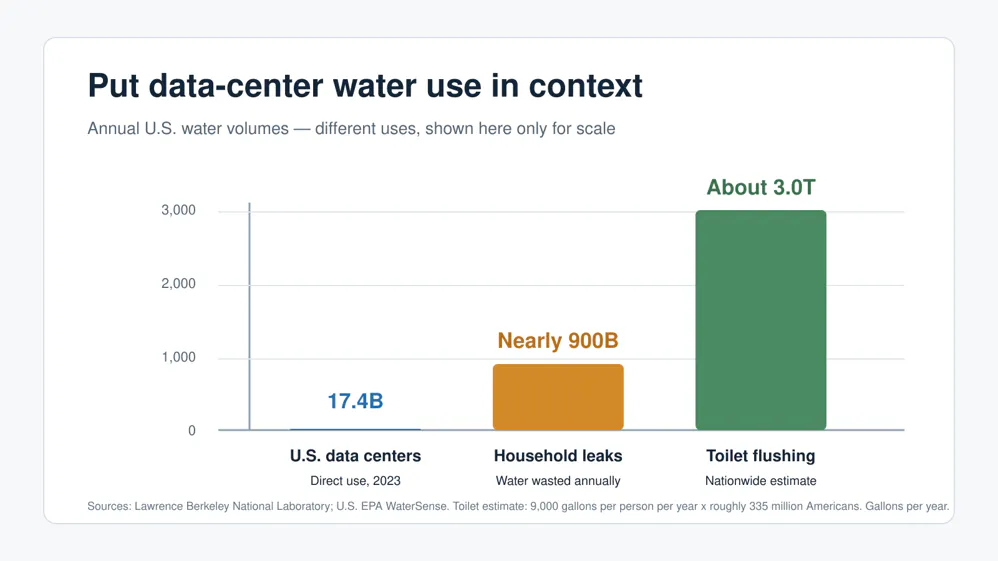
Graphic 2: Data centers’ direct annual water use is significant and warrants local planning. It should still be compared honestly with other large sources of water loss and demand. The toilet figure is an estimate based on an EPA-reported benchmark of 9,000 gallons per person per year, multiplied by roughly 335 million Americans.
The same Berkeley Lab study provides a crucial warning against simplistic claims from either side of the argument. It found that the average water used at the data-center site was a little above one-third of a liter per kilowatt-hour in 2023, and projected that average to rise modestly as large facilities and liquid-cooled AI equipment expand. In other words, computing is becoming more efficient in many ways, but total water demand can still rise because America is building far more computing capacity.
That is the honest picture: efficiency improvements matter, but they do not erase the importance of rapid growth.
Water at the building is only part of the story
There is also an off-site question. A water-free cooling system generally needs more electricity on hot days because it relies on fans and refrigeration equipment rather than evaporation. Producing that extra electricity can itself involve water, depending on the power plants serving the grid.
Berkeley Lab estimated that the indirect water footprint tied to the electricity used by U.S. data centers was far larger than the direct water used at the buildings: nearly 800 billion liters in 2023. This does not mean a data center is opening a pipe and drawing that amount from the local water system. It means the power plants that make electricity—especially certain coal, natural-gas, nuclear, and hydroelectric facilities—have their own water footprints.
This is why there is no single magic answer. A community can insist on almost no on-site water use, and that may be exactly right for a dry area. But planners should also ensure there is enough reliable electricity and understand what power supply will serve the facility. Good policy does not simply move a problem from the data center’s property line to somewhere else.
The “one bottle per AI question” claim is a poor way to inform the public
The popular claim that one chatbot prompt consumes a bottle of water makes for a strong headline. It is not a dependable way to describe what happens in the real world.
Water per question varies enormously. It depends on the kind of model, how long the question and answer are, what computers are used, the weather, the cooling system, how fully the machines are being used, and the local electric grid. Berkeley Lab researchers found that water use per computing task can vary by more than 10,000 times across different circumstances.
That does not mean water is unimportant. It means a made-for-social-media number is not a substitute for facts about a particular facility.
If a company proposes a data center in West Virginia, Virginia, Arizona, Texas, or anywhere else, the public deserves the project’s actual engineering plan—not a national average, not a viral estimate, and not a corporate talking point.
Why the location matters more than the headline
Water is not like a national warehouse where every gallon is interchangeable. A gallon available in the Ohio River basin is not the same thing as a gallon drawn from a stressed aquifer in the desert. A community with abundant surface water, a sound treatment system, and room in its water permits faces a different question from a fast-growing county that already imposes summer watering restrictions.
That is why people should be skeptical when advocates or opponents use one figure to settle every argument. The same facility design can be sensible in one place and irresponsible in another.
In a water-rich region, a properly planned data center may be a manageable new customer, especially if it pays for any needed pipes, pumps, storage, treatment capacity, and backup equipment. In an area where wells are declining or a small utility already struggles during dry weather, that same project may need a different cooling design, a reclaimed-water source, a smaller scale, or a different site altogether.
This is not a special rule written only for technology companies. It is how communities should approach a major factory, food-processing plant, power plant, mine, warehouse complex, or residential development. The public resource is the water system. The obligation of local government is to protect it first and negotiate from a position of knowledge.
For places such as West Virginia, the debate should also recognize the enormous difference between a real water shortage and a capacity problem. A region may have substantial rainfall, rivers, and groundwater while a particular small water system still lacks the pipes, pumps, treatment capacity, or storage to serve a new industrial customer. The remedy in that case is not necessarily to reject development. It is to make certain the development pays its fair share of the needed upgrade and that existing customers are protected.
Why companies sometimes choose water-based cooling
It is tempting to say, “If water use worries us, simply require a completely waterless facility.” In some places that may be the right answer. But the choice has consequences, and the public deserves to understand them.
Evaporation is an extremely effective way to move heat. A cooling tower can remove large amounts of heat with less electricity than a system that relies entirely on compressors and giant fans. That matters because a large data center runs every hour of every day. A modest difference in cooling efficiency can become a very large electric bill over a year.
Dry coolers avoid most on-site water consumption, but their fans work hardest precisely when outdoor temperatures are highest. Some systems use mechanical refrigeration as well. This can raise the building’s electric demand at the same time homes, stores, hospitals, and other businesses are also trying to keep cool.
The point is not that one choice is always better. The point is that water and electricity cannot be planned in separate boxes. A serious proposal should show the local community both sides of the ledger. If it uses water to save electricity, the company should prove the water source is dependable and fair. If it avoids water by using more electricity, the company should prove that the grid can serve it without endangering reliability or forcing others to pay for upgrades.
Some facilities use hybrid systems. They rely on dry cooling most of the year, then use a limited amount of water only when temperatures reach certain levels. Others use outside air during cool weather and reserve chillers for the hottest periods. Those designs can be very attractive in a four-season climate, but the details matter. A proposal should state the conditions under which it switches into a water-using mode and how much water that mode requires.
Reclaimed water can help—but it is not a magic word
Many companies now say they will use reclaimed water, recycled wastewater, or non-potable water rather than treated drinking water. In the right place, that can be a meaningful benefit.
Reclaimed water is wastewater that has been treated to a level suitable for uses such as industrial cooling, irrigation, or other non-drinking purposes. Using it can take pressure off a drinking-water system and can provide a revenue source for a local sewer utility.
But “reclaimed water” should be the beginning of public due diligence, not the end of it. The community should ask whether enough reclaimed water is available year-round; whether it requires new pipes or storage; who will pay for them; whether the water quality is appropriate for the cooling equipment; and whether using it affects streams, treatment plants, or other customers.
The company should also be clear about whether it will need drinking water as a backup. There is nothing inherently wrong with backup supply, but it should be disclosed in a permit and incorporated into drought planning. A promise that is technically true on an average day may be less reassuring if the facility turns to the drinking-water system at the exact moment households are under conservation rules.
Efficiency is improving, but growth is growing faster
There is a real success story in modern data-center engineering. Facilities today are generally far more energy-efficient than earlier generations. Berkeley Lab estimates that average Power Usage Effectiveness—an industry measure of how much extra energy a facility needs beyond the computers themselves—fell from 1.6 in 2014 to 1.4 in 2023. Lower is better. The laboratory projects further improvement as more servers move into newer, large-scale facilities and liquid cooling expands.
That is important progress. It means less electricity is wasted moving air, running cooling equipment, and powering other building systems.
Yet efficiency is not the same as lower total demand. Americans are using more cloud services. Businesses are putting more information online. Video, health-care records, digital payments, factory systems, research computing, defense needs, and AI all require more processing. Berkeley Lab estimates that U.S. data-center electricity use rose from 58 terawatt-hours in 2014 to 176 terawatt-hours in 2023. The report projected a range of 325 to 580 terawatt-hours by 2028.
That growth is why policymakers must stop treating the question as a choice between celebrating data centers and worrying about them. Both are necessary. The nation needs the capacity. It also needs enough generation, transmission, water infrastructure, and clear rules to support that capacity responsibly.
The same principle applies to water. Better equipment can reduce the water needed for a unit of computing, but a country that dramatically expands computing can still use more water in total. Anyone claiming the problem is already solved is getting ahead of the facts. Anyone claiming no improvement is happening is also wrong.
What the public should demand before construction begins
For a major proposal, the company’s water plan should be a public document written in language residents can understand. It should include a map of the water source and wastewater destination; daily, monthly, and annual estimates; expected peak demand; the cooling system; backup arrangements; and the terms under which use will be curtailed.
The local water utility should independently confirm that it has both the raw-water supply and the physical capacity to meet the demand. Those are different things. A river may have more than enough water, but a treatment plant may not have enough filters, pumps, storage tanks, or transmission lines. A project may sound feasible until one learns that the cost of the necessary upgrade will be charged to every existing household.
The company should be required to pay for the facilities needed to serve its own project. That can include an extension of the main, a booster station, a new storage tank, additional treatment equipment, or a reclaimed-water line. It should also contribute fairly to the system it will rely upon over the long term. A local government that gives away water capacity without protecting ordinary ratepayers is not being pro-business. It is failing to negotiate.
The permit should include an enforceable drought plan. That plan can establish different operating levels for normal conditions, voluntary conservation, declared drought, and emergency conditions. Households, hospitals, fire protection, and core public needs must come first. A responsible company will understand that certainty is better than a political fight after the wells or reservoirs begin to fall.
Finally, the facility should publish regular water-use reports. A simple quarterly report showing actual withdrawals, source, consumption, and compliance with its permit would eliminate much of the mistrust that feeds the public controversy. What is measured can be managed. What is hidden becomes a rumor.
Do not use water debate to avoid the larger grid question
The rapid growth of data centers raises a larger challenge that is often ignored in water arguments: electricity.
Data centers need reliable power around the clock. A facility that supports emergency communications, banking, hospitals, cloud services, or national-security work cannot simply shut down when the wind is calm or the sun goes down. It needs firm generation, sufficient transmission, backup systems, and a grid strong enough to handle new demand without sacrificing the needs of families and existing employers.
That does not mean a new data center should be allowed to impose its costs on everyone else. The company, its utility, regulators, and state leaders should identify what new generation and transmission are necessary and how those costs will be paid. The principle should be simple: a new, large load should help pay for the infrastructure made necessary by that load.
This matters to the water question because an honest environmental accounting has to consider the full system. A facility that reports almost no water at its property line may still raise the water and fuel needs of the power plants that serve it. Conversely, a facility using some reclaimed water for efficient cooling may reduce peak electric demand. Neither fact automatically decides the issue. They are facts that local leaders must weigh openly.
The bottom line
The phrase “AI is drinking America dry” is a slogan, not a water plan.
It ignores the difference between a closed loop that is filled and recirculated, a cooling tower that evaporates water, a dry cooler that relies more heavily on electricity, and a hybrid system that changes with weather. It ignores the difference between a water-rich river basin and a drought-stricken aquifer. It ignores the difference between a company that pays for new infrastructure and one that expects families to absorb the cost.
America should not make choices about its industrial future based on viral claims. Data centers deserve neither a blank check nor a blanket condemnation. They deserve the same standard applied to every major user of public infrastructure: tell the truth about the demand, protect existing residents, pay for the capacity you require, prepare for emergencies, and report your performance.
If a project meets that standard, data centers can be part of a stronger American economy and a more modern digital system without becoming a threat to local water security. If it cannot meet that standard, the community has every right to demand a better design or a better location.
What responsible data-center water policy looks like
Communities should welcome the economic opportunity that data centers can bring: construction jobs, skilled technical work, tax revenue, fiber investment, and a stronger case for new generation and grid improvements. They should not, however, give away public resources without clear conditions.
Before approving a major project, local leaders should require a plain-English public answer to these questions:
1. What cooling system will be installed? The answer should say whether it uses cooling towers, dry coolers, closed loops, direct-to-chip cooling, or a hybrid system.
2. What is the expected water demand in an average year and on the hottest day? Peak-day demand can matter more to a local utility than an annual average.
3. Will the facility use drinking water, treated wastewater, reclaimed water, surface water, or groundwater? A company that can use reclaimed water may reduce pressure on drinking-water supplies, but the quality, treatment cost, and reliability of that source must be spelled out.
4. What happens during drought or an emergency? The permit should establish limits, conservation steps, and a clear priority for household drinking water and public safety.
5. Who pays for larger pipes, treatment capacity, storage, and other upgrades? Existing families and small businesses should not be handed the bill for infrastructure built to serve a large new customer.
6. Will the company publish its water use? Regular public reporting builds trust. A community should not have to rely on rumors years after a project is operating.
7. Is there enough electric generation and transmission to serve the site reliably? Water and power planning must be handled together.
These are not anti-data-center demands. They are the terms any serious community should set for any major industrial customer.
A better debate
America is going to build more data centers. The question is whether it will do so intelligently.
The case for data centers is straightforward. They are not a luxury appendage to the economy. They support communications, health care, manufacturing, finance, national security, education, scientific research, public safety, and the daily tools used by millions of Americans. AI will make the demand for computing larger, not smaller.
The case for responsible planning is just as straightforward. No community should be expected to accept a project that threatens an already strained water source, hides its expected demand, or shifts its infrastructure costs onto local ratepayers.
The answer is not to repeat that data centers are “water monsters.” Nor is it to pretend that all cooling systems are water-free. The answer is to demand the facts: the specific design, the specific water source, the actual peak demand, the drought plan, the cost-sharing agreement, and the public reporting.
When the discussion is based on those facts, the frightening claim that AI is drinking America dry loses much of its force. Data centers have real resource needs. So do farms, factories, hospitals, schools, homes, and power plants. A growing country has to manage those needs—not invent a false choice between water security and the digital infrastructure on which modern life increasingly depends.
Reporting notes and primary sources
· Lawrence Berkeley National Laboratory, 2024 United States Data Center Energy Usage Report (published December 19, 2024), including estimates of direct and electricity-related water consumption: https://eta.lbl.gov/publications/2024-lbnl-data-center-energy-usage-report
· Lawrence Berkeley National Laboratory, The water use of data center workloads (2025), finding that water use per workload varies by more than 10,000-fold depending on technology, grid, climate, and operations: https://eta.lbl.gov/publications/water-use-data-center-workloads
· U.S. Environmental Protection Agency, water-use statistics, including nationwide household-leak estimates: https://www.epa.gov/watersense/statistics-and-facts
· U.S. Environmental Protection Agency, wastewater overview, noting that U.S. treatment facilities process about 34 billion gallons daily: https://www.epa.gov/nutrientpollution/sources-and-solutions-wastewater