


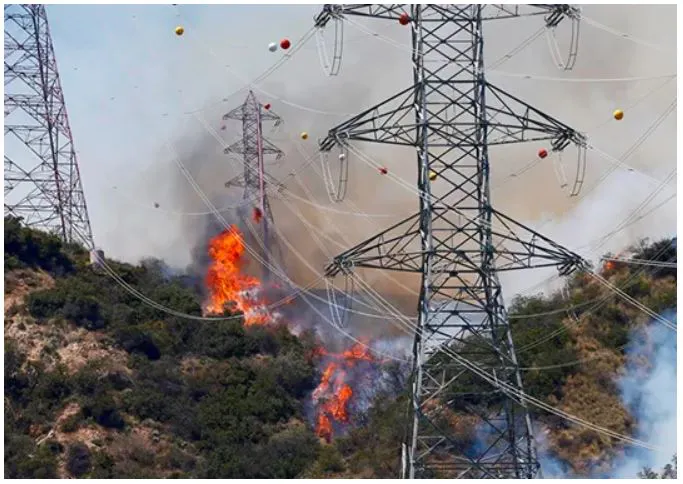
Wildfire has become one of the defining operational and financial risks facing electric utilities. (Please check my other posts on wildfires as an OBL, or Off-Balance Sheet Liability, and on wildfires and credit ratings.) While much of the industry's attention naturally focuses on vegetation management, grid hardening, inspections, and emergency response, a less visible transformation is underway inside regulatory agencies.
The California Public Utilities Commission (CPUC) Decision 24-05-064 is a comprehensive update to its Risk-Based Decision-Making Framework. Although written for California investor-owned utilities, the decision reflects a broader evolution in how regulators, insurers, investors, and utility boards increasingly expect wildfire risk to be measured and managed.
For utilities operating in wildfire-prone regions (California and the Pacific Northwest to Texas, Colorado, New Mexico, and the Southeast) the message is clear: the future of wildfire mitigation will be driven less by hazard maps and more by quantified risk intelligence.
The End of "Hazard Mapping" as the Primary Decision Tool
For decades, wildfire planning started with hazard maps. These maps identified areas with dangerous fuels, steep terrain, drought stress, or other conditions associated with wildfire.
Hazard mapping remains valuable, but regulators are increasingly asking a different question.
Instead of asking, "Where could a wildfire occur?" they are asking, "What is the probability of loss, what are the consequences, and how much risk reduction does a mitigation investment actually deliver?"
This distinction may appear subtle, but it fundamentally changes how utilities prioritize investments.
A utility may have hundreds of miles of line crossing high-hazard terrain. Yet only a subset of those assets may represent the greatest threat to customers, infrastructure, public safety, or financial exposure. The challenge is no longer identifying where hazard exists; it is determining where limited mitigation dollars will reduce the greatest amount of future risk.
Regulators Are Demanding Better Answers About Uncertainty
One of the most significant themes in the CPUC framework is the treatment of uncertainty. Historically, risk assessments often produced single-value estimates that implied a level of precision not supported by the underlying data.
The new framework pushes utilities to explain confidence levels, model assumptions, data limitations, and sensitivity to changing conditions. Regulators want to understand not only what utilities believe the risk to be, but how certain they are about those conclusions.
This is a challenge that extends well beyond California.
Every utility wildfire model contains uncertainty. Weather changes. Fuel conditions evolve. Ignition sources are imperfectly understood. Climate conditions are shifting faster than historical records can fully explain.
Organizations that can transparently communicate uncertainty will increasingly have an advantage when seeking regulatory approval for mitigation spending.
Catastrophic Risk Is Receiving More Attention
Another important aspect of the CPUC framework is its emphasis on low-frequency, high-consequence events.
Traditional expected-value calculations can unintentionally obscure the significance of catastrophic outcomes. A single ignition may have a low probability, but if that event results in billions of dollars in damages, extensive customer outages, or significant loss of life, the consequences can overwhelm conventional planning assumptions.
Utilities throughout the country are familiar with this reality. It is similar to the wildfire challenges faced by large property insurance companies, with similar impact and solutions.
Both industries has watched wildfire-related liabilities contribute to major credit impacts, reserve increases, and heightened scrutiny from investors. As a result, boards, regulators, and rating agencies are increasingly focused on tail-risk events rather than average-case outcomes.
The question is no longer simply, "What is our expected annual wildfire loss?"
It is increasingly, "What is our exposure to the next catastrophic event?"
Climate Change Is Forcing a Forward-Looking Approach
Historically, utilities often relied heavily on past fire activity to guide future planning. But this approach is broken as the future, under changing weather trends, causes wildfire risk to behave differently.
The CPUC explicitly calls for greater incorporation of climate-driven changes in risk assessment. Higher temperatures, changing precipitation patterns, prolonged drought, shifting vegetation growth, and more extreme weather conditions are altering wildfire behavior across many regions.
Utilities are therefore being asked to look beyond historical averages and evaluate how risk conditions may evolve over the coming years. Again, this shift aligns with what many insurers and agricultural firms are already doing. The focus is moving from retrospective analysis toward forward-looking probability assessments capable of capturing changing environmental conditions.
Measuring Return on Mitigation Investment
Perhaps the most important implication for utility executives is the growing requirement to demonstrate measurable risk reduction.
Historically, utilities often justified investments based on compliance requirements, engineering judgment, or generalized safety improvements. But today, regulators, investors and customers are seeking something more specific.
How much risk does a vegetation management program remove?
How much risk reduction results from covered conductor installation?
How much value is created by sectionalizing devices, undergrounding, advanced inspections, or grid modernization?
What is the relative effectiveness of competing mitigation strategies?
The ability to answer these questions consistently may become one of the most important capabilities in future wildfire planning.
Utilities face growing pressure from customers, regulators, and investors to demonstrate that every dollar spent delivers measurable safety and reliability benefits. Risk-informed decision-making provides a framework for making those comparisons.
Athena is now able to offer residential and commercial property owners introductions to clients who offer access to property insurance, based on the effectiveness of community mitigation.
The National Trend
While D.24-05-064 applies specifically to California, its broader themes are appearing throughout the utility sector. Utilities across the country are facing increasing expectations around:
Probabilistic risk assessment
Climate-adjusted forecasting
Transparency of assumptions and methodologies
Quantification of uncertainty
Cost-benefit evaluation of mitigation programs
Prioritization of limited capital toward the highest-risk assets
These expectations are not coming solely from regulators. They are increasingly driven by corporate insurers, investors, rating agencies, and utility boards seeking a more rigorous understanding of wildfire exposure.
In many ways, wildfire risk management is undergoing a transformation similar to the evolution of reliability planning decades ago. What was once guided primarily by engineering judgment is becoming increasingly supported by data-driven analytics, probability modeling, and measurable performance outcomes.
The New Question Utilities Must Answer
For years, wildfire mitigation planning focused largely on identifying where hazardous conditions existed. Today the questions are more challenging:
Where is future loss most likely to occur, how severe could that loss be, and which investments will reduce that risk most effectively?
Utilities that develop the analytical capabilities to answer that question will be better positioned to prioritize mitigation investments, defend capital expenditures, improve resilience, and maintain stakeholder confidence.
As wildfire risk continues to grow across the United States, the utilities that thrive will not simply be those that collect the most data. They will be the organizations that convert data into actionable risk intelligence capable of guiding operational and investment decisions.
California may be the first state to formalize these expectations at scale, but it is unlikely to be the last.
Athena Intelligence is a geospatial analytics company that transforms wildfire and environmental data into operational intelligence for utilities, insurers, municipalities, and infrastructure investors. Athena’s Voice of the Acre® platform was designed to measure wildfire risk through probabilistic forecasting, uncertainty quantification, climate-adjusted risk assessment, and measurable mitigation outcomes. If you’d like to learn more, reach out to us at [email protected]