


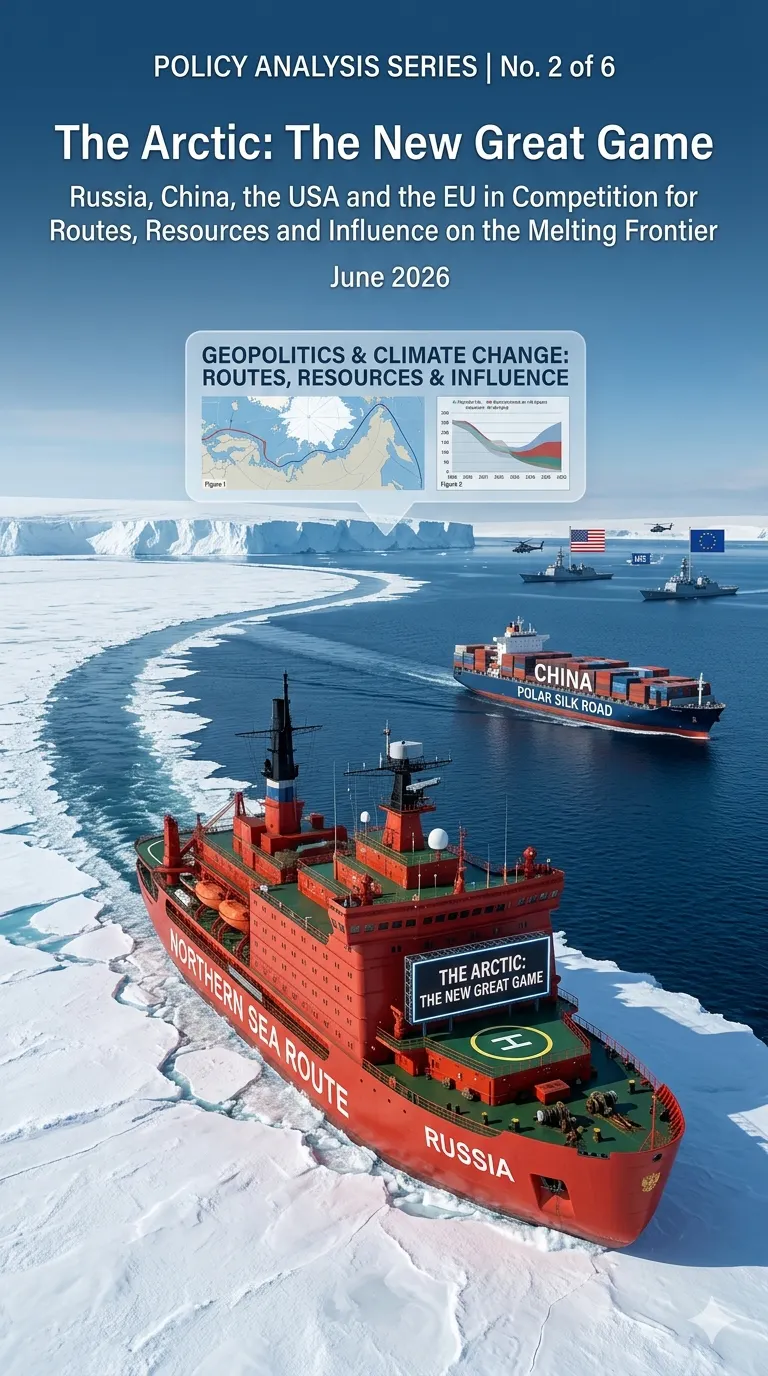
The Arctic:
The New Great Game
Russia, China, the USA and the EU in Competition
for Routes, Resources and Influence on the Melting Frontier
June 2026
Prepared for academic and policy research purposes
Series context:
No. 1 PUBLISHED — The Climate Multiplier (Sahel, Middle East, South Asia)
No. 2 (this volume) — The Arctic: The New Great Game
No. 3 — Climate Finance and the Global South Revolt
No. 4 — The Green Transition as New Colonialism?
No. 5 — Climate Security and the NATO Green Turn
No. 6 — The 2026 Iran War and Its Climate Policy Consequences
Abstract
The Arctic is undergoing a fundamental transformation. What was once characterised as a zone of exceptional cooperation — an island of diplomatic rationality amid Cold War rivalry — has become one of the most contested geopolitical frontiers of the twenty-first century. The melting of Arctic sea ice, driven by climate change at a rate four times the global average, is simultaneously exposing vast untapped resource reserves, opening new commercial shipping routes, and stripping away the natural barriers that once insulated the region from great-power competition.
This analysis examines the four principal actors in the emerging Arctic contest: Russia, which holds the largest territorial claims and the most formidable military and icebreaker infrastructure; China, which has declared itself a 'near-Arctic state' and is building economic and military footholds through its partnership with Moscow; the United States, which under the Trump administration has escalated its Arctic posture dramatically — including an unprecedented bid to acquire Greenland; and the European Union, which faces the dual challenge of managing the security implications of Arctic competition while protecting its economic and environmental interests in the region.
The analysis concludes that the Arctic is moving from a zone of managed cooperation toward a zone of structural great-power competition, with the potential for direct military confrontation increasing as ice loss accelerates. The institutional framework that managed Arctic relations since 1996 — the Arctic Council — has been effectively paralysed by Russia's suspension following the Ukraine invasion. Its replacement with a new governance architecture adequate to the security challenges of the melting frontier represents one of the most urgent and underappreciated challenges in contemporary international relations.
PART I
The Physical Transformation: Climate as the Enabler of Competition
1. The Melting Frontier: Climate Change as Geopolitical Accelerant
1.1 Arctic Amplification: Four Times Faster Than the Global Average
The Arctic is warming at approximately four times the rate of the global average — a phenomenon scientists call Arctic amplification. The mechanism is self-reinforcing: as white ice and snow (which reflect solar radiation back into space) are replaced by darker open ocean (which absorbs it), the warming accelerates. In September 2024, Arctic sea ice reached just 3.9 million square kilometres — the lowest minimum extent ever recorded by satellite. Sustained warm air pulses from east Siberia in August 2025 caused extreme additional melting in the Beaufort Sea, suggesting that even recent record lows may not represent a floor.
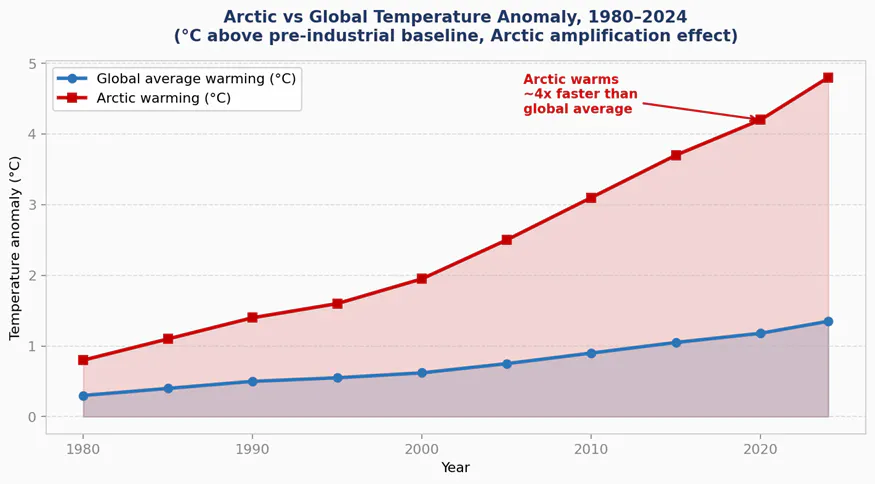
Figure 1: Arctic vs Global Temperature Anomaly, 1980–2024 (°C above pre-industrial baseline). The Arctic warms approximately four times faster than the global average — a rate of change that is fundamentally altering the region's geopolitical character. Sources: WMO (2025), NSIDC, World Affairs Council (2025).
The geopolitical implications of this physical transformation are profound and multi-directional. Ice loss simultaneously opens new commercial shipping routes, exposes previously inaccessible resource deposits, creates new submarine navigation corridors, and reduces the natural defensive buffer that has historically insulated the Arctic from the kind of sustained military competition that characterises other strategic regions. As one US Naval Institute analysis noted in January 2026, the Arctic is transitioning from a region where geography was the primary security guarantee to one where military capability will increasingly determine access and control.
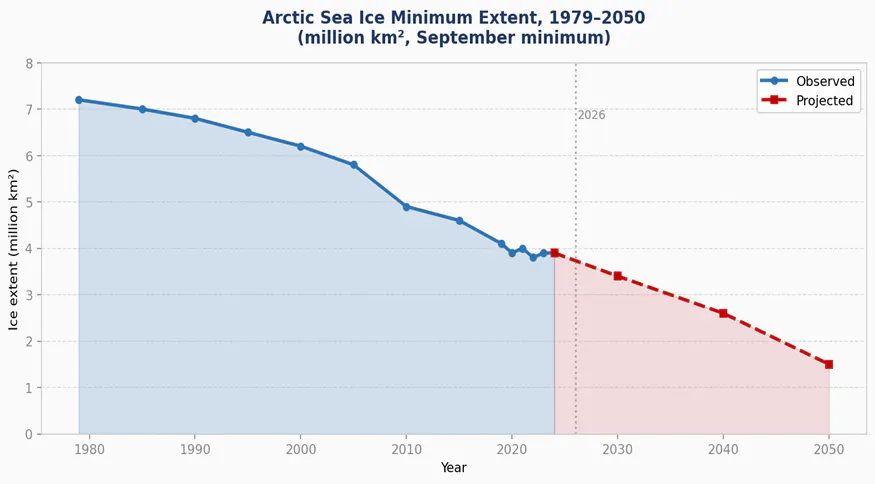
Figure 2: Arctic Sea Ice Minimum Extent, 1979–2050 (million km², September minimum). The observed decline from 7.2 million km² in 1979 to 3.9 million km² in 2024 is projected to continue toward ice-free Arctic summers before 2050 under current emission trajectories. Sources: NSIDC, World Affairs Council (2025), IPCC AR6.
1.2 The Resource Prize: What Is at Stake
The Arctic is estimated to contain approximately 30% of the world's undiscovered natural gas and 13% of its undiscovered oil — representing, respectively, some 47 trillion cubic metres of gas and 90 billion barrels of oil. The United States Geological Survey's 2008 assessment remains the most comprehensive, and subsequent exploration has generally confirmed its broad outlines. Beyond hydrocarbons, the Arctic holds substantial deposits of rare earth elements, nickel, cobalt, copper, gold, diamonds, and uranium — many of the critical minerals whose strategic importance has been dramatically elevated by the clean energy transition.
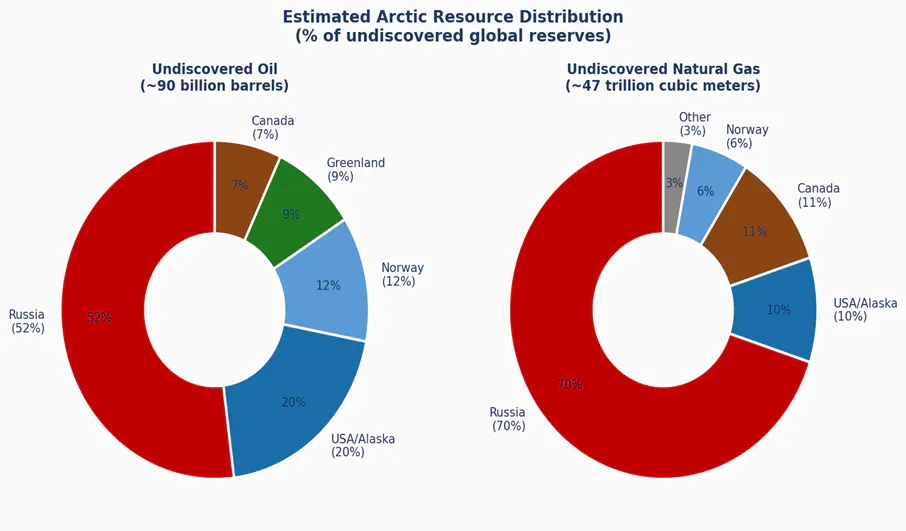
Figure 3: Estimated Arctic Resource Distribution (% of undiscovered global reserves). Russia dominates both oil (52%) and natural gas (70%) reserves, giving it a structural advantage in any future hydrocarbon extraction scenario. Greenland's significant mineral deposits explain the strategic logic behind the US acquisition bid. Sources: USGS, World Oil (2026), CSIS (2025).
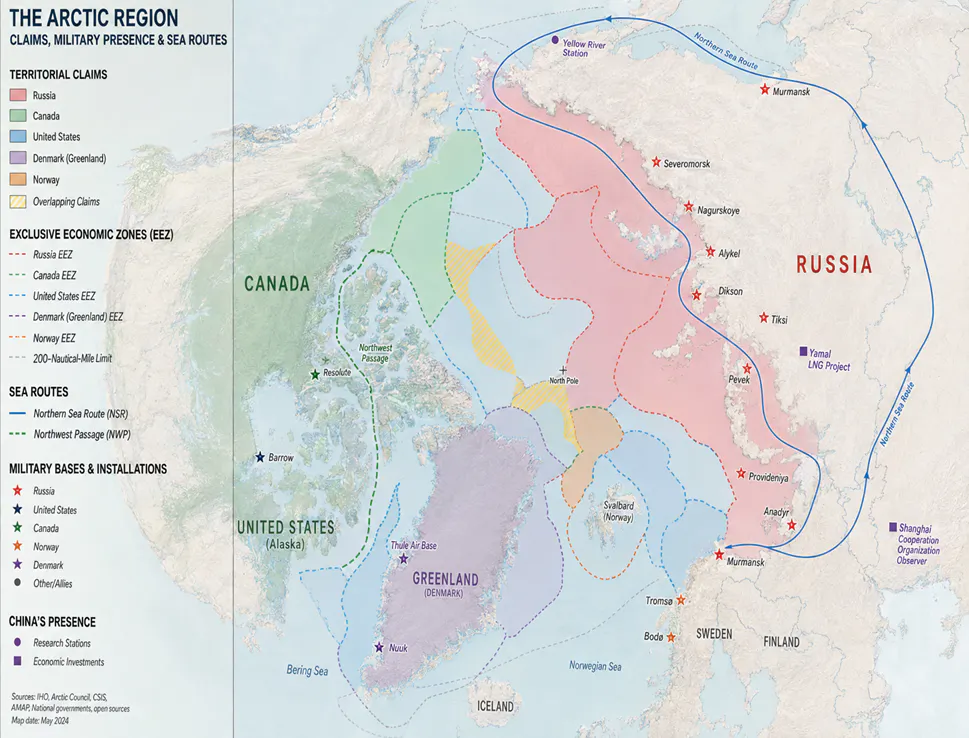
Map 1: The Arctic Region — Territorial Claims, Exclusive Economic Zones (EEZ), Sea Routes and Military Presence, 2024. Russia's dominant territorial position, overlapping claims at the North Pole, and the strategic corridors of the Northern Sea Route and Northwest Passage are clearly shown. Sources: IHO, Arctic Council, CSIS, AMAP, National governments, open sources. (Map date: May 2024)
Russia's geographic position is decisive: it controls the largest share of Arctic territory and the most accessible coastal shelf. Norway's Johan Castberg oil field, which commenced production in 2025, represents the western frontier of Arctic hydrocarbon development and demonstrated the economic viability of Arctic offshore production under current technology and price conditions. Greenland's mineral wealth — particularly its rare earth elements and uranium deposits — explains much of the strategic logic behind the Trump administration's unprecedented bid to acquire the island.
PART II
The Northern Sea Route: Geopolitics of a New Trade Corridor
2. The Northern Sea Route: From Soviet Highway to Global Chokepoint
2.1 The Route and Its Strategic Significance
The Northern Sea Route (NSR) stretches 5,600 kilometres along the Russian Arctic coast from the Kara Gate in the west to the Bering Strait in the east. It traverses six seas of the Arctic Ocean — the Barents, Kara, Laptev, East Siberian, Chukchi, and Bering — and represents the shortest maritime connection between the Atlantic and Pacific Oceans. Compared to the Suez Canal route, the NSR reduces the Shanghai-Rotterdam voyage from approximately 21,000 km to 15,000 km, and the transit time from 40-50 days to approximately 20 days — a reduction of roughly 40-50%.
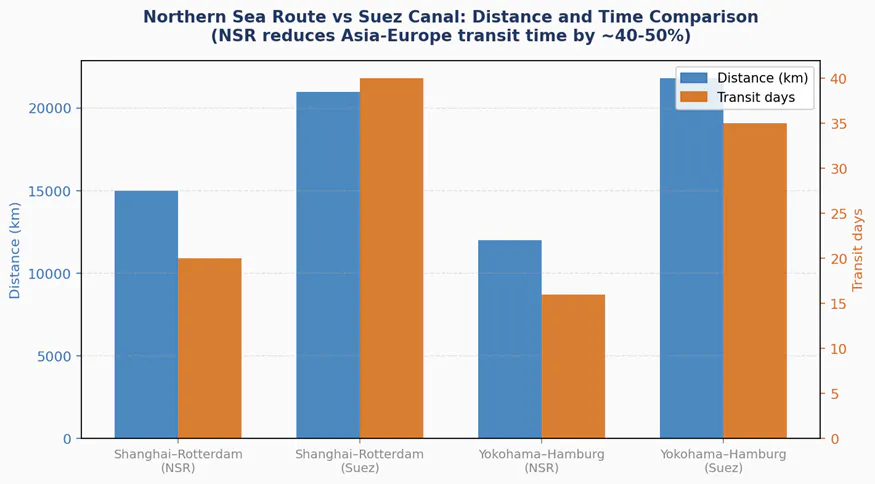
Figure 4: Northern Sea Route vs Suez Canal — Distance and Transit Time Comparison. The NSR reduces Asia-Europe transit time by approximately 40-50%, representing enormous commercial value if year-round or near-year-round navigation becomes viable. Sources: World Affairs Council (2025), World Oil (2026).
In October 2025, the Chinese container ship Istanbul Bridge completed its maiden voyage via the NSR — the first containership to make the journey — reducing the typical transit from 40-50 days via the Suez Canal to approximately 20 days. The symbolic significance was considerable: China was demonstrating operational Arctic shipping capability and signalling its intention to become a major participant in the route's commercial development.
2.2 Traffic Growth and the China-Russia Oil Corridor
Traffic along the NSR has grown substantially since 2013, driven primarily by Russian energy exports and, increasingly, by Chinese commercial interest. More than 1,800 ships travelled on the Arctic polar waterway in 2025, a 40% increase from 2013. The 2025 summer-autumn season saw 103 transit voyages along the corridor, up from 97 in 2024. However, volume growth has been uneven, and significant obstacles to large-scale commercial use remain.
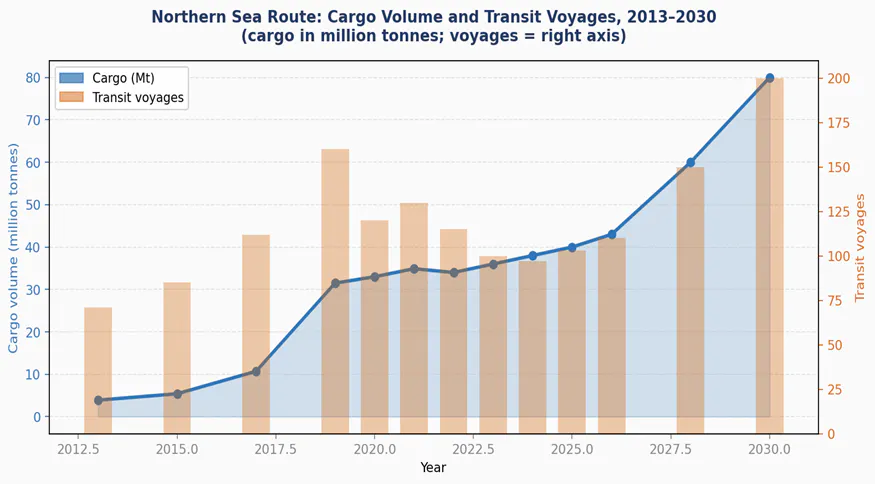
Figure 5: Northern Sea Route — Cargo Volume and Transit Voyages, 2013–2030. While cargo volume has grown from approximately 4 million tonnes in 2013 to an estimated 40+ million tonnes in 2025, the vast majority is Russian domestic cargo rather than international transit. Sources: ScienceDirect (2024), Centre for High North Logistics/NORD University (2025), World Oil (2026).
A critical development has been the emergence of an Arctic oil corridor driven by Chinese demand for sanctioned Russian crude. In the 2025 navigation season, 34 tankers transported approximately 1.9 million tonnes of crude oil along the NSR. China's NewNew Shipping Line signed agreements to invest up to five billion rubles to build a logistics complex in Provideniya Bay — a direct commercial stake in the route's infrastructure. The Bellona Foundation's 2025 analysis characterised this as China's maritime role being deeply entangled with Russian geopolitical ambitions, Western sanctions evasion, and environmental risk.
However, significant constraints limit the NSR's near-term commercial potential. Four of the world's five largest container shipping companies — MSC, Maersk, CMA CGM, and Hapag-Lloyd — announced in October 2025 that they will not use the NSR, citing environmental, navigation safety, and geopolitical concerns. Only China's COSCO Shipping, a state-owned enterprise, has not made a similar statement. Russia's requirement that all commercial vessels use Russian icebreaker escorts — at substantial cost — further limits the route's competitiveness for non-Russian commercial shippers.
The NSR Constraint
Russia controls the NSR as sovereign territorial waters and requires all commercial vessels to use Russian icebreaker escorts. This gives Moscow direct leverage over commercial access to the route — a form of chokepoint control analogous to Egypt's position on the Suez Canal. As Russia's fleet of 45 icebreakers (including 8 nuclear-powered vessels) dwarfs all competitors, this structural advantage is likely to persist for decades even if the US builds its planned 11 new icebreakers.
PART III
The Great Power Competition: Russia, China, USA
3. Russia: The Arctic Hegemon Under Pressure
3.1 Russia's Structural Arctic Dominance
Russia's position in the Arctic is structurally dominant in ways that no other actor can match in the near or medium term. Russia controls the longest Arctic coastline, the most developed Arctic infrastructure, and the world's largest icebreaker fleet — 45 vessels including 8 nuclear-powered ships, with the new nuclear-powered Stalingrad whose keel was laid in November 2025 as the latest addition. At the Kola Peninsula ceremony in March 2025, President Putin personally launched the Yasen-M nuclear-powered submarine Perm and explicitly framed US and NATO Arctic engagement as threatening Russian interests.
Russia has invested heavily in Arctic military infrastructure since 2014: reopening Soviet-era Arctic military bases, establishing a new Arctic Command, constructing new and upgraded deep-water ports, and deploying novel weapons systems including hypersonic missiles with Arctic operational profiles. The Kola Peninsula remains Russia's most critical strategic asset — home to the bulk of Russia's nuclear submarine fleet and the nuclear deterrent infrastructure that makes Russia a global great power.
3.2 Russia's Arctic Economy and the Sanctions Constraint
Russia's Arctic development ambitions have been significantly constrained by the Ukraine-related sanctions regime. Offshore Arctic exploration has largely disappeared since the 2022 invasion, with no major new wells in Russian waters and no significant discovery announcements. A reversal is largely dependent on a ceasefire and implementation of a peace deal. Russia has responded by deepening its dependence on Chinese capital and technology for Arctic development — a strategic pivot that simultaneously provides economic lifeline and introduces a new form of dependence that Moscow views with some ambivalence.
The internal FSB document obtained by the New York Times in 2025 — detailing Moscow's concerns about Chinese intelligence operations in the Arctic using mining firms and university research centres as cover — illustrated the structural tension in the Russia-China Arctic partnership. Moscow needs Beijing's capital and technology; Beijing needs Moscow's territorial access and icebreaker infrastructure. Both sides benefit from their partnership against Western sanctions and governance frameworks, but neither entirely trusts the other's long-term Arctic intentions.
The Yamal LNG Paradox
Russia's Yamal LNG project — the most significant Arctic energy development of the past decade — is both a triumph of Russian Arctic development and a demonstration of its strategic ambivalence. The project depends on Chinese financing, Chinese LNG tankers, and Chinese off-take agreements. It has generated billions in revenue while simultaneously deepening Russia's structural dependence on China for Arctic energy export. As Western sanctions prevent European buyers from participating, Yamal LNG has become an involuntary engine of China's Arctic strategy.
4. China: The Near-Arctic State Strategy
4.1 Building Presence Without Territory
China has no Arctic territorial claims and no Arctic coastline. Yet by 2026 it has emerged as the second most significant external actor in the region — a position achieved through a systematic, multi-decade strategy of building scientific, commercial, and increasingly military presence without formal sovereignty. China declared itself a 'near-Arctic state' in its 2018 Arctic Policy White Paper, a conceptual framing that has no basis in international law but which Beijing has pursued with characteristic strategic patience.
The key instruments of China's Arctic strategy have been: scientific research stations (including the Yellow River Station in Svalbard); observer status on the Arctic Council (granted in 2013); investment in Arctic shipping and logistics infrastructure through the Polar Silk Road initiative; and the development of its own icebreaker fleet (three operational vessels, with a nuclear-powered icebreaker reportedly under construction). In 2025, China's COSCO container ship became the first non-Russian commercial containership to transit the NSR, and in September 2025, NewNew Shipping Line announced a five-billion-ruble logistics complex investment at Provideniya Bay.
The US Department of Defense's early 2025 report on Chinese Arctic activity described a situation of 'unprecedented styles of collaboration' between China and Russia, noting that in the decade since China gained Arctic Council observer status in 2013, it has 'massively expanded its Arctic footprint.' The PLAN's 2022 combined naval patrol in the Bering Sea with Russia — operating within 200 nautical miles of Alaska — represented the most operationally significant manifestation of China's growing Arctic military presence.
China's Polar Silk Road
China's Polar Silk Road initiative, announced as part of the Belt and Road framework, envisions the NSR as a commercial complement to the BRI's overland corridors. The strategic logic is compelling: a China-Russia Arctic partnership gives Beijing access to the shortest maritime route to Europe (via the NSR), the largest untapped hydrocarbon reserves (in Russia's Arctic shelf), and a geopolitical alignment that strengthens both powers' leverage against Western institutions. For Beijing, the Arctic is simultaneously an energy security opportunity, a logistics revolution, and a great-power status statement.
5. The United States: The Greenland Gambit and Arctic Sentry
5.1 The Greenland Crisis of January 2026
The most dramatic manifestation of the Trump administration's Arctic escalation was the Greenland crisis of January 2026. Trump had first raised the possibility of US acquisition of Greenland in 2019; his second administration transformed this from rhetorical provocation to formal policy demand, backed by the threat of punitive tariffs. On January 11, 2026, Trump threatened to impose tariffs starting at 10% on Denmark and seven other European allies unless they agreed to negotiate a transfer of sovereignty over Greenland. On January 17, an estimated quarter of Nuuk's population took to the streets in protest. EU ambassadors held an emergency meeting on January 18.
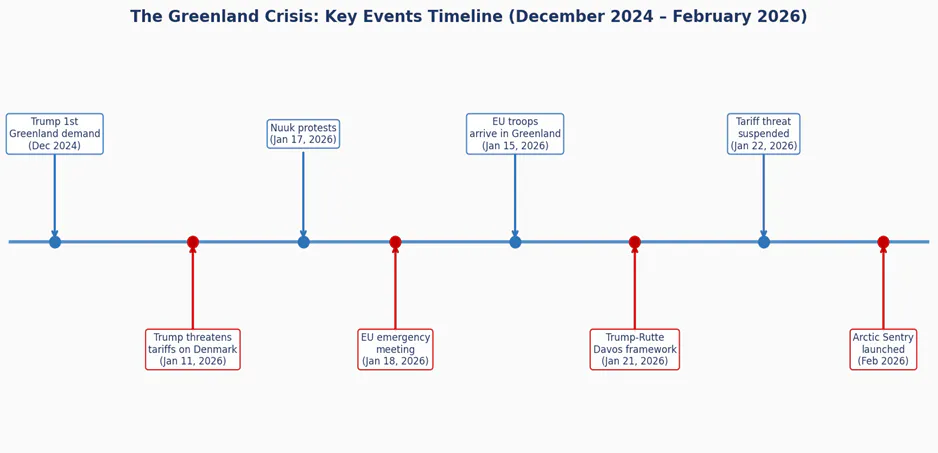
Figure 6: The Greenland Crisis — Key Events Timeline (December 2024 – February 2026). The crisis moved from tariff threats to NATO framework deal in under six weeks, but left unresolved the fundamental question of US strategic ambitions in Greenland and the wider Arctic. Sources: NBC News, Al Jazeera, Atlantic Council, Courthouse News Service (January 2026).
The crisis was resolved — or at least deferred — at Davos on January 21, 2026, when Trump announced that he had reached a 'framework of a future deal' with NATO Secretary General Mark Rutte on Greenland and the wider Arctic region, and suspended the tariff threats. The framework's content was never fully disclosed, but Trump described it as giving the US 'total access' to Greenland and the Arctic. The Atlantic Council's assessment was that Trump took a win on Arctic security rather than pursuing the legally and politically impossible option of forced acquisition.
The crisis produced two significant institutional outcomes. First, NATO launched Arctic Sentry in February 2026 — a new military coordination framework for the seven Arctic NATO member states, led by Joint Force Command Norfolk, providing for maritime patrols, naval deployments, shared intelligence, and permanent US access to bases in Arctic NATO countries. Second, the European Parliament suspended work on the EU-US trade deal ratification in protest at Trump's Greenland demands — illustrating how the Arctic gambit had ramified into the broader transatlantic economic relationship.
5.2 The Icebreaker Asymmetry and US Arctic Capability Gap
Trump's Greenland manoeuvre was partly a response to a genuine and significant US capability deficit in the Arctic. As he noted in October 2025: 'We have one icebreaker, Russia has 48. That's ridiculous.' This asymmetry is stark and strategically significant. Russia's fleet of 45 icebreakers (including 8 nuclear-powered vessels) gives it unmatched capacity to project power, escort commercial shipping, and sustain year-round operations in Arctic waters. The US Coast Guard has a total of two icebreakers, one of which requires significant maintenance.
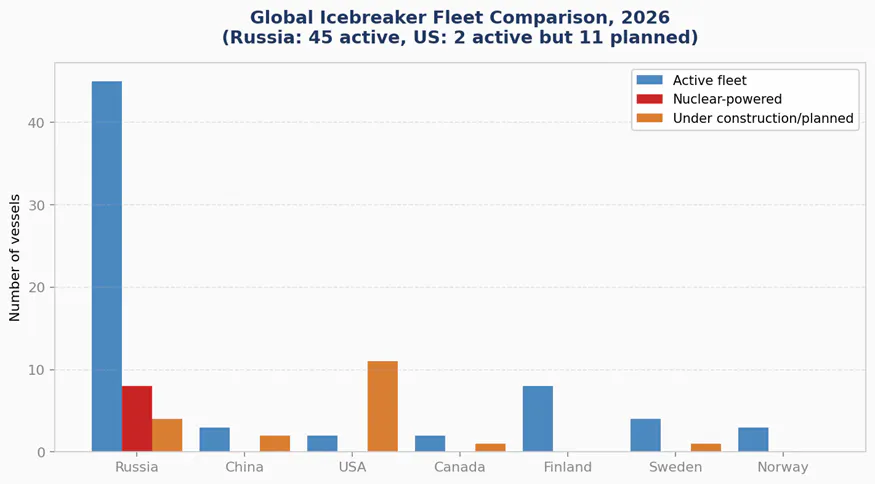
Figure 7: Global Icebreaker Fleet Comparison, 2026 (active fleet, nuclear-powered, and under construction/planned). Russia's overwhelming dominance — 45 active vessels including 8 nuclear — is the single most decisive military-commercial capability asymmetry in the Arctic. The US-Finland MOU (October 2025) for 4+7 new icebreakers marks an attempt to close the gap over the next decade. Sources: CS Monitor (2026), CNBC (2026), CIMSEC.
The October 2025 US-Finland MOU — committing to four icebreakers built by Finnish yards and seven more in US shipyards — represents a serious attempt to close the gap, but will take a decade or more to materialise. In the interim, the US Arctic capability deficit constrains Washington's ability to operationalise its stated ambition of Arctic dominance.
PART IV
The EU and the European Arctic: Interests Without Power?
6. The EU in the Arctic: Interests, Exposure, and Institutional Gap
6.1 The EU's Arctic Interests
The European Union is not an Arctic state but has substantial interests in the Arctic region. Several EU member states — Finland, Sweden, and Denmark — are Arctic states. The Nordic-Baltic Eight (NB8) bloc, which has emerged as the most coherent regional security grouping in Northern Europe, operates primarily within EU and NATO frameworks. The EU is the largest trading partner of the Arctic states, the primary market for Arctic energy exports, and the most immediately affected party outside the region when Arctic geopolitics destabilise shipping routes, resource prices, or the security environment of Northern Europe.
The CSIS analysis published in February 2026 characterised the situation bluntly: 'The rules-based international order that once governed the region is not merely fraying — it is fast unraveling.' For the EU, this represents a direct security challenge. Arctic shipping routes, if they become commercially viable at scale, will affect European port hierarchies, energy supply chains, and trade costs. Arctic resource development will shape global energy and critical mineral markets. Arctic military competition — particularly between Russia and a NATO that includes several EU member states — has direct implications for European security architecture.
6.2 The Greenland Dimension: Von der Leyen's Response
The EU's response to the Greenland crisis of January 2026 was notable for its relative coherence — an achievement given the EU's typical fragmentation on geopolitical issues. Von der Leyen stated publicly that the EU would continue working with the US to reinforce Arctic security while emphasising that Greenland is 'in principle' covered by the EU's mutual assistance clause. European troops deployed to Greenland on January 15, 2026 — the same day Denmark and Greenland's foreign ministers met with Vice President Vance and Secretary Rubio in Washington. The European Parliament's suspension of trade deal ratification work in protest at Trump's Greenland demands demonstrated a willingness to use economic leverage in response to the geopolitical provocation.
The EU's fundamental dilemma in the Arctic is structural: it has substantial interests but limited direct military presence or Arctic-state membership. Its influence operates primarily through its member states (particularly Denmark, Finland, and Sweden), through the Arctic Council (now paralysed), and through its regulatory and economic weight as the region's primary commercial partner. Building a more direct EU role in Arctic governance and security is an agenda item that has been discussed for years but has not yet produced the institutional architecture to match the EU's interests.
6.3 The NB8 Model: Europe's Functional Arctic Response
The most effective European response to Arctic security challenges has come not from EU-level institutions but from the Nordic-Baltic Eight (NB8) grouping, which has established itself as a model of the kind of issue-specific, functionally coherent coalition described in the previous volume of this series. The NB8 has moved faster than NATO or EU machinery to address Russian hybrid threats, protect critical subsea infrastructure, and coordinate Arctic surveillance and patrol activities. The February 2026 launch of NATO Arctic Sentry formalised some of this cooperation within a NATO framework — but the NB8's agility reflects the advantages of a smaller, more homogeneous coalition with direct security interests in the region.
The NB8 as Arctic Security Model
The Nordic-Baltic Eight — Denmark, Estonia, Finland, Iceland, Latvia, Lithuania, Norway, and Sweden — represents the most functionally effective regional security grouping in Northern Europe. All eight are now NATO members (Finland and Sweden having joined in 2023 and 2024 respectively), giving the alliance a coherent Arctic flank for the first time. The NB8's ability to coordinate faster and more effectively than larger institutional frameworks illustrates the middle power coalition logic described in this series: issue-specific, functionally defined, and built around direct security interests rather than comprehensive alliance membership.
PART V
Military Competition, Governance Crisis, and Policy Responses
7. The Military Dimension: Arctic Sentry vs Russian Arctic Command
The militarisation of the Arctic has accelerated dramatically since 2022. Russia has established a dedicated Arctic Command, reopened Soviet-era Arctic bases and airfields, deployed novel weapons systems including the Poseidon nuclear-armed torpedo and Tsirkon hypersonic missile with Arctic operational profiles, and expanded its submarine patrol activity in Arctic waters. The NATO response has been the February 2026 Arctic Sentry framework, which provides the first integrated military coordination structure for the seven Arctic NATO member states, led by Joint Force Command Norfolk.
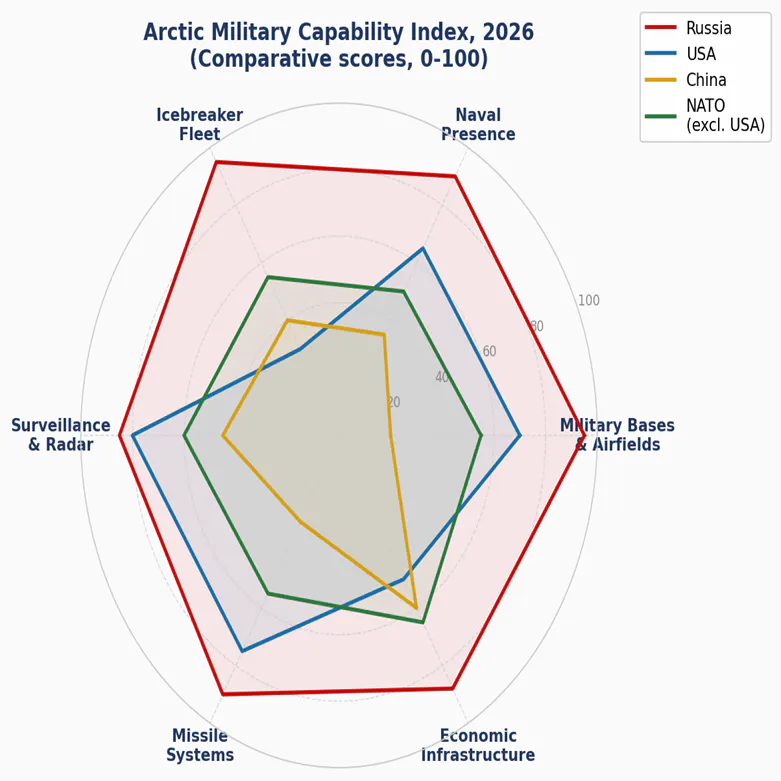
Figure 8: Arctic Military Capability Index, 2026 (comparative scores, 0-100). Russia's dominance across all capability dimensions — particularly icebreaker fleet, missile systems, and naval presence — is the defining structural feature of Arctic military competition. NATO's aggregate capability (excluding the US) is competitive in surveillance and economic infrastructure but lags significantly in icebreaker and nuclear deterrent dimensions. Source: Author's synthesis based on USNI Proceedings (2026), NATO, DoD (2025).
The military picture that emerges is one of Russian dominance in the physical dimensions of Arctic power — icebreaker fleet, naval presence, missile systems, and established base infrastructure — offset by NATO's collective strength in surveillance, electronic warfare, and the economic infrastructure of the European Arctic. China occupies a growing but still secondary role, with its most significant contribution being its joint naval exercises with Russia and its commercial investment in NSR logistics infrastructure.
Actor
Key Arctic Military Assets
Strategic Priority
Vulnerability
Russia
45 icebreakers, Arctic Command, Kola bases, hypersonic missiles
Sovereignty + resource control
Sanctions, technology isolation
USA
2 icebreakers (11 planned), NORAD, Arctic Sentry
Denying adversary dominance
Capability gap vs Russia
China
3 icebreakers (+1 nuclear planned), PLAN patrols
Commercial access + influence
No territorial claims
NATO (NB8)
Surveillance, subsea cable protection, joint exercises
Deterrence + early warning
No unified Arctic command
EU
Regulatory + economic leverage, NB8 members
Resource/route access + security
No direct military presence
Table 1: Arctic Military and Strategic Posture by Actor, 2026. Source: Author's synthesis based on USNI, NATO, DoD, CSIS sources.
8. The Arctic Council Crisis and the Governance Vacuum
The Arctic Council, established in 1996 as a forum for the eight Arctic states and six permanent participant indigenous groups, represented the institutional embodiment of Arctic exceptionalism — the idea that the region could be governed through cooperation even when broader geopolitical relations were competitive. The Quincy Institute's January 2026 analysis described the 2025 Alaska summit between Putin and Trump as reflecting a 'thaw in US-Russia relations' in the Arctic context, suggesting that even amid broad geopolitical confrontation, some residual cooperative logic persisted.
However, the Council has been effectively paralysed since March 2022, when the seven non-Russian member states suspended their participation following the Ukraine invasion. Russia held the chairmanship from 2021 to 2023 and refused to cede it under normal rotation procedures. The body has not met in plenary format since the invasion. This governance vacuum is significant: the Arctic Council was the primary institution for managing issues from environmental protection and search-and-rescue coordination to fisheries management and indigenous peoples' rights. Its incapacity leaves all of these functional areas without adequate institutional management.
The Arctic Governance Vacuum
The paralysis of the Arctic Council since March 2022 has left the world's fastest-warming region without adequate institutional governance at precisely the moment when the pace of change most requires it. Environmental protection, scientific cooperation, search-and-rescue coordination, fisheries management, and indigenous rights protections are all affected. The vacuum is being partially filled by NATO Arctic Sentry on the security side, but the non-security dimensions of Arctic governance — arguably even more consequential in the long term — have no institutional replacement.
PART VI
Policy Responses: What Adequate Looks Like
9. Scenarios: Three Possible Arctic Futures
9.1 Managed Competition (Most Likely Near-Term)
The most likely near-term trajectory is managed competition: continued militarisation and resource competition, with occasional cooperation on specific functional issues (search-and-rescue, environmental emergencies), but no comprehensive governance framework and no formal conflict. The NATO Arctic Sentry framework provides a deterrence architecture, while Russia-China Arctic cooperation provides a counterweight. Commercial shipping on the NSR grows incrementally, primarily serving Russia-China bilateral trade rather than becoming a genuinely global route.
9.2 Cooperative Stability (Optimistic Scenario)
A resumption of US-Russia dialogue — building on the signals at the 2025 Alaska summit — could provide the basis for a broader Arctic governance compact. If the Ukraine conflict reaches a negotiated settlement, the Arctic Council could be reactivated and its governance framework extended to address climate, resources, and shipping under a climate-aware framework. This scenario requires political will that is currently absent, but the structural incentives for cooperation — particularly around climate monitoring, environmental protection, and search-and-rescue — remain real.
9.3 Great-Power Confrontation (Risk Scenario)
The risk scenario involves an incident — a collision of naval vessels, a disputed resource development, a subsea cable sabotage — that triggers a rapid escalation between Russian and NATO forces in Arctic waters. As ice loss reduces the natural barrier between the Atlantic and Arctic oceans, the strategic geography becomes more similar to the North Atlantic of the Cold War, where the potential for miscalculation was managed only by elaborate protocols and communication channels that currently do not exist for the Arctic context. The combination of Russian hypersonic missile deployment, Chinese-Russian naval joint exercises, and US Arctic Sentry creates a complex interaction environment with limited deconfliction mechanisms.
Scenario
Probability
Key Trigger
EU/NATO Response
Managed competition
High (55-65%)
Sustained Ukraine war, frozen NSR access
Arctic Sentry + NB8 deterrence
Cooperative stability
Low-Medium (15-25%)
Ukraine ceasefire, US-Russia reset
Arctic Council reactivation
Great-power confrontation
Low but rising (20-30%)
Naval incident, cable sabotage, resource dispute
Article 5 activation risk
Table 2: Arctic Future Scenarios — Probability and Key Variables. Source: Author's synthesis.
10. Policy Recommendations
10.1 For NATO and EU Member States
First, close the Arctic capability gap. The US-Finland MOU on icebreaker construction is a necessary but insufficient step. NATO should develop a shared icebreaker and Arctic patrol vessel pool accessible to all Arctic member states, reducing the dependency on US bilateral capability and distributing the cost of Arctic presence more equitably.
Second, revive Arctic governance. Even without Russian participation, the seven non-Russian Arctic states should establish a functioning governance framework for the non-military dimensions of Arctic management: environmental monitoring, scientific cooperation, search-and-rescue, and fisheries. Russia should be invited to participate in technical working groups on a case-by-case basis, keeping the door open for future broader re-engagement.
Third, develop a coherent EU Arctic strategy. The EU's current Arctic engagement is fragmented across member state bilateral relationships, the Arctic Council, and sectoral policy instruments. A unified EU Arctic Strategy, backed by dedicated financing instruments for Arctic security, infrastructure, and climate monitoring, would give the EU the coherent institutional presence that its interests require.
• Establish EU Arctic Security Dialogue with the NB8 as the primary interface
• Develop EU financing instruments for Arctic-relevant infrastructure in Nordic and Baltic member states
• Integrate Arctic climate monitoring into EU climate policy frameworks
• Build EU critical mineral supply partnerships with Greenland and Canada as alternatives to Chinese-processed Arctic minerals.
10.2 For the United States
The Greenland gambit demonstrated the limits of transactional coercion in managing alliance relationships — even when the underlying strategic interest (keeping Greenland out of Chinese and Russian influence) is shared by all parties. The framework deal of January 2026 was a more productive basis for US Arctic engagement: collective security, shared intelligence, and coordinated deterrence rather than unilateral acquisition.
Accelerating the icebreaker construction programme and funding the US Arctic Research Commission to maintain scientific leadership are essential near-term priorities. Over the medium term, the US should engage Russia on a bilateral Arctic incident-prevention protocol — building on the model of Cold War naval communication agreements — to reduce the risk of miscalculation as military activity in the region increases.
10.3 For the International Community
The Arctic governance vacuum must be addressed before it produces a crisis. A Climate-Arctic Governance Initiative — bringing together Arctic states, major Arctic stakeholders (including China as an observer), and representatives of Arctic indigenous communities — should be convened outside the paralysed Arctic Council framework to develop binding commitments on environmental protection, search-and-rescue coordination, and responsible shipping practices. Climate change does not respect geopolitical boycotts: the governance of the world's fastest-warming region cannot wait for the resolution of the Ukraine conflict.
Recommended Framework: Climate-Arctic Governance Initiative
Proposed mandate: 1. Environmental monitoring and climate science cooperation across all Arctic and near-Arctic actors. 2. Search-and-rescue coordination protocols for the increasingly navigable Arctic Ocean. 3. Responsible shipping standards for NSR commercial use, including environmental and safety requirements. 4. Fisheries management for newly accessible Arctic waters. 5. Indigenous peoples' rights protection across jurisdictions. Participation: all Arctic states + China as observer + EU as associate. Format: technical working groups operating independently of broader geopolitical status. Convener: Norway (as the Arctic state with the strongest track record of pragmatic multilateral engagement across geopolitical divides).
11. Conclusions
The Arctic is no longer a zone of exceptionalism. The combination of accelerating climate change, growing resource accessibility, expanding commercial shipping potential, and direct great-power competition has transformed the region into one of the most consequential strategic frontiers of the twenty-first century — and one of the least adequately governed.
Russia enters this competition from a position of structural advantage: the largest territorial claims, the most developed Arctic infrastructure, and the world's most powerful icebreaker fleet. But Russian advantage is constrained by the sanctions regime that has frozen Arctic offshore development and by the structural ambivalence of its partnership with China, which needs Moscow's Arctic access while developing its own independent Arctic capabilities. China enters as the most dynamic rising actor: no territorial claims but growing presence across every functional domain of Arctic engagement, from science and shipping to military exercises and logistics investment.
The United States enters the competition belatedly and with a significant capability gap, having allowed its Arctic military and commercial infrastructure to atrophy for three decades. The Trump administration's Greenland gambit — however diplomatically disruptive — reflected a real strategic anxiety about the US position in a region increasingly dominated by adversary military capability. The NATO Arctic Sentry framework, the US-Finland icebreaker MOU, and the Greenland framework deal are first steps toward a more serious US Arctic posture, but they are just that: first steps.
The European Union, meanwhile, faces the Arctic challenge that characterises its broader geopolitical position: substantial interests, significant economic and normative influence, but limited direct military presence and structural fragmentation. The NB8 model points toward the kind of issue-specific, functionally coherent coalition architecture that can give European interests effective representation even without a unified EU Arctic military capability.
The deeper conclusion is that the Arctic requires governance as urgently as it requires deterrence — and that these two needs are inseparable. A region warming four times faster than the global average, containing 30% of the world's undiscovered gas reserves and some of the world's most critical mineral deposits, traversed by a commercially significant new shipping route, and bordered by nuclear-armed great powers with competing territorial and resource claims, cannot be left to the logic of pure power competition. The paralysis of the Arctic Council is not merely an institutional inconvenience; it is a governance emergency with consequences that will extend far beyond the Arctic itself.
Series Overview: Geopolitics & Climate Change (6 volumes)
No. 1 (published): The Climate Multiplier — Sahel, Middle East, South Asia. No. 2 (this volume): The Arctic: The New Great Game. No. 3: Climate Finance and the Global South Revolt. No. 4: The Green Transition as New Colonialism? No. 5: Climate Security and NATO. No. 6: The 2026 Iran War and Climate Policy Consequences.
References and Key Sources
Academic and Policy Research
• CSIS (2026). Northern Connections: The European Arctic by 2035. February 10, 2026.
• USNI Proceedings (2026). War in the Arctic? Vol. 152/1/1,475. January 2026.
• Quincy Institute for Responsible Statecraft (2026). Restraint and Diplomacy in Arctic Policy. January 27, 2026.
• Arctic Institute (2026). Rising Tensions and Shifting Strategies: US Grand Strategy in the Arctic. February 7, 2026.
• MERICS (2026). The Arctic, outer space and influence-building: China and Russia join forces. 2026.
• World Affairs Council (2025). The Melting Arctic: A New Frontier. December 2025.
• Atlantic Council (2026). By taking a win on Greenland, Trump set US and allied security on a better path. January 22, 2026.
• Bellona Foundation (2025). Vessels on the Northern Sea Route. Environmental Transparency Report. 2025.
• World Oil (2026). Regional Report: Focus on Arctic oil and gas sharpened during 2025. January 2026.
Official Documents
• NATO (2026). Arctic Security — Arctic Sentry. nato.int. February 2026.
• US Department of Defense (2025). Report on Chinese Military Activity in the Arctic. Early 2025.
• US Coast Guard (2025). Arctic Strategic Outlook. Updated 2025.
• Arctic Council (2022, last active session). Ministerial Declaration. Reykjavik process.
News and Wire Sources
• CS Monitor (2026). In thawing Arctic, Russia seeks military and economic edge. January 5, 2026.
• CNBC (2026). How Chinese, Russian Arctic ambitions are fueling a US polar icebreaker mission. March 28, 2026.
• Corporate Knights (2026). China's Arctic shipping ambitions are enabling a dangerous oil corridor. April 22, 2026.
• NBC News (2026). Trump pauses Greenland-linked tariffs on 8 European countries. January 22, 2026.
• Al Jazeera (2026). Trump announces new tariffs over Greenland: How have EU allies responded? January 18-22, 2026.
• Euronews (2026). EU will keep Arctic ties with US amid Greenland tension: von der Leyen. January 15, 2026.
• Geopolitical Economy Report (2026). Militarization of the Arctic. March 15, 2026.
• CIMSEC (2026). The Arctic is a Strategic Distraction. Centre for International Maritime Security. 2026.