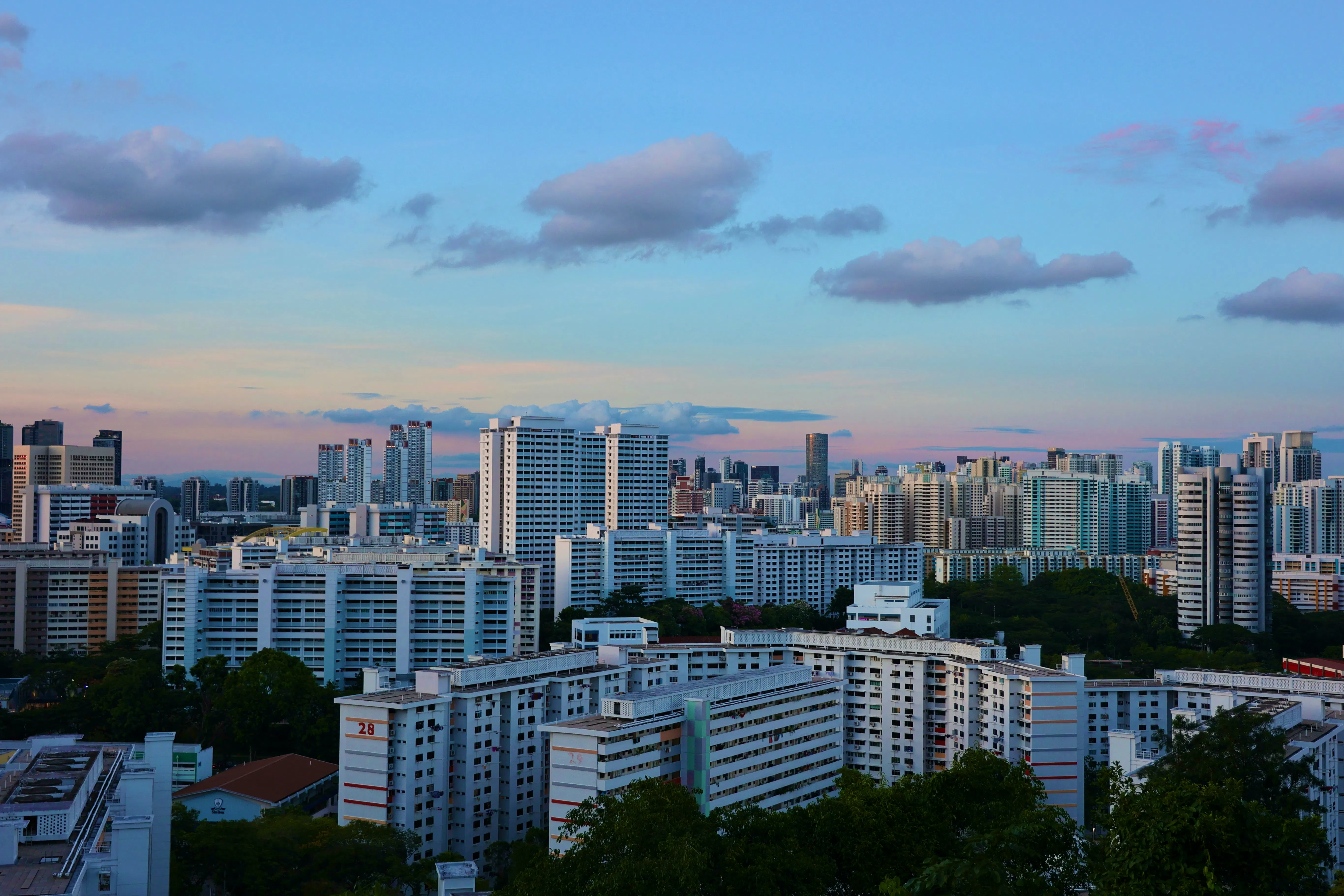
By powering hybrid solar air conditioners directly with modular DC distribution, urban buildings can slash conversion losses, optimize rooftop utilization, and ease grid demand during peak hours.
---
A walk through the city
Walking through Singapore and looking up at high-rise HDB condominiums, one question comes naturally:
How much energy could be saved if all those air conditioners could run fully on solar during the day?
Air conditioning is the single largest electricity consumer in high-rise buildings. In Singapore, daytime cooling alone can account for more than 40% of total building demand. If we don’t address cooling directly, rooftop solar will never make a meaningful dent in the grid load.
---
The Problems with Today’s Architecture
1. AC-Powered Air Conditioners in High-Rises
Most units still run entirely on AC power from the grid. Rooftop solar often feeds into “general supply,” while cooling demand — the biggest daytime load — remains untouched.
2. DC → AC → DC Conversion Losses
Even when rooftop solar is used, it’s inefficient. Because DC from solar panels → inverted to AC → supplied into the building → AC delivered to the air conditioner → rectified back into DC internally inside the air conditioner.
Each stage wastes energy as heat. In practice, conventional AC-coupled systems lose about 12–30% of generated energy, whereas with a modular DC approach ~11–18% more energy could reach the loads.
3. Panel Demand of Hybrid Solar Air Conditioners
Hybrid solar air conditioners exist and can run directly on DC (e.g., 70V - 350 V). But in today’s installations, each unit requires a dedicated set of panels. To power hybrid air conditioners with 12,000 BTU each, you typically would need about 3 solar panels per unit — meaning 300 panels for 100 units in a high-rise.
Because panels are locked to individual units, the diversity factor (not all units run simultaneously) cannot be applied. In roof-constrained environments, this makes large-scale deployment impractical.
---
A Modular DC Breakthrough
That’s where a shared modular DC distribution system changes everything.
Powermodules: Each panel's output is boosted on the roof and split into standardized 48 V “Power Units” within the Power Module.
Voltage Tiers: Create DC voltage “highways” (48 V to 336 V) dynamically on demand.
Load Connect Modules (LCMs): Plug-in units that connect each air conditioner to the right voltage tier with built-in protection and sensing.
Central Controller: Allocates solar fairly and efficiently, with reconfiguration times under 200 ms.
Instead of tying three panels to every aircon, all panels feed into a common pool. Solar is allocated dynamically, so every unit gets its fair share — and more of the generated energy is actually used.
---
Quantified Benefits
11–18% more energy delivered to loads compared to conventional AC-coupled solar systems.
30 - 40% less Solar Panels required due to smarter use via the diversity factor: not all air conditioners peak at once, so fewer panels can serve the same overall cooling demand.
100% utilization of produced solar: even if roof space cannot host enough panels to cover the full load, every installed panel contributes — with surplus power redirected to other DC loads (lighting, refrigeration, batteries) instead of being stranded.
Thinner, lower-cost cabling: higher distribution voltages (96–336 V DC) reduce conductor size and cost.
---
A Realistic Path for High-Rise Solar
This is not about disconnecting from the grid. It’s about making the most of limited rooftop solar — ensuring that every watt generated is used effectively, while reducing the number of panels required to achieve the same comfort.
For high-rise nations like Singapore, rooftop solar is often dismissed as insufficient. With modular DC distribution, the picture changes: the largest daytime load — cooling — can finally be tackled directly from the rooftop.
The result: same comfort, fewer panels, less grid demand. A realistic way to make rooftop solar work for high-rise living.
---
The Path Forward
Two patents protecting this architecture are currently pending in Singapore (applications SG 10202501817Q and SG 10202502153X, the latter filed under the FAST-8 GreenTech track).
We are now seeking two evaluation partners worldwide to co-develop and validate prototypes. Partners will gain:
Early access to the full technical package.
A 12–18 month head start before commercial licensing.
Strategic positioning in the emerging market for modular DC distribution.
---
About the Author
Walter Conrads is the Director of Conrads Consulting Pte. Ltd. (Singapore). With over 20 years of experience in IT consulting and systems architecture, he is the inventor of two patent-pending Modular DC Distribution Systems (SG 10202501817Q, SG 10202502153X) focused on efficient renewable energy integration.