𝗣𝗲𝗼𝗽𝗹𝗲 𝗻𝗲𝗲𝗱 𝘁𝗼 𝘂𝗻𝗱𝗲𝗿𝘀𝘁𝗮𝗻𝗱 𝘁𝗵𝗶𝘀 𝗼𝗯𝘀𝗰𝘂𝗿𝗲 𝘂𝘁𝗶𝗹𝗶𝘁𝘆 𝗽𝗿𝗼𝗰𝗲𝘀𝘀.
A✌️459-word✌️2.5-minute✌️read
I never dreamed I’d write about the inner workings of the utility industry. Not that long ago my knowledge about utilities didn’t extend beyond reviewing my electric bill. Yet with data centers proliferating, it behooves everyone to understand the basics.
Data centers are an easy target for rising prices, and given a mere forecast of demand can cause costs to rise, that target is not unwarranted.
I’m referring to capacity auctions.
I’m no expert, but I know enough to ring this alarm bell.
Capacity auctions set prices for future electricity supplies. It’s a necessary process to ensure that utilities have sufficient capacity to meet future demand with a sufficient buffer to address demand spikes.
Makes perfect sense.
Here’s the problem: when the price that power generators bid to supply future power rises, it increases the cost of electricity to ratepayers.
Because demand was flat, over the last couple of decades this has been a non-issue. There was a level of predictability to these auctions.
Those days are over.
Data center forecasts varied widely, but they all predict drastic increases to future demand. The end result is that the prices being bid in capacity auctions are spiking.
The worst part: even if the forecasts are wrong, it won’t matter. The damage will have been done.
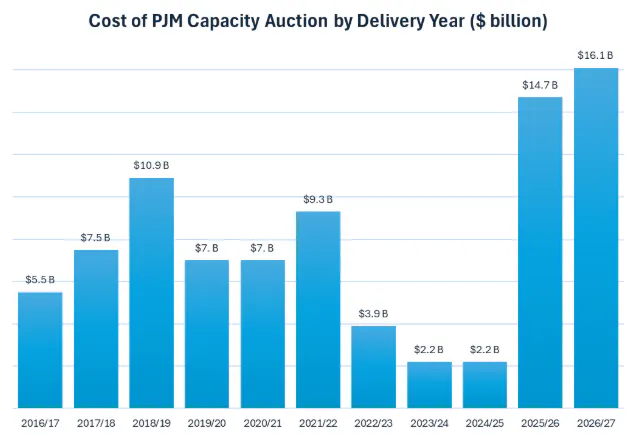
Case in point: The recent PJM auction.
PJM is the largest of the country’s seven regional transmission organizations. It manages the Mid-Atlantic and Midwest regions with a population of about 67 million.
According to Monitoring Analytics – the independent market monitor for PJM – expected demand from data centers accounted for $6.5 billion or 40% of the $16.4 billion of costs from PJM’s December capacity auction. The vast majority of that $6.2 billion is related to yet to be built data centers.
The end result: costs are being incurred based on an assumption that these data centers will come on line by the 2027/28 delivery year starting on June 1, 2027.
Combined, the last three auctions have had $21.3 billion of costs associated with data centers.
Who pays for this?
The 67 million ratepayers in PJM’s territory.
Utilities bear some of the blame. However, in my opinion, the lion’s share of the blame should be placed on regulators. A stop-gap floor/ceiling was placed on recent auctions, but that's like placing a band aid on a gash.
Increase demand was foreseeable, not necessarily from AI, but from a decade-long effort to electrify everything. Yet regulators have not changed the utility incentive model.
We need to revamp the current cost-plus model which perversely rewards spending and thus rate hikes. Moving to a model that rewards saving money, versus spending it, is long overdue.
#datacenters #PJM #electricityrates