


The invisible energy accumulation that defines the real climate crisis
Published originally on Substack.
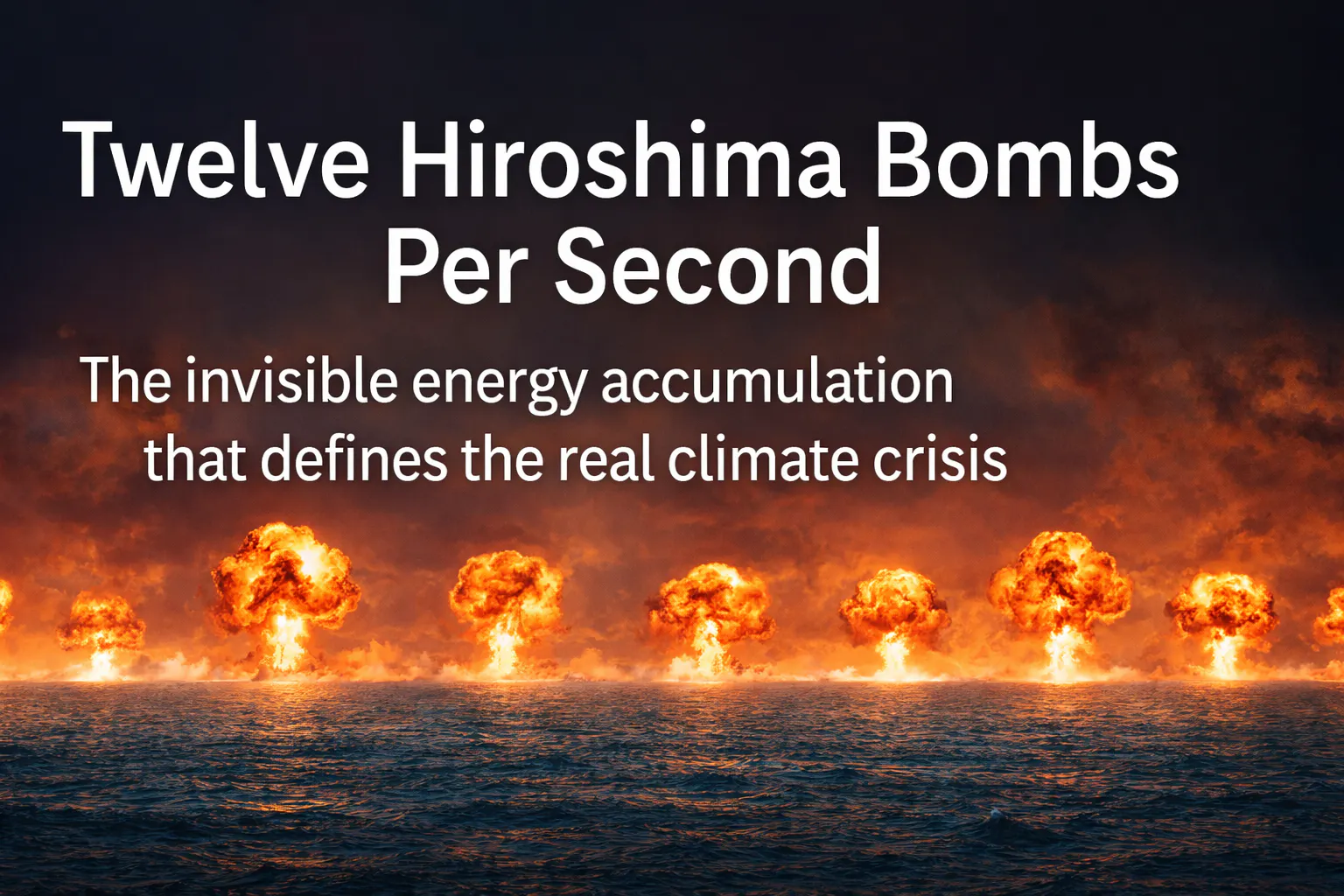
Last year, the world’s oceans absorbed a record amount of heat, equivalent to twelve Hiroshima-scale explosions every second.
Not metaphorically.
Thermodynamically.
Over the course of a single year, that adds up to roughly 378 million Hiroshima bombs’ worth of energy quietly absorbed by seawater. No flash. No sound. No ruins photographed from above. Just heat, banked in the largest thermal reservoir on Earth.
Spread across the planet’s surface, about 510 million square kilometers, that is roughly 1.35 Hiroshima bombs per square kilometer, added in just one year.
The Hiroshima bomb's immediate lethal zone covered roughly 13 square kilometers. In energy terms, global warming added the equivalent of more than ten planet-wide kill zones to the ocean in a single year.
And then we did it again.
A Century of Accumulation, Not a Single Event
This was not an anomaly.
It was part of a century-long trend.
For more than 100 years, the oceans have been absorbing the vast majority of excess heat trapped by greenhouse gases—over 90 percent. The atmosphere gets the headlines, but the ocean keeps the books.
Every year, we add to the balance.
None of it is erased.
Unlike air temperatures, which fluctuate seasonally, ocean heat is durable. Once driven below the surface, it remains locked within the system, slowly migrating through layers of water that circulate on timescales far longer than those of politics, markets, or human lifespans.
Through the thermohaline circulation—the great global conveyor belt that moves heat and salt through the deep ocean—this energy will be recirculated back to the surface over roughly 1,000 to 1,500 years.
This is not speculation.
It is how the ocean works.
The heat we added in the 20th century will still be influencing the climate when today’s nations, borders, and financial systems are long gone.
That is what makes ocean warming uniquely dangerous.
Why This Threat Feels Invisible and Isn’t
There is no mushroom cloud.
No crater.
No single day that history books will mark as “the moment it happened.”
But thermodynamics does not require drama.
The oceans now contain orders of magnitude more energy than all nuclear weapons ever built, and that energy is not inert. It expands water and raises sea levels. It fuels stronger storms and heavier rainfall. It disrupts marine ecosystems, destabilizes fisheries, and weakens the foundations of global food systems.
Civilizations do not collapse because of explosions. They collapse when harvests fail, coastlines retreat, and climate patterns no longer behave as expected.
Ocean heat is the silent amplifier of it all.
Sea level rise is not primarily about melting ice; it is about thermal expansion.
Extreme rainfall is not just about warmer air; it is about warmer oceans that feed storms with more latent heat.
Marine heatwaves are not anomalies; they are symptoms of a system storing too much energy.
This is why focusing solely on emissions misses the core of the problem.
Emissions Are the Cause. Heat Is the Consequence.
Climate policy treats carbon dioxide as the enemy.
Physics treats heat as the outcome.
Carbon matters because it traps energy. That energy does not vanish. It accumulates, and the oceans are where it goes.
Even if global emissions were reduced to zero tomorrow, the heat already stored in the oceans would continue to cycle through the Earth system for centuries. Storms would still draw on it. Seas would still rise. Circulation patterns would still adjust.
This is not an argument against mitigation.
It is an argument against pretending mitigation alone is sufficient.
We are managing inputs while ignoring inventory.
The Heat Ledger
Think of the ocean as a planetary ledger.
Every year, humanity adds another entry:
· X joules of excess heat.
There are no withdrawals.
No refunds.
No shortcuts.
We debate 2030 targets. The ocean is tracking millennia.
Yet despite this, climate discourse rarely asks the most basic thermodynamic question:
What is our plan for the heat that is already here?
Not the emissions we hope to avoid.
The heat we have already banked.
Because physics does not negotiate.
And the ocean does not forget.
Why This Is an Existential Risk—Without Hyperbole
The phrase “existential threat” is often overused, but this is not one of those cases.
A civilization of eight billion people depends on:
• stable coastlines,
• predictable rainfall,
• functioning marine ecosystems,
• and agricultural systems adapted to historical climate patterns.
Ocean heat undermines all four.
Not suddenly, but relentlessly.
There is no single threshold at which humanity “dies.” There is something far more dangerous: a long-term decline in habitability, marked by cascading food insecurity, mass displacement, economic stress, and geopolitical instability.
History shows that complex societies fail not from a single shock but from too many stresses arriving at once.
Ocean heat is the ultimate stress multiplier.
The Blind Spot at the Center of Climate Policy
We have built a global framework for counting carbon molecules while largely ignoring the energy those molecules trap.
We track parts per million as we add Hiroshima-scale energy to the oceans every few seconds.
We argue about offsets and accounting rules as the planet’s primary heat sink continues to fill.
This is not a failure of science.
It is a failure of imagination and of courage.
Once you acknowledge the heat ledger, uncomfortable questions follow:
• Can mitigation alone stabilize the climate on human timescales?
• What responsibility do we have for heat already stored?
• Are there ways to actively manage planetary heat, rather than merely slow its accumulation?
These questions are rarely asked, not because they are unscientific but because they challenge the boundaries of current policy thinking.
The Choice We Are Making by Default
By refusing to confront ocean heat directly, we are making a choice, whether we admit it or not.
We are choosing a future where:
• Sea levels have continued to rise for centuries,
• extreme weather becomes increasingly destructive,
• food systems face mounting stress,
• and every generation inherits a hotter, less stable world than the one before.
Not because we lacked alternatives, but because we refused to consider alternatives beyond emissions accounting.
A Final Accounting
The Hiroshima comparison makes people uncomfortable. It should.
Not because it exaggerates the danger, but because it reveals how numb we have become to scale.
Twelve bombs per second.
Three hundred seventy-eight million per year.
For a century.
No blast. No smoke. Just heat.
Climate change is not a distant abstraction or a future scenario. It is a century-long accumulation of energy, already written into the oceans, whose consequences will echo through the next thousand years.
The only real question left is whether we continue to ignore the ledger or finally decide to balance it.
From Emissions to Heat Management
At some point, climate realism demands a shift in framing.
Mitigation slows the rate at which heat enters the system.
Adaptation helps societies withstand damage.
Neither addresses the heat already stored in the ocean.
That leaves a missing category in climate policy—heat management.
This is where Thermodynamic Geoengineering enters the conversation, not as science fiction or atmospheric manipulation, but as applied physics. The idea is simple in principle, even if ambitious in scale: convert excess ocean heat into useful work while moving it from the surface, where it drives warming, storms, and sea-level rise, into the deep ocean, where it is isolated from the climate system for centuries.
It is not sunlight blocking.
It is not carbon burial.
It is not dumping anything into the ocean.
It is the deliberate application of the same thermodynamic logic that governs every power plant, refrigerator, and heat pump scaled to the planetary level.
The ocean already provides the temperature gradient. The physics is well understood. The question is no longer whether it is theoretically possible but whether we are willing to think beyond a climate strategy that manages inputs while ignoring inventory.
Thermodynamic Geoengineering does not replace emissions cuts. It complements them by addressing the part of the problem that emissions cuts cannot address: the heat that is already here.
Ignoring that option does not make the heat go away.
It merely ensures that future generations will inherit the bill.
Climate change is not a future threat. It is a century of excess energy already written into the oceans.
Every year, we add more heat. None of it disappears. It expands the seas, fuels storms, and destabilizes food systems—quietly, relentlessly, and on timescales far longer than our politics.
We have built climate policy around counting carbon molecules while ignoring the energy they trap. That blind spot is no longer defensible.
Physics does not negotiate.
The ocean does not forget.
The only real choice left is whether to continue pretending that mitigation alone is enough or finally confront the heat ledger we have been building for generations.