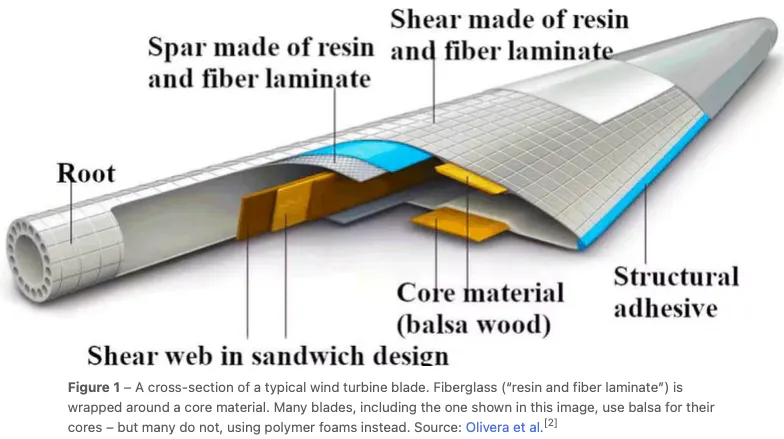
ScienceFeedback: “Some wind turbine blades are made from balsa wood, but they’re not a major part of Amazon deforestation, contrary to online claims.” A common strategy that misinformers use against renewable energy is to claim that wind turbines or solar panels ‘aren’t as green as they seem.’ A common tactic is to criticize the materials that these energy sources use. So, what do we make of this recent claim that wind turbines aren’t green because their blades are made with balsa wood “plundered from the Amazon rainforest.” Granted, some turbine blades use balsa wood for its strength + lightweight, most of it from plantations in Ecuador.
“However, a growing number of blades use polymer foams instead, which are not environmentally spotless either, but [at least] they can be made from recycled plastic and don’t require logging.” Today’s typical wind turbine blade is designed to meet these demands with a durable fiberglass shell, wrapped around a stiff yet lightweight core (Figure 1). The alternative to balsa is most commonly PET foam, 1 of the most easily recycled plastics. “Many blade makers indeed use PET foam made from recycled plastic bottles.” According to one estimate, PET already accounted for 20% of the material in the world’s blade cores in 2018, rising to 55% in 2023.
“In Ecuador, according to Global Forest Watch, agriculture was responsible for 92.7% of tree cover loss from 2001 to 2024; by comparison, logging was responsible for just 2.4%.” Let’s call a spade for what it is. “Fossil fuel plants are tens of times more greenhouse-gas-intensive than wind turbines over their entire lives, no matter where in the world they are built…these emissions go on to cause climate change—something that itself exacerbates tree loss in the Amazon.” To quote Spiro Agnew from 1970, stop this naysaying, you “nattering nabobs of negativism.”