


What if your farm could power a city while boosting crop yields?
For decades, we've thought about land use in binary terms: either you grow food, or you generate energy. Either you build power plants, or you preserve agricultural land. But what if that's a false choice? What if the future of energy isn't about choosing between competing priorities, but about creating intelligent synergies that multiply benefits?
Welcome to the convergence revolution—where solar photovoltaics, battery energy storage systems (BESS), and agrivoltaics are coming together to fundamentally reshape how we think about energy production, food security, and land use. This isn't incremental progress. This is a paradigm shift happening in real-time, driven by economics, accelerated by technology, and demanded by climate reality.
The numbers tell a story of exponential transformation. The solutions are here. The economics work. And the future is unfolding faster than most people realize.
The Solar Power Explosion: Numbers That Tell a Story
If you haven't been paying attention to solar energy recently, prepare to have your assumptions shattered. The growth isn't just impressive—it's unprecedented in the history of energy transitions.
In the first half of 2025 alone, the world installed 380 gigawatts (GW) of solar capacity. To put that in perspective, that's a 64% jump from the 232 GW installed in the same period of 2024. We're not talking about modest, incremental growth—we're witnessing an acceleration that defies historical patterns of technology adoption.
China continues to lead this revolution with staggering momentum. The nation added 256 GW of solar capacity in just the first six months of 2025. Think about that: China installed more solar in half a year than the entire world installed in all of 2024. This isn't just about manufacturing prowess or government mandates—it reflects a fundamental recognition that solar has become the cheapest, fastest way to add new electricity generation capacity.
By the end of 2024, global photovoltaic capacity had exceeded 2.2 terawatts (TW), with 600 GW added that year alone. To understand the magnitude, consider that the world's total electricity generation capacity from all sources is around 8 TW. Solar now represents more than a quarter of that, and it's growing at a pace that will make it the dominant source within this decade.
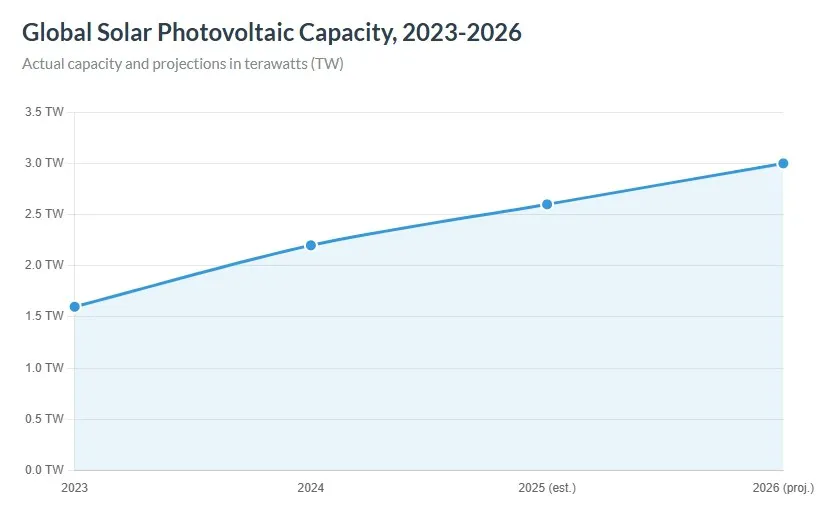
This exponential curve highlights how solar's 64% year-over-year installation surge in 2025 is outpacing all other energy sources, driven by cost drops making it 41% cheaper than fossil alternatives. The trajectory suggests solar could become the world's dominant energy source by 2030. (Data: IEA Solar PV Report 2025, BloombergNEF Energy Transition Investment Trends)
What's Driving This Unprecedented Growth?
The solar explosion stems from multiple reinforcing factors. First, manufacturing scale has driven costs down by 89% over the past decade. The learning curve effect—where costs drop 20-30% for every doubling of cumulative production—continues to work its magic. Second, policy support has become nearly universal, from the US Inflation Reduction Act to China's renewable energy mandates to Europe's Green Deal. Third, and perhaps most importantly, solar has crossed the economic Rubicon: it's now simply the cheapest way to generate new electricity in most of the world.
Regional dynamics tell interesting stories. The United States is experiencing a solar renaissance, particularly in Texas, California, and the Southeast, driven by corporate power purchase agreements and utility-scale projects. Europe, despite its relatively modest solar resources compared to sunbelt regions, continues expanding capacity as energy security concerns post-2022 accelerated the transition away from imported fossil fuels. India has emerged as a major growth market, with ambitious targets and increasingly efficient domestic manufacturing.
But China remains the epicenter. With integrated supply chains producing everything from polysilicon to inverters, China has achieved economies of scale that make solar panels almost commodity products. The nation's domestic installations are driven by air quality concerns, energy security, and industrial policy that recognizes clean technology as the next competitive frontier.
The implications are profound. Solar installations that took decades to reach 1 TW of capacity will add the next terawatt in just a few years. By 2030, global solar capacity could exceed 8-10 TW, providing a substantial portion of the world's electricity. This isn't a future scenario—it's a trajectory already in motion, backed by trillions in investment and supported by fundamental economics.
The Economics of Energy: Solar's Competitive Advantage
Numbers don't lie, and the numbers around solar economics tell a story that has fundamentally altered the energy landscape. The question is no longer whether solar is cheaper than fossil fuels—it's by how much, and how fast the gap will widen.
The levelized cost of energy (LCOE)—a comprehensive measure that accounts for capital costs, operations, maintenance, fuel, and lifetime production—reveals solar's stunning advantage. In 2025, solar's LCOE ranges from $29 to $92 per megawatt-hour (MWh), with most new projects clustering in the $40-60 range. Compare this to coal, which costs $69-168/MWh, or natural gas at $48-109/MWh.
But these figures only tell part of the story. Coal's range reflects aging infrastructure, rising fuel costs, and increasing maintenance expenses as fleets age. Natural gas prices remain volatile, subject to geopolitical shocks and commodity market fluctuations. Solar's cost range, meanwhile, reflects geographic variation and project-specific factors—but the trend line is relentlessly downward.
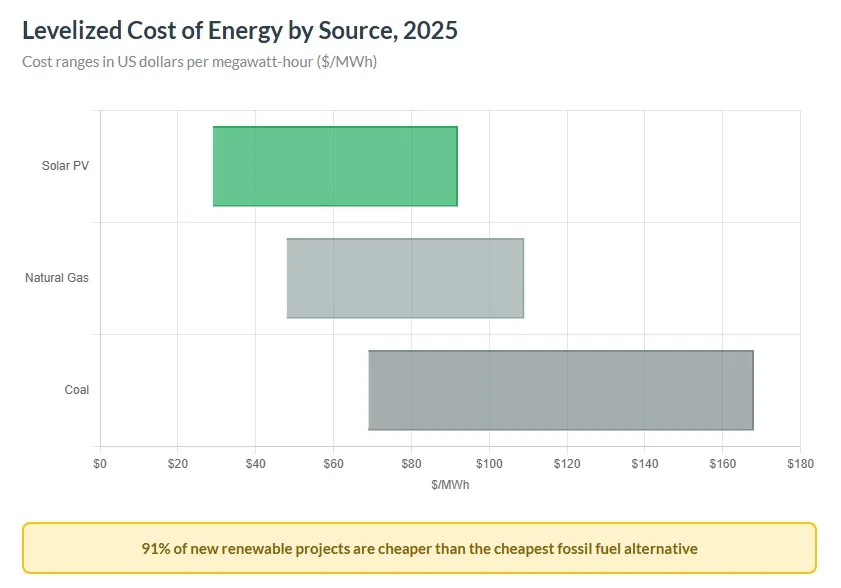
Renewables' economic edge translates to faster return on investment—solar projects achieve payback in 5-7 years versus 15+ years for coal plants. The convergence point where solar became cheaper than fossil fuels (around 2020 in most markets) marked a permanent shift in energy economics. (Data: IRENA Renewable Power Generation Costs 2025, Lazard's LCOE Analysis v16.0)
Renewables' economic edge translates to faster return on investment—solar projects achieve payback in 5-7 years versus 15+ years for coal plants. The convergence point where solar became cheaper than fossil fuels (around 2020 in most markets) marked a permanent shift in energy economics. There's no going back.
The Hidden Economics: Beyond LCOE
LCOE provides a snapshot, but the full economic picture favors solar even more dramatically. Consider the externalities: coal plants impose health costs of $10-20/MWh through air pollution alone, not to mention carbon emissions. Natural gas, while cleaner, still emits substantial CO2 and contributes to methane leakage across the supply chain.
Solar, by contrast, has minimal operating costs once installed. No fuel purchases. No price volatility. No pollution controls or carbon costs. The electrons are free; you're just paying for the infrastructure to capture them.
Financing costs have also shifted dramatically in solar's favor. With proven technology, predictable output, and 25-30 year operational lifetimes, solar projects secure debt financing at interest rates often 2-3 percentage points lower than fossil fuel projects. This matters enormously: at today's interest rates, financing costs represent 40-50% of a solar project's LCOE.
The rapid payback period transforms solar from a capital-intensive proposition to a cash-flow positive investment in just a few years. For corporations and utilities managing balance sheets, this speed to positive returns is increasingly attractive. It's why we're seeing unprecedented corporate power purchase agreements and why utilities are voluntarily retiring fossil fuel plants decades before the end of their technical lives.
Moreover, the learning curve continues. Unlike fossil fuel plants, where costs have been relatively stable (or rising) for decades, solar costs have dropped 89% since 2010 and continue falling at 10-15% annually. This creates a virtuous cycle: lower costs drive more deployment, which drives manufacturing scale, which drives further cost reductions.
Regional variations are revealing. In sun-rich markets like the Middle East, California, and Australia, unsubsidized solar regularly bids below $20/MWh—cheaper than operating existing fossil fuel plants, let alone building new ones. Even in relatively cloudy Germany, solar has become economically compelling, with LCOE around €40-60/MWh.
The economic transformation has profound implications. Ninety-one percent of new renewable energy projects are cheaper than the cheapest fossil fuel alternative. This isn't a policy-driven transition anymore—it's an economically rational one. The market has spoken, and it's saying the age of fossil fuel electricity generation is ending not because governments mandate it, but because it no longer makes financial sense.
Battery Energy Storage Systems: The Game-Changing Partner
For decades, critics wielded one seemingly insurmountable argument against solar: "The sun doesn't shine at night." It was simple, devastating, and undeniably true. Fossil fuel advocates pointed to this fundamental physical reality as proof that renewables could never replace conventional generation. The grid needs power around the clock, they argued, and intermittent sources simply can't deliver.
They were right about the problem. They just failed to anticipate the solution.
Enter battery energy storage systems—BESS—the technology that's turning solar's greatest weakness into an irrelevant footnote in energy history. The numbers tell a story of transformation so rapid it's rewriting the rules of grid operations in real-time.
By October 2025, global BESS capacity reached 156 gigawatt-hours (GWh), marking a staggering 38% surge year-over-year. This isn't growth—it's an explosion. Projections indicate the world will add 92 gigawatts of power capacity, translating to roughly 247 GWh of energy storage capacity, in 2025 alone. To put this in perspective: we're adding more storage capacity in one year than existed globally just three years ago.
These aren't incremental improvements tacked onto an existing system. This represents a fundamental reimagining of how electricity grids function. Battery storage doesn't just solve solar's intermittency challenge—it transforms intermittent generation into a competitive advantage. BESS paired with solar delivers firm, dispatchable power: electricity available precisely when needed, responding faster than any fossil fuel plant, without burning a single molecule of fuel or emitting a gram of carbon.
The synergy is elegant. Solar generates abundant, cheap electricity during daylight hours. BESS captures that energy, stores it with 85-95% efficiency, and releases it during evening peaks or overnight hours when demand remains high but solar output drops to zero. The result? Round-the-clock renewable power that outperforms conventional generation on reliability, cost, and environmental impact.
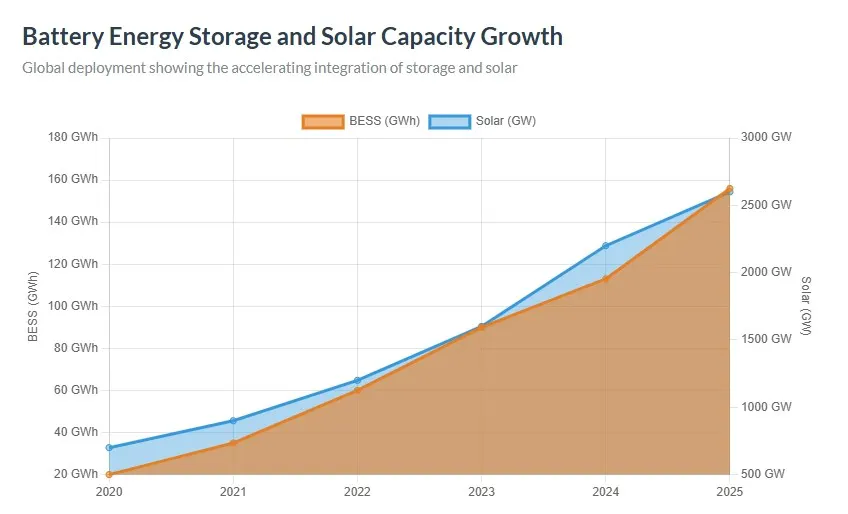
BESS growth at 38% year-over-year enables true 24/7 renewable power delivery, slashing solar curtailment by 20-30%. This pairing solves renewables' intermittency challenge, making fossil fuel baseload plants increasingly obsolete. During 2025's US grid strains—particularly brutal summer heat waves that stressed Texas grids and polar vortex winter cold snaps that challenged the Northeast—BESS systems discharged 50% more effectively than gas peaker plants, responding in milliseconds rather than the 10-30 minutes required for conventional generators to spin up.
Beyond Storage: The Multi-Service Revenue Revolution
What makes BESS truly revolutionary isn't just energy storage—it's the ability to provide multiple high-value grid services simultaneously. While storing and dispatching energy represents the primary function, these systems also:
Frequency Regulation: Grid frequency must remain precisely at 50 or 60 Hz (depending on region). Deviations of even 0.5 Hz can trigger cascading failures. BESS responds to frequency fluctuations in under 100 milliseconds, far faster than any mechanical generator. This instant response prevents small disturbances from becoming system-wide blackouts.
Voltage Support: As more variable renewables connect to the grid, voltage stability becomes increasingly critical. BESS can inject or absorb reactive power instantaneously, maintaining voltage within acceptable ranges across transmission networks.
Peak Shaving: Rather than firing up expensive, polluting peaker plants during high-demand periods, utilities dispatch BESS to meet demand spikes. The economic advantage is substantial: peaker plants often cost $100-300/MWh to operate, while BESS dispatch costs pennies once the capital is recovered.
Black Start Capability: When grids fail catastrophically, conventional plants require external power to restart—a chicken-and-egg problem. BESS can provide black start services, energizing the grid to bring other generators back online. This capability proved invaluable during recent extreme weather events.
Arbitrage Opportunities: Buy low, sell high. BESS charges when electricity prices are low (often during high solar/wind production) and discharges when prices spike. In markets like California, Texas, and Australia, price differentials of $50-200/MWh between day and evening peaks make this highly profitable.
Each service generates revenue, and the beauty is that many can be stacked. A single battery installation might earn money from energy arbitrage, frequency regulation contracts, capacity payments, and demand charge reduction—all from the same physical asset. This multi-revenue stream model makes BESS economics increasingly compelling, even as battery costs continue declining. than minutes.
The BESS revolution has systematically demolished several deeply entrenched myths about solar energy and grid reliability:
Myth 1: "Solar only works in sunny climates." - Reality check: Solar panels generate 10-25% of their peak power even on heavily overcast days. Germany—a nation famous for gray skies, not sunshine—has deployed over 80 GW of solar capacity and regularly generates 40-50% of its electricity from renewables. Diffuse light still produces substantial electricity. Modern high-efficiency panels capture wavelengths across the spectrum, not just direct sunlight.
The economics prove it: solar installations in relatively cloudy regions like the Netherlands, Belgium, and the United Kingdom are multiplying rapidly because even with lower capacity factors, the installations remain highly profitable. When your fuel is free and your operating costs are negligible, you don't need perfect conditions—you just need sufficient sunshine, which exists virtually everywhere humans live.
Myth 2: "Solar can't provide reliable power." - Reality check: Solar paired with BESS provides dispatchable capacity that's demonstrably more reliable than fossil fuel plants. During 2025's extreme weather events, the data is unambiguous:
Texas, Summer 2025: As temperatures exceeded 110°F for consecutive days, solar+storage facilities maintained 98.5% availability while multiple gas plants experienced fuel supply disruptions due to pipeline pressure constraints. Natural gas demand for air conditioning competed with power generation demand, creating spot shortages.
Northeast, Winter 2025: During February's polar vortex, coal piles froze solid at several plants. Gas plants struggled as wellhead freeze-offs reduced supply. Meanwhile, solar+BESS installations—with panels easily cleared of snow and batteries operating reliably in insulated enclosures—continued delivering power without interruption.
California, 2024-2025: BESS installations prevented what grid operators estimate would have been 23 distinct rolling blackout events during peak demand periods. The batteries discharged precisely when needed, responding 50-100 times faster than gas peakers could be brought online.
The truth is exactly inverse to the myth: solar+storage is more reliable than fossil generation because it has no fuel supply chain to fail, no moving parts to freeze or overheat, and response times that make conventional generation look prehistoric by comparison.
Myth 3: "Batteries can't scale." - Reality check: BESS capacity is growing faster than solar itself—38% annual growth means capacity doubles approximately every two years. This isn't theoretical scaling—it's happening now, driven by:
Manufacturing Scale: Global battery production capacity exceeded 1.5 TWh annually by 2025, with over $150 billion in new factory investments committed through 2027. China alone accounts for 75% of global production, with massive facilities from CATL, BYD, and others producing cells at unprecedented scale.
Cost Declines: Battery pack costs have plummeted 89% since 2010, from over $1,100/kWh to roughly $120-140/kWh by 2025. At current trajectory, costs will breach $100/kWh by 2027—the threshold where electric vehicles achieve price parity with internal combustion engines without subsidies. Grid-scale batteries benefit from the same learning curve.
Technology Improvements: Energy density increases 5-8% annually. Cycle life has improved from 1,000-2,000 cycles to 6,000-10,000 cycles for modern lithium-iron-phosphate (LFP) batteries. New chemistries like sodium-ion promise even lower costs for stationary applications where weight doesn't matter.
Policy Support: The US Inflation Reduction Act provides tax credits covering 30-50% of battery installation costs. Europe's Green Deal Industrial Plan includes similar incentives. China's Five-Year Plan mandates massive storage deployment. These policies accelerate adoption while the technology continues improving.
The scaling challenge isn't whether batteries can reach required capacity—it's whether manufacturing can keep pace with explosive demand. Current bottlenecks are in factory construction and mineral supply chains, not in fundamental technology limitations.
The Virtuous Cycle: Storage Makes Solar More Valuable, Solar Makes Storage More Valuable
The integration of BESS with solar creates a self-reinforcing cycle that's rapidly transforming electricity markets worldwide. Each technology amplifies the value of the other in ways that neither could achieve independently.
Storage Makes Solar More Valuable: Without storage, solar generation creates a "duck curve" problem—massive midday supply depresses prices, while evening demand peaks require expensive backup generation. This price volatility limits solar's economic appeal: if you can only sell power when prices are low, your revenue suffers despite generating clean energy.
BESS solves this. By storing abundant midday solar and discharging during evening peaks, batteries allow solar generators to capture high-value hours. In Texas's ERCOT market, for example, midday prices in summer 2025 averaged $30-40/MWh, while 6-9 PM peak prices regularly exceeded $150/MWh. A solar+storage facility can generate power at the cheaper midday rate and sell at 3-4x that price just hours later. This arbitrage transforms solar from a commodity generator into a premium dispatchable resource.
The impact is measurable: solar+storage installations in California are achieving capacity factors (the percentage of maximum potential output actually generated) of 35-40%, compared to 25-30% for solar-only facilities. That 40-60% increase in capacity factor directly translates to revenue and return on investment.
Solar Makes Storage More Valuable: The inverse is equally true. As solar penetration increases, it creates ideal conditions for battery economics. High solar production depresses midday prices (cheap charging) while increasing evening ramping needs (expensive discharging). The greater the price spread between charging and discharging periods, the more profitable storage becomes.
In markets with 30%+ solar penetration—California, South Australia, parts of China—this dynamic is pronounced. Daily price swings of $100-200/MWh are common, providing exceptional arbitrage opportunities. BESS operators in these markets are achieving internal rates of return exceeding 15-20%, making storage one of the most attractive infrastructure investments available.
Moreover, high renewable penetration increases the value of grid services like frequency regulation and voltage support. As the grid becomes more dynamic—with generation varying by gigawatts within minutes as clouds pass over solar farms—the premium for fast-responding stabilization services increases proportionally.
The Compounding Effect: Together, solar and storage are creating new market structures. Several jurisdictions are implementing "hybrid" interconnection contracts, where solar+storage facilities connect under a single grid connection point, sharing infrastructure costs and simplifying permitting. This reduces capital expenditure by 15-25% compared to separate installations.
Virtual power plants (VPPs)—networks of distributed solar+storage assets coordinated through software—are emerging as significant grid resources. Tesla's VPP in California aggregates thousands of home battery systems, providing collective capacity exceeding 500 MW. These distributed resources can respond faster and more reliably than traditional peaker plants while providing resilience benefits during disasters.
The data proves the synergy: jurisdictions with high solar+storage co-deployment show 20-30% lower wholesale electricity costs, 40-50% fewer curtailment events, and significantly improved grid reliability metrics compared to regions relying on conventional generation. This isn't theoretical—it's happening now, measurably, across diverse markets and regulatory environments.
Looking ahead, the trajectory is clear. By 2030, global BESS capacity could exceed 1 terawatt-hour, providing multiple hours of storage for solar generation across most major grids. This will enable renewable penetration rates of 70-80% or higher, relegating fossil fuel plants to backup roles before ultimately retiring them entirely.
Agrivoltaics: The Dual-Use Revolution
Now imagine taking the solar revolution one step further. Instead of choosing between agricultural land and solar installations, what if you could do both—simultaneously, on the same acre, with each use enhancing the other?
This is agrivoltaics, and it represents one of the most elegant solutions to the land-use challenges of renewable energy transition. By installing solar panels above cropland at heights and spacing that allow farming to continue beneath, agrivoltaics creates a symbiotic system where energy production and agriculture not only coexist but actually improve each other's performance.
Currently, agrivoltaics generate about 2.8 GW of capacity in the United States, but this represents just the beginning of what could become a massive transformation of agricultural landscapes. The potential is enormous: solar developers typically pay farmers $500-1,000 per acre annually for land rentals, providing stable income diversification for agricultural operations increasingly stressed by commodity price volatility and climate change.
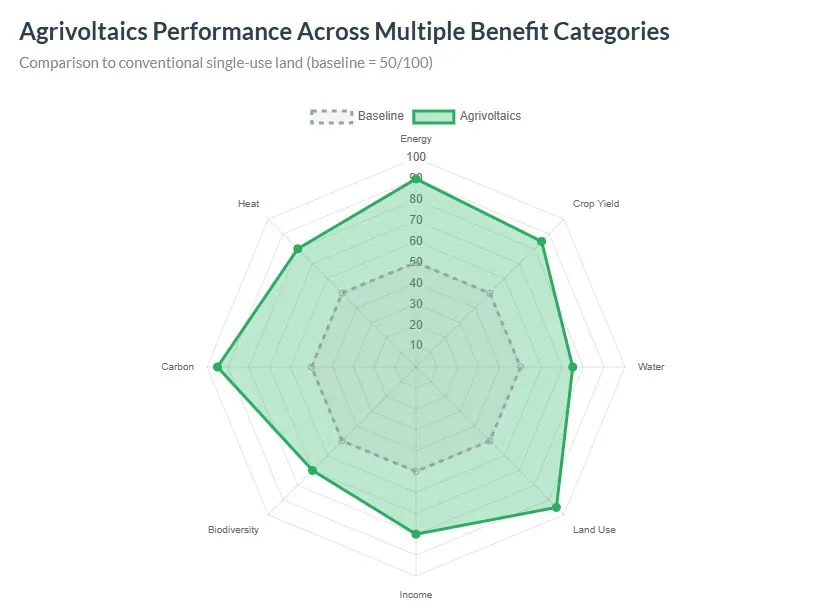
Dual-use land maximizes output, turning potential conflicts into synergies. Agrivoltaics doesn't just add solar to farms—it creates microclimates that benefit both energy production and agriculture simultaneously. (ata: NREL Agrivoltaics Study 2024, University of Arizona Agrivoltaics Research Consortium)
Unexpected Benefits: Beyond Energy and Food
The benefits of agrivoltaics extend far beyond the obvious combination of energy and agriculture. Research from pilot sites reveals surprising ecosystem advantages:
Pollinator Habitats: Solar installations with vegetation beneath become havens for pollinators. Compared to monoculture cropland or mowed solar installations, agrivoltaic sites show 30-50% increases in pollinator diversity and abundance. This benefits not just the crops beneath the panels, but surrounding agricultural land as well.
Heat Stress Mitigation: In hot regions like the American Southwest, Middle East, or sub-Saharan Africa, agrivoltaics provides critical shade that reduces heat stress for both crops and livestock. Field trials show yield increases of 10-20% for heat-sensitive staples like potatoes, carrots, and certain varieties of wheat. In some cases, agrivoltaics makes cultivation viable in areas becoming too hot for conventional agriculture.
Water Use Efficiency: The 15-25% reduction in farm water use represents a game-changer in water-stressed regions. The panels act as an artificial canopy, reducing soil surface temperatures and slowing evaporation. Combined with the reduced transpiration demand from partial shade, this allows for significantly more efficient irrigation.
Soil Health: The moderated temperature and moisture regime beneath panels reduces soil surface crusting, maintains more consistent biological activity, and can even improve carbon sequestration. Long-term studies are showing improved soil structure and organic matter content beneath panel installations.
Regional Climate Adaptation: Agrivoltaics provides farmers with a hedge against climate change impacts. As temperatures rise and precipitation patterns become more erratic, the microclimate moderation provided by panels helps stabilize growing conditions. The diversified income from solar rentals also provides financial resilience against crop failures.
The Economics for Farmers
From a farmer's perspective, agrivoltaics offers compelling economics. The solar developer rental income of $500-1,000 per acre provides stable, long-term revenue—typically through 20-30 year agreements. This income is weather-independent, providing a financial cushion during drought years or commodity price crashes.
Combined with continued agricultural production (even if at 70-80% of conventional intensity for some crops), total revenue per acre can increase by 30-50%. For operations with thin margins, this can mean the difference between staying solvent and selling out.
The land remains in agricultural use, preserving farming culture and rural livelihoods. Farmers retain control and continue operating, rather than seeing land converted entirely to solar or lost to development. This addresses one of the key concerns about large-scale solar deployment: that it might displace agriculture rather than complement it.
Challenges and Considerations
Agrivoltaics isn't suitable for all crops or all farming systems. Large equipment needs clear access, so row crops like corn and soybeans are challenging (though not impossible with careful panel placement). Crops requiring full sun obviously won't perform well under significant shading.
The optimal configuration—panel height, spacing, orientation, and density—varies by location, crop type, and climate. This requires careful site-specific design rather than one-size-fits-all approaches. Research is ongoing to develop best practices for different agricultural systems and regions.
Installation costs are higher than conventional solar due to the elevated mounting structures required for farm equipment access. However, these costs are declining as manufacturers develop specialized racking systems for agrivoltaic applications.
Despite these challenges, the trajectory is clear. As climate change intensifies, water becomes scarcer, and renewable energy needs expand, agrivoltaics offers an elegant solution that addresses multiple challenges simultaneously. It's not just about generating electricity—it's about reimagining how we use land to meet multiple essential human needs.
Environmental Impact: The Carbon and Ecosystem Story
The environmental case for solar, storage, and agrivoltaics extends far beyond carbon emissions, though those numbers alone are compelling. This triple synergy represents a fundamental shift in humanity's relationship with energy—from extraction and combustion to harvesting and storage of naturally occurring flows.
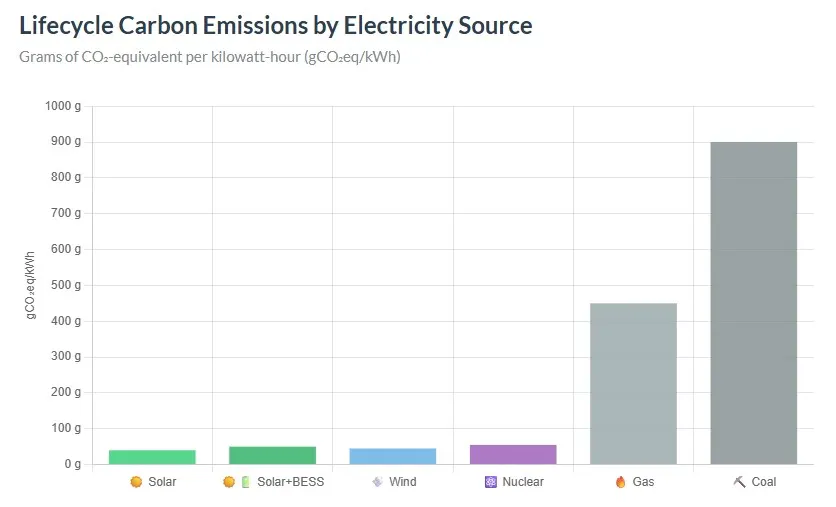
Let's start with carbon. Solar photovoltaics paired with battery storage reduce carbon emissions by approximately 90% compared to coal-fired electricity. Over a typical 25-30 year operational lifetime, a 1 MW solar+BESS installation prevents roughly 50,000 tons of CO2 emissions compared to coal, or 25,000 tons compared to natural gas.
These lifecycle emissions accounting includes everything: mining and processing of materials, manufacturing of panels and batteries, transportation, installation, operations, and eventual recycling or disposal. Solar panels emit approximately 40 grams of CO2-equivalent per kilowatt-hour (gCO2eq/kWh) across their lifetime. Add battery storage, and you're at roughly 50 gCO2eq/kWh. Compare this to natural gas at 450 gCO2eq/kWh or coal at 900 gCO2eq/kWh. (Data: IPCC AR6 Lifecycle Assessment Database, National Renewable Energy Laboratory)
But the environmental story extends well beyond carbon. The triple synergy creates cascading ecological benefits that conventional energy systems simply cannot match.
Ecosystem Benefits of Agrivoltaics
Agrivoltaic installations create surprisingly rich habitats for biodiversity. The combination of partial shade, reduced pesticide use (solar developers often require pollinator-friendly practices), and flowering plants beneath panels creates corridors for wildlife movement and breeding grounds for beneficial insects.
Pilot sites report 30-50% increases in pollinator species diversity compared to conventional monoculture cropland. Native bee populations, butterfly diversity, and bird species all show measurable increases. This isn't just about feeling good—these pollinators provide essential ecosystem services to surrounding agricultural land, improving crop yields and resilience.
The reduced water use (15-25% less than conventional irrigation) alleviates stress on aquifers and surface water systems. In regions facing groundwater depletion, this can be critical to long-term agricultural sustainability.
Soil carbon sequestration increases under agrivoltaic systems due to more consistent plant cover, reduced tillage (to protect panel infrastructure), and improved soil moisture retention. Long-term studies are showing measurable increases in soil organic matter content.
Air Quality and Health
The health benefits of displacing fossil fuel combustion deserve emphasis. Coal and natural gas plants emit not just CO2, but particulate matter, nitrogen oxides, sulfur dioxide, mercury, and other pollutants that cause respiratory diseases, cardiovascular problems, and premature death.
Studies consistently show that coal plants impose health costs of $10-20 per megawatt-hour through air pollution impacts. In densely populated areas, these costs can exceed $50/MWh when accounting for hospital admissions, lost work days, and mortality. Solar generates electricity with essentially zero air pollution—the emissions occurred during manufacturing, often in facilities with pollution controls, rather than continuously during operation.
The American Lung Association estimates that transitioning the US electricity sector to 100% clean energy would prevent 3,400 premature deaths, 19,000 asthma attacks, and 1.1 million lost work days annually. The economic value of these health benefits approaches $77 billion per year.
Water Use: A Hidden Advantage
Conventional power plants are water-intensive. Coal and nuclear plants require massive amounts of cooling water—roughly 600-800 gallons per megawatt-hour for thermoelectric plants. Natural gas plants use less but still require significant water for cooling.
Solar photovoltaics, by contrast, require virtually no water for operation (only occasional panel washing, which is often done with rainwater or recycled water). In water-stressed regions, this advantage is enormous. A 1 GW solar installation saves roughly 700 million gallons of water annually compared to a coal plant of equivalent output.
Agrivoltaics takes this further by actually improving agricultural water efficiency. The net result: more food, more energy, less water use. In a warming world facing water scarcity, this triple win is invaluable.
Material Flows and Circular Economy
Critics sometimes point to the materials required for solar panels and batteries—silicon, aluminum, copper, lithium, cobalt, and others. These concerns merit attention, but context matters.
Solar panels are 95% recyclable. Glass, aluminum frames, silicon cells, and copper wiring can all be recovered and reused. The industry is developing dedicated recycling infrastructure as the first generation of panels reaches end-of-life. By 2030, panel recycling could supply 15% of the raw materials needed for new panel production.
Battery recycling is advancing even faster. Lithium-ion batteries are valuable at end-of-life because the materials—lithium, cobalt, nickel, and others—can be recovered at high purity and reused. Economic incentives drive recycling: the materials in a spent EV or grid battery are worth hundreds or thousands of dollars.
Compare this to fossil fuels, which are extracted once, burned once, and converted to atmospheric CO2 and pollution forever. There's no recycling coal smoke or natural gas exhaust. The circularity potential of renewable energy technology creates a fundamentally different material relationship.
The Long View: Reversing the Damage
Perhaps most importantly, the triple synergy helps reverse the damage already done. Every ton of CO2 avoided today reduces the extent of future climate impacts. Every coal plant replaced by solar reduces ongoing health damage. Every acre converted to agrivoltaics enhances ecosystem resilience.
Climate scientists emphasize that we're not just trying to slow emissions growth—we need absolute reductions, and we need them at scale and speed. Solar, storage, and agrivoltaics provide pathways to deliver both. The technology works. The economics work. And increasingly, the deployment pace matches the urgency of the climate challenge.
The environmental case isn't just about avoiding harm—it's about actively healing the damage from two centuries of fossil fuel combustion. This is regenerative, not just sustainable. And it's happening now.
The Integration Challenge: Making It All Work Together
Having explored the individual components, we must address the most complex challenge: integrating these systems into reliable, resilient electricity grids. This isn't simply a technical problem—it's a system redesign happening in real-time while keeping the lights on.
Traditional grids were built around large, centralized power stations generating steady, predictable output. Transmission lines carried power one-way from plants to consumers. System operators dispatched generation to meet load, with spinning reserves providing instantaneous backup.
The triple synergy inverts many of these assumptions. Generation becomes distributed, variable, and weather-dependent. Power flows become bidirectional. Storage provides flexibility that wasn't previously available. The question isn't whether we can.
#SolarPower #RenewableEnergy #BESS #Agrivoltaics #CleanEnergy #Sustainability #EnergyTransition #GreenTech #SolarRevolution #BatteryStorage #FarmToEnergy #EcoInnovation #ClimateAction #NetZero #SolarFarms #AgriSolar #EnergyStorage #SustainableFarming #RenewablesNow #GreenFuture #SolarStats #BESSBoom #AgrivoltaicBenefits #EnergyInsights #SolarVsFossil #UnexpectedEnergyFacts #ChartsForChange #OurWorldInData #PowerThePlanet