


“The stone age did not end for lack of stones,
and the oil age will end long before the world runs out of oil.”
– Saudi Oil Minister Sheik Zaki Yamani, 1973
Is this the way the world will end?
The title here, “The end is near”, refers not to the end of the world, but to the end of the oil age as we have known it. To those heavily invested in the current oil business, it may feel like the end of the world, but to the rest of us it could be the dawn of a new and more sustainable world of clean energy. It will come about just as Sheik Yamani intimated: not because the world will exhaust the supply of fossil fuels, but because it will find better alternatives.
Electric vehicles are already making inroads into global markets for gasoline and diesel fuel. But we’ll continue to use some amount of hydrocarbon fuels for decades to come. They’re incredibly energy dense compared to batteries, and there are applications that need that density. Those include long distance air travel and off-road heavy equipment. And despite inroads by new EVs, there are literally trillions of dollars of investment in gasoline and diesel powered equipment that will remain operational for years to come. That investment won’t be quickly abandoned. What can happen (relatively) quickly is a transition from fossil hydrocarbons to “drop in” synthetic fuels for those applications that still require energy dense hydrocarbon fuels.
An imminent large-scale transition to drop-in synthetic fuels is not on the consensus road map of the oil industry. However, I contend that the technology to make the transition economically feasible is very near – if not already here. Furthermore, there are potent environmental and geostrategic reasons to implement the transition ASAP. I’ll get to those, but first a little background. (Readers not interested in background should skip to the next section.)
The road to synthesis
Among those who think about the issue at all, there’s a tendency to see synthetic fuels as something exotic and high tech. There’s an assumption that it will require a lot of sophisticated R&D to bring synthetic fuels into the “real world” of widespread commercial use. That’s wrong. What it really requires is mostly just an abundance of cheap electricity. For much of the world, cheap wind and solar energy, coupled with advanced battery technologies now entering commercial service, are close to providing that.
Synthetic fuels are nothing new. We’ve known various ways to make them for nearly a century. That’s when the Fischer-Tropsch process for making “synthetic crude oil” was developed. But facilities to make it were capital intensive. Synthetic fuels weren’t economically competitive with the stuff that could be refined from crude oil pumped from the ground – provided the latter was available.
In World War II, after the Allies managed to block Germany’s access to oil from abroad, the Nazi regime attempted to pivot to synthesis of liquid fuels from its local coal supplies. They had built pilot plants making small amounts even before the war. They knew it was technically possible, but bombing campaigns by the Allies made it impossible to build the large plants that Germany would have needed to fuel their war machine. As much as anything else, it was exhaustion of fuel for their tanks, trucks, and airplanes that cost them the war.
In early post-war years, the government of South Africa successfully adopted German F-T synthesis technology to build their own coal-to-liquids synthesis facility. Though not large enough to meet South Africa’s entire fuel needs, it was enough to cushion their economy from volatile price swings of global oil markets.
For 20 years, South Africa’s state-run synfuel complex operated at a loss. Then in the early ‘70s, global oil prices shot up. With capital costs of the original complex already amortized through years of subsidies, and after years of process tweaks and equipment upgrades, the synfuel operation suddenly turned profitable. To fund expansion, the operation was reorganized as a public company to raise capital on global stock markets. The company, Sasol, expanded its chemical products portfolio and built new facilities. It later partnered with Qatar Petroleum, leveraging its experience and technology to build the Oryx gas-to-liquids facility. Sasol remains a leader in synthetic fuels technology today.
Sasol is by no means the only company with expertise in the production of synthetic fuels using F-T synthesis. Shell Oil has its own variation for production of those fuels from natural gas. It employed that technology in building what is currently the world’s largest natural gas to liquid fuels facility. That’s the Pearl GTL plant. Like Sasol’s Oryx plant before it, the Pearl plant is located in Qatar’s Ras Laffan Industrial City. It has a capacity of 140,000 BPD, vs. the Oryx plant’s 40,000 BPD.
A number of other companies, including recent startups, are active in production or in development of technology for production of drop-in synthetic fuels. They are specifically targeting the SAF market (Sustainable Aviation Fuels). Not all the candidate fuels are based on classical F-T synthesis. One is based on synthesis from methanol, and another on synthesis from ethanol. Those have their own chemical synthesis paths. Another candidate is derived from various plant oils. It’s essentially an advanced version of the homemade biodiesel made from used cooking oil in the early days of the “Mother Earth” movement of the 1970s.
All of these candidates for SAF, being based on biomass, can assert a claim carbon neutrality. It’s debatable whether most could qualify as truly sustainable at the levels of production needed to fully replace fossil fuels in commercial aviation. The ethanol used for synthesis of SAF, for example, is corn ethanol. Growing that much corn for production of ethanol is costly in energy and farmland, and raises the cost of food.
F-T synthesis: a deeper dive
F-T synthesis is an old technology, but it produces high quality alkane (paraffin) fuels. They have zero or ultra low sulfur or nitrogen content and burn very cleanly. They produce no soot or particulates when burned in engines, and can be stored indefinitely without gelling. There is, however, a significant complication.
F-T synthesis itself is not a complete pathway for production of synthetic fuels. It is a back end process. It requires a separate front end to produce the feedstock of synthesis gas from which the F-T reaction builds paraffinic fuels. Synthesis gas is a specific mix of carbon monoxide and hydrogen. Broadly speaking, there are two approaches to making it. It can be made by a catalytic reaction of hydrogen and carbon dioxide, or by a catalytic reaction of high pressure steam with a carbon-rich source material. The latter approach is known as steam reforming.
Historically, steam reforming has been the overwhelmingly dominant approach to making synthesis gas (or “syngas”). It doesn’t require a large supply of cheap electricity. The carbon-rich source material has been coal, refinery coke, or natural gas. But these aren’t carbon neutral, and their carbon cost transfers to the synthetic fuel that the F-T process produces.
The CO2 + hydrogen approach is cleaner and simpler – but not cheaper. It uses a lot of hydrogen. If the hydrogen is green (electrolytic) then the syngas is carbon neutral. The fuels made from this syngas by F-T synthesis are often referred to as e-fuels, and are carbon neutral. But green hydrogen has yet to become cheap enough to make this option attractive for the general market. That may be changing soon.
To get a better handle on this issue, let’s look at some numbers.
Diesel and kerosine contain a mix of hydrocarbon molecules of different weights, but a representative molecule in diesel fuel is dodecane. Its chemical formula is C12H26. The net reaction equation for synthesis of dodecane from CO2 and hydrogen is:
12 CO2 + 37 H2 => C12H26 + 24 H2O + heat
The net molecular weights of these reactants are respectively: 528 for 12 CO2; 74 for 37 H2; 170 for 1 C12H26; and 432 for 24 H2O.
That means that to synthesize one kg of dodecane, we need (528/170)= 3.106 kg of CO2 and (74/170)= 0.435 kg of H2. One US gallon of diesel fuel is about 3.2 kg, so if we let CC and CH be the costs per kg of CO2 and H2 feedstocks respectively, then the formula for the minimum cost per gallon of synthetic diesel fuel is 3.2 x (3.106 x CC + 0.435 x CH).
Optimistic but not totally implausible values for CC and CH in the near future are respectively 2¢ and $1.50 per kg. Using those figures, the minimum cost of synthetic diesel would come to $2.28 per US gallon. That’s less than the November 2025 retail price of $2.48 for conventional diesel at the refinery (before adding Marketing and Distribution costs plus taxes; see figure below). But $2.28 is only the cost of CO2 and hydrogen feedstocks. To that, we’d need to add cost of capital, O&M of the synthesis plant, and some margin of profit to arrive at a pre-tax and pre-distribution and marketing retail price.
The capital cost of an e-fuel synthesis plant is significant, but lower than it would have been in the near past. Developments like 3-D printing of heat exchangers and microchannel reactors, along with better catalyst technologies, have lowered the specific cost of many chemical processing plants, while also reducing O&M costs. In light of that, a cost of $2.28 per gallon for feedstocks when the cost of hydrogen is $1.50 / kg, suggests that synthetic diesel has the potential to compete directly with diesel refined from natural crude oil, even without credit for synthetic diesel’s clean burning, storability, and carbon neutrality. It all comes down to the cost of capital and the ability / willingness to operate with thin profit margins. (See figure below.)
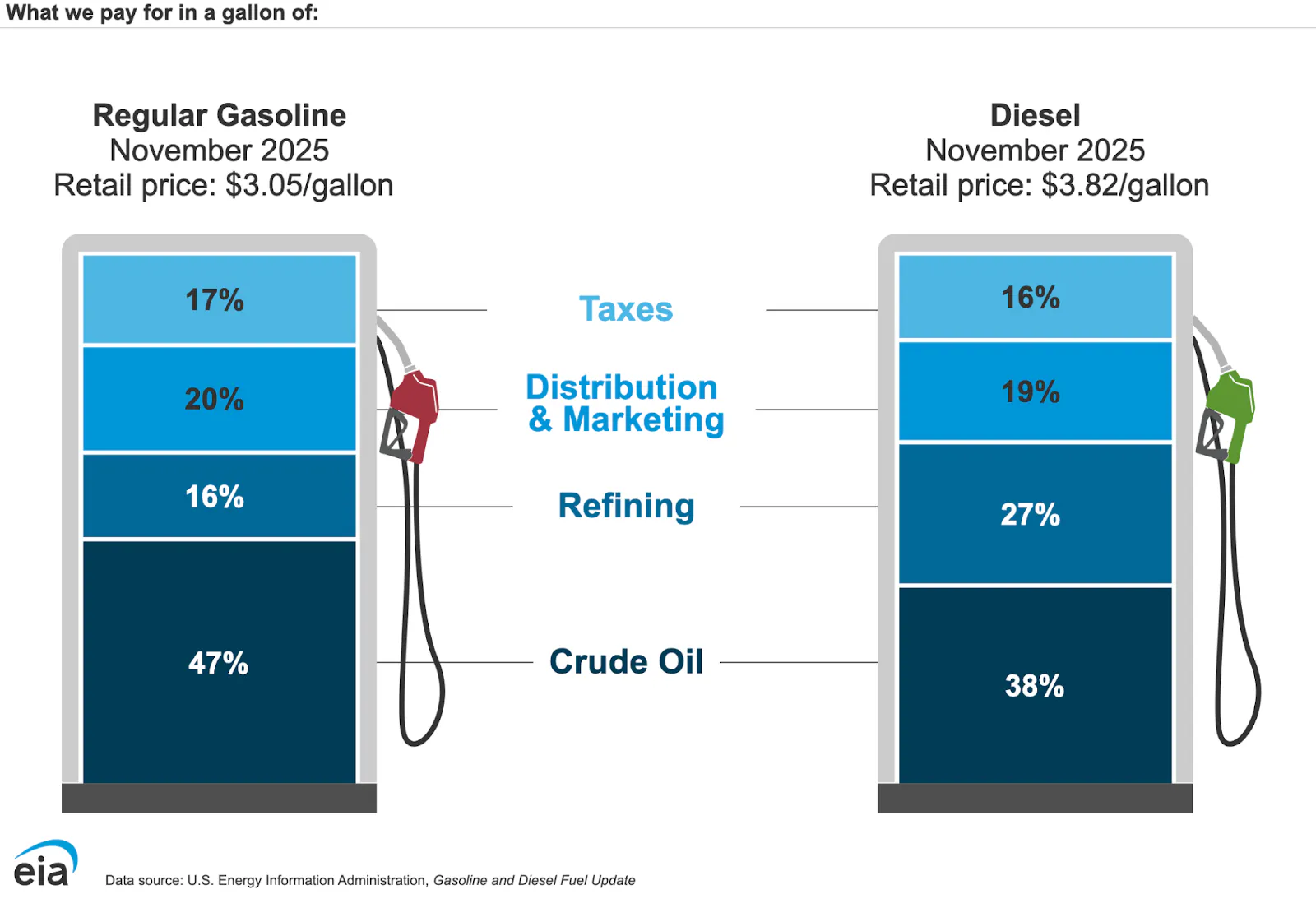
One thing to note about these figures and the minimum cost formula for feedstocks is that the cost is relatively insensitive to the cost of CO2, but highly sensitive to the cost of hydrogen. Doubling the cost of CO2 from 2¢ per kg to 4¢ per kg would raise the minimum cost of synthetic diesel by 20¢ per gallon. By contrast, doubling the cost of green hydrogen from $1.50 to $3.00 per kg would raise the minimum cost of diesel by $2.10 per gallon.
Cost of green hydrogen
The $1.50 / kg used above for the cost of green hydrogen is presently not realistic. It’s toward the low end of what was optimistically projected not many years ago by advocates of the hydrogen economy, but it has failed to materialize. The cost of green hydrogen has remained stubbornly high, at around $6.00 to $8.00 per kg without subsidies. That’s way too high to make carbon-neutral synthetic fuels economically competitive for the general market. It has also left plans for the hydrogen economy floundering. But what happened? Why is the cost so far above what was projected?
The short answer is that advocates underestimated the negative effects of hydrogen’s low volumetric energy density and the limited infrastructure for distribution and storage. They had expected that initial subsidies and the need to address climate change would stimulate the market enough to kick off a virtuous cycle of increasing production and declining costs. Wright’s Law of the experience curve would then take over. Subsidies could be lowered, and eventually dropped. The trouble was that even at subsidized prices, there wasn’t a big enough immediate market for green hydrogen to kick off a virtuous cycle. Also, the kind of developments needed to create a major drop in the cost of electrolysis weren’t the accumulation of small incremental gains that industrial learning curves typically bring about. What was needed were the kind of disruptive innovations of the sort that occasionally, unpredictably, emerge from university research labs.
So where does that leave carbon-neutral drop-in e-fuels? Just to start with, let’s ignore the capital cost and lifetime of electrolyzers, and consider only the cost of electricity. As a practical matter, it takes about 50 kWh to produce one kg of hydrogen by water electrolysis. If we want that kg of hydrogen to cost $1.50, then the cost of electricity must be no more than ($1.50 / kg) / (50 kwh) or 3.0¢ / kWh. Is that a feasible price?
3¢ / kWh is way below what we pay for power from the grid, but actually, for a dedicated (i.e, not grid connected) solar plus batteries facility in a good location, 3¢ / kWh probably is feasible. The same applies to dedicated wind power. There are some caveats, however.
The list below, taken from this web page, is the top ten list of lowest solar power prices in the world as of April 2021.
1.04¢/kWh – Saudi Arabia, 600 MW, announced April 2021
1.239¢/kWh – Saudi Arabia, 1.5 GW, announced April 2021
1.316¢/kWh – Portugal, % of 10 MW, announced August 2020
1.35¢/kWh – Abu Dhabi, 1.5 GW, announced April 2020
1.50¢/kWh – New Mexico, USA, 100 MW, announced May 2020
1.57¢/kWh – Qatar, 800 MW, announced January 2020
1.61¢/kWh – Saudi Arabia, 300 MW, announced April 2020
1.65¢/kWh – Portugal, 150 MW, announced July 2019
1.69¢/kWh – Dubai, 900 MW, announced December 2019
1.75¢/kWh – Brazil, 211 MW, announced July 2019
One of these is in the US (in New Mexico), two are in Portugal, one is in Brazil, and the other six are all in the Middle East. All of them come in significantly below 2¢ / kWh, with the lowest an astonishing 1.04 ¢ / kWh. There’s no detail given as to exactly what those prices include, but presumably it’s for “as available” DC power exported from the solar array. That would exclude the high power inverters, transmission lines, and other equipment needed to integrate the power into a national grid, However if the power is dedicated to production of green hydrogen for e-fuels, none of that is needed. What is needed is a lot of cheap, long-lived battery storage.
Battery storage is needed because, even if there are major price drops, electrolysis equipment for green hydrogen production will still be expensive. There is a cost for capital, and that makes it important to utilize expensive equipment at high capacity factors. With no energy storage, the CF for solar powered electrolysis would be less than 30% – even in prime solar regions like Saudi Arabia.
As for battery energy storage, the current state of the art is probably CATL’s Naxtra series of Sodium-ion batteries. CATL has projected a cost of USD $19 or less per kWh at the cell level, when the batteries are in high volume projection. They are now entering full scale commercial production for use in 2026, but have not yet reached high volume production. $19 / kWh at the cell level translates to $50 per kWh in shipped EV battery packs. The announced cycle lifetime to 80% of original capacity is 10,000 cycles. Round trip energy efficiency at slow charge and discharge rates is in the range of 90-95%. For a gigawatt scale plant dedicated to and optimized for green hydrogen production, a BESS module cost of $40 / kWh is plausible. The batteries will be fully cycled once per day; 10,000 cycles would take 27 years. In those 27 years, each kWh’s worth of original storage capacity would deliver 0.9 kWh average per cycle x 10,000 cycles, or 9,000 kWh total. The amortized equipment cost would be $40 / 9000, or 0.44¢ per kWh.
0.44¢ / kWh added to a 2.0¢ / kWh cost of power from the solar arrays gives 2.44¢ / kWh for steady DC power to the electrolyzers. That’s safely below the 3¢ / kWh we were shooting for to be able to make green hydrogen at $1.50 / kg. However, we have to recognize that it’s based on assumptions that might not hold. In particular, it’s based on amortization of a very large and costly BESS over an assumed 27-year lifespan at zero percent interest. If the actual cost of capital is even a modest 6.0% per year, that would more than double the added cost for buffering of electricity. It would rise to around 0.9¢ / kWh. That drives the net COE from the BESS from 2.44¢ per kWh to 2.9¢. Still under 3.0¢, but nibbling at the margins.
Strategic considerations
If the case for producing drop-in e-fuels as wholesale replacements for fuels refined from fossil resources were framed strictly in terms of a conventional business investment, it’s doubtful that it would get off the ground. The story would be quite different if the world were to come to its senses and price the cost of carbon emissions into the cost of oil, but as matters stand, the sad fact is that the projected ROI for production of carbon neutral e-fuels for the general market is too low to be of interest to the venture capital community at large.
That’s not the end of the story, however. There are strategic considerations that now weigh in favor of the transition. The fight against global warming is one, of course, but even if the world has given up on that, there are others.
A big strategic consideration is the desire of oil importing nations to reduce their exposure to global supply lines that are beginning to look shaky. The demonstrated willingness of the United States, under the Trump administration, to ignore longstanding international treaties and seize foreign oil tankers on the high seas has sent a chill through nations around the world. In what feels like an impending collapse of the old “rules based international order”, independence from oil imports suddenly looks very desirable. The material feedstocks for e-fuels are ubiquitous: just CO2 and water. The required energy for production of hydrogen is more problematic. Nations with high solar resource potential have access to cheap power from the sun. Nations with high offshore wind resource potential have access to cheap power from the wind. Nations with neither have the option of nuclear power, but that’s a long term prospect. In the near term, their option would be to import e-fuels from reliable partner nations that have sufficient cheap energy to support an e-fuels industry. At least the choices can be diversified and the supply lines kept shorter and more secure.
A related strategic consideration is the need to hedge against hyperinflation and financial chaos. Hyperinflation has happened enough times in the past that there is an established strategy for riding it out: invest in tangible assets that hold intrinsic value. Their valuation rises with inflation. Gold and other precious metals have been the classic safe havens, and we’ve certainly seen movement in those markets of late. A problem is that any large move to shift investments in that direction automatically drives up market prices. They become poor havens for late movers. An e-fuel production complex, on the other hand, is a tangible asset with intrinsic value, and a rise in demand for the capital equipment needed to build it will not produce a serious pricing bubble. (The capital equipment market for plant equipment is large and diverse.) Once finished, the plant will deliver a steady stream of a high value product with low marginal production cost. It should be a safe investment, even if the immediate ROI is low.
Opposition?
The fact that a change makes rational sense does not mean that it will happen. There will be opposition to the transition to e-fuels; it remains to be seen how much that opposition will impede the transition. Implementations will likely come first in nations with sound economic and geopolitical motivations to eliminate their dependence on imported fossil fuels. But if “big oil” were to perceive the transition as a major threat, it would probably be able to mount covert PR campaigns to foster opposition by green parties in Europe and elsewhere where the need to reduce carbon emissions is taken seriously. The ironic message would have to be “E-fuels are a conspiracy by Big Oil to keep the world running on gasoline and diesel and slow the transition to electric vehicles.” Big Oil would be exploiting green activists’ image of it as evil in order to dupe them into opposing something that they should properly support.
But what about the actual substance of that message? Isn’t it true that availability of drop in e-fuels would prolong the world’s reliance on gasoline and diesel fuel? Mightn’t it slow the transition to electric vehicles? Conceivably it could, but so what? That would be an argument against production of e-fuels only if one had already conflated means and ends. The end is reduction of global carbon emissions; electrification of transportation is a partial means toward that end, not the end itself. By eliminating net carbon emissions for sectors that are currently impossible or impractical to electrify, e-fuels can only help.
In practice, I doubt that production of e-fuels will have any real impact on progress toward electrification. EV’s are becoming more popular because they’re more efficient and ultimately cheaper. They use cheaper energy more efficiently, have fewer moving parts, and are more amenable to smart driving features that make driving safer and more comfortable. Meanwhile, electrification of carbon-intensive industrial processes like steel and cement production are being driven by cost and efficiency issues as much or more than by carbon abatement.
In the end, the relationship between e-fuels and green hydrogen will be more symbiotic than competitive. Production of e-fuels depends on green hydrogen; it will create an immediate market for electrolytic hydrogen that will drive the kind of cost reductions in electrolysis equipment that advocates of the hydrogen economy have sought in vain. E-fuels will not and cannot compete with hydrogen in applications where the use of hydrogen makes sense. (They do exist). E-fuels will prevail only in applications where hydrogen is impractical. Those will be applications where high volumetric energy density and ease of transport and storage are critical. I.e., the very applications where visions of the hydrogen economy have faltered.