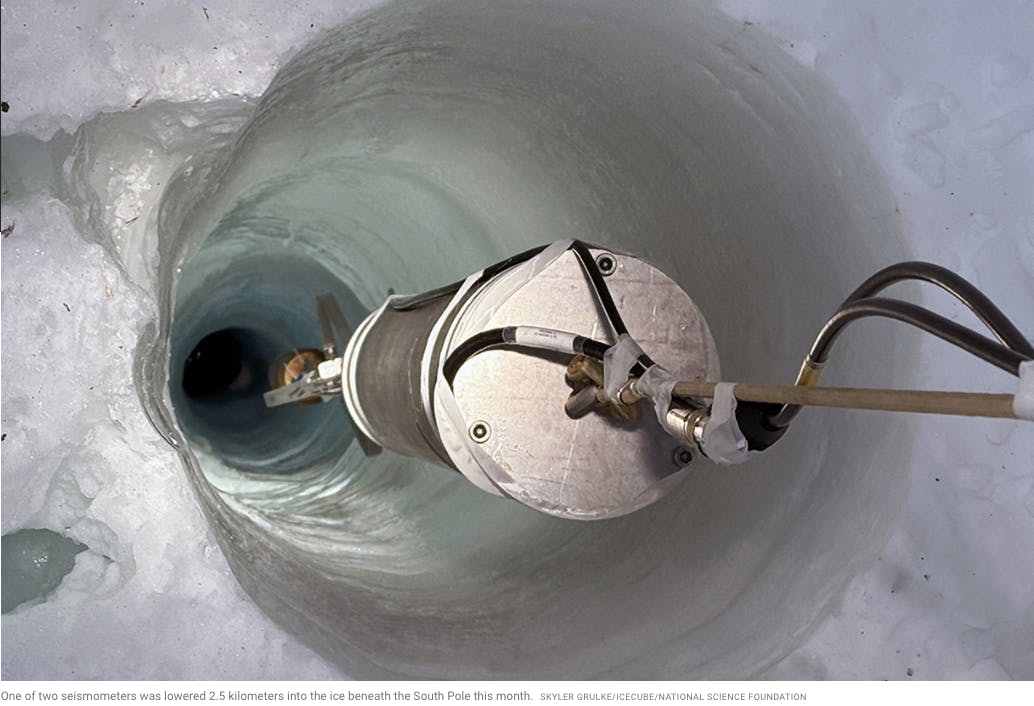
AAAS: “Earthquake sensors buried in the quietest spot on Earth.” In early January, researchers finished drilling two 2.5-km-deep holes in the South Pole’s ice using jetted hot water. “Once that water finishes freezing, it will trap two exquisitely sensitive seismic sensors in the quietest place on Earth, making them capable of detecting any earthquake in the world above magnitude 5.” The focus of the U.S. Geological Survey’s (USGS’s) $1 million Deep Ice Seismometer project, are already beginning to beam up signs of life. Since “there are just a few permanent seismic stations in Antarctica, the sensors will fill a critical gap in studies that examine the structure and composition of Earth’s mantle and core by looking for changes in how earthquakes travel through the planet.” Researchers also expect them to capture the creaks and groans of Antarctica’s ice sheet, which could improve knowledge about how fast it is slipping into the sea and contributing to sea level rise [SLR]—not to mention identify nuclear tests + meteorite impacts.
“Earth is a noisy place…ocean waves, wind, weather—even animal stampedes and vehicular traffic—all produce noise that seismologists must filter out.” Earth’s rotation, which distorts the long-period waves of seismic events and Earth’s background “hum,” is another problem. “Seismologists know of only one place that solves both issues: the South Pole, [which] is cold and quiet, far from any ocean, and lacks human infrastructure—as one of Earth’s poles, it also eliminates the rotational effects. “Canadian seismology company Nanometrics engineered the seismometers and helped design a special vessel to enclose them, crucial for withstanding high pressures and frigid temperatures, explains Geoffrey Bainbridge, Nanometrics’s lead seismometer designer.”
The seismometers will not come fully online until the entire water column freezes—but recall that water expands as it changes to solid phase. Will be ready in a month. Wonderful scientific collaboration.