AAAS: "To prevent forest fires, Trump wants to end a road-building ban. Scientists are skeptical," by Warren Cornwall.
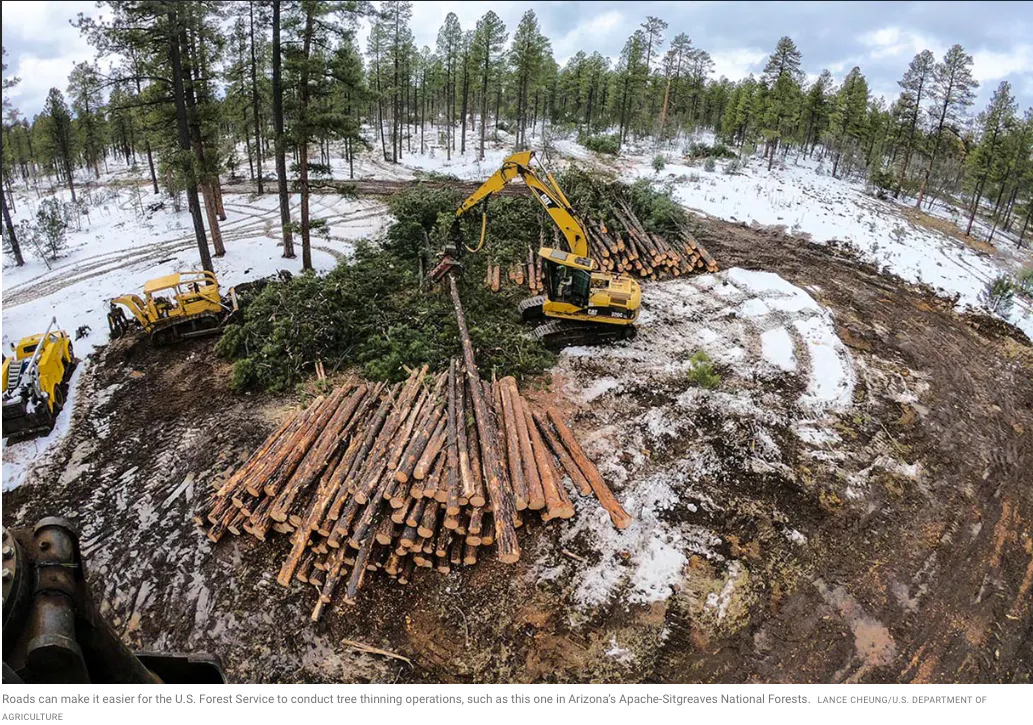
Administration claims decades-old “roadless rule” prevents efforts to improve forest health.
"It’s infuriating that the potential for reducing fire risk is even used as a justification for putting more roads into our national forests," says Jennifer Balch, a UC Boulder fire scientist. Balch’s work has shown that humans start 84% of all wildfires nationwide, + that roads are a major way people bring in matches, fireworks, + other spark-producing tools.
'The roadless area conservation rule banned road construction on more than 175,000 sq. km of roadless areas, nearly 1/4 of all national forest land. "Since then, it has been embroiled in a near-constant legal + political tug-of-war."
"In 2020, the first Trump administration rescinded the rule in Alaska’s Tongass National Forest, opening it to loggers." In 2021, Biden administration reversed that change. In 2026, the second Trump administration is going further + proposing to eliminate the rule nationwide. Public comments on the proposed change will be accepted through 21 September on a draft environmental impact statement, which spells out the science underpinning the proposed repeal.
USFS notes that > 29,000 sq. km of land lie within forests designated as high priority “firesheds”—places posing elevated wildfire risk to infrastructure + communities. In 2020, USFS ecologist Sean Healey published a paper in Environmental Research Letters reporting that from 1985 to 2016, national forest acreage burned at approximately same rate regardless of whether it was shielded from road construction.
"Alexandra Syphard, a wildfire scientist, began circulating a letter last month critiquing USFS’s environmental impact analysis." Some 30 prominent wildfire scientists added their names to the letter within days.
Scientists have also voiced concerns about the detrimental ecosystem impacts of roads, as conduits for invasive plants such as grasses—which raise fire risks—and that their construction can unleash more sediment pollution into nearby creeks and rivers. Areas subject to the roadless rule contain > 130,000 km of river + help protect watersheds supplying water to at least 25 M people, scientists reported this year in PLOS Water.