

Net Metering & Successor Methodologies: A Practical White Paper
Summary
As the name suggests, the Net metering is the net recording of energy generation and consumption by the same meter installed on the site. The net value is achieved by having a bi-directional meter at the site. Net Energy Metering (NEM) has accelerated distributed solar adoption by allowing customers to offset grid consumption with on-site generation and receive credits for exports. As distributed energy resources (DERs) scale, states are transitioning to successor designs—net billing with time- and location-varying export credits—aimed at aligning customer incentives with grid value while maintaining affordability and equity. This paper clarifies how NEM works, details credit-allocation methodologies (Cascade vs. Percentage) used in multi-account or community contexts, summarizes evolving U.S. policy, and offers actionable recommendations for utilities, regulators, and market participants.
1. Introduction
1.1 What is Net Metering?
Net metering ‘nets’ electricity imported from the grid against electricity exported from a customer's behind-the-meter renewable system over a billing period. A bi-directional meter measures both directions; some programs use separate meters for consumption and generation with billing netting. The concept extends to virtual/remote arrangements where credits from a Host facility are assigned to other accounts (beneficiaries/subscribers).
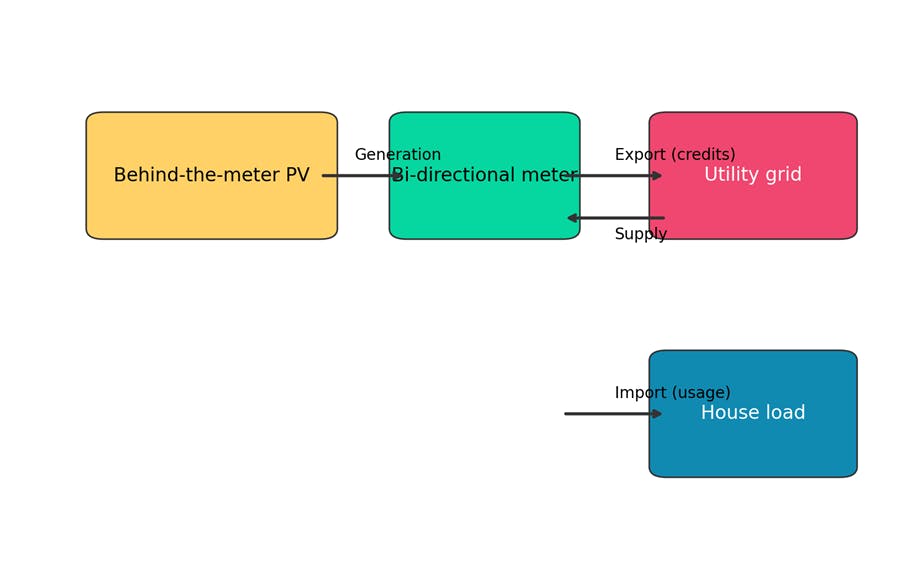
Figure 1: How net metering works with a bi-directional meter (import vs. export credits).
1.2 What is the reason behind its popularity?
Reducing carbon emissions has become a global imperative, driving governments to adopt policies that accelerate the transition to clean energy. Among the most effective mechanisms supporting this shift is Net Metering, which empowers consumers to generate renewable energy—typically through rooftop solar—and offset their grid consumption by exporting excess electricity back to the utility network. This approach not only reduces reliance on fossil fuels but also democratizes energy production, enabling households and businesses to actively participate in decarbonization efforts. Achieving these objectives requires a combination of robust regulatory frameworks, transparent crediting methodologies, and streamlined interconnection standards. Equally critical is public engagement: widespread adoption of Net Metering programs hinges on consumer awareness, economic incentives, and trust in fair compensation for distributed generation. Together, these elements form the foundation for scaling renewable energy and meeting national and international climate goals.
2. Governing Initiatives
2.1 Federal & State Jurisdiction
In the U.S., NEM is primarily a state jurisdictional retail program. FERC dismissed a 2020 petition seeking federal jurisdiction over NEM (NERA, Docket EL20-42), leaving retail netting to states; PURPA continues to shape avoided-cost concepts for buy-all/sell-all and qualifying facilities distinct from NEM.
3. Technical Overview
3.1 How NEM Works on the Grid
Behind-the-meter PV first serves on-site load; excess exports are credited per program rules. Credits may carry over month-to-month and ‘true-up’ annually. In some jurisdictions, the true-up method for retained credit on Host is usually less dollar per dollar. The rule discourages the retention credit for the Host and encourages them to distribute all generation and associated credits to its subscribers. For standalone generating units the rule does not apply.
3.2 Interconnection & Hosting Capacity
NEM and DER (Distribution Energy Resource) are two different methodologies for Net Metering credit distribution. In this Paper the focus is the NEM methodology. DER is an advanced version of Net Metering credit distribution. It is Safe, fast interconnection and transparent hosting capacity analyses enable rising DER levels while managing voltage, protection, and reverse power flow. Smart-inverter standards (e.g., IEEE 1547) and streamlined procedures are critical.
4. Net Metering Methodologies (Credit Allocation)
Multi-account crediting appears in virtual/remote net metering and community programs. We describe two practical methods observed in utility implementations: Cascade and Percentage allocation. These allocation methods can be used for kWh distribution which is called Volumetric Credit distribution or for actual generation credit distribution which is called Monetary Distribution.
4.1 Cascade Method
Credits are applied in a fixed order of subscribers each billing cycle until Host generation (kWh or $ value) is exhausted. Early-in-order accounts receive more predictable benefits; late-order accounts may receive none in low-generation months.
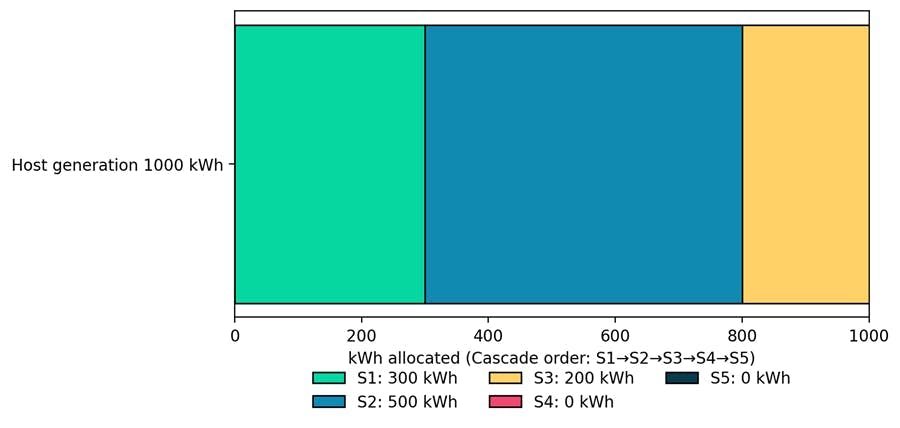
Figure 2: Cascade allocation example — 1,000 kWh distributed as S1=300, S2=500, S3=200, S4=0, S5=0.
4.2 Percentage Method
Each subscriber is assigned a percentage share (often informed by historical usage and Host production forecasts). Host generation is apportioned pro rata each month, ensuring all subscribers receive some credit.
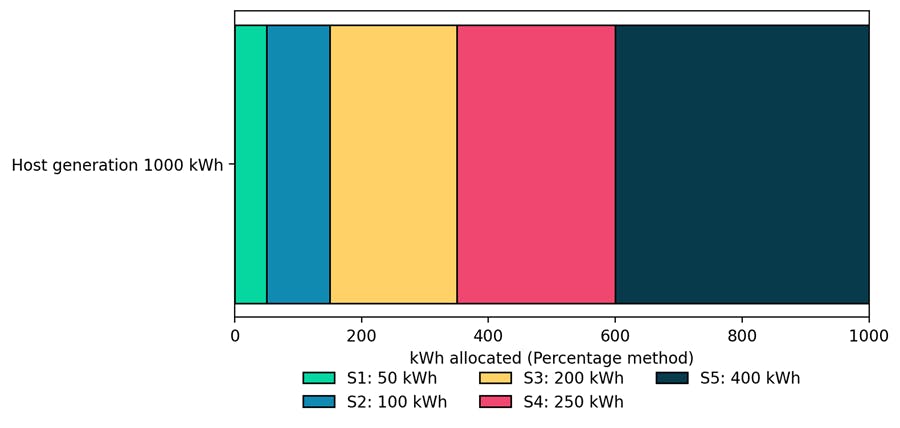
Figure 3: Percentage allocation example — shares of 5%, 10%, 20%, 25%, 40% applied to 1,000 kWh.
4.3 Allocation Method Comparison
Feature
Cascade
Percentage
Credit predictability
High for early-order; low for later-order
Moderate; proportional each month
Fairness perception
Lower for late-order subscribers
Higher; consistent shares
Administrative simplicity
Simple sequencing
Requires share management & analytics
Risk in low-generation months
High for late-order subscribers
Spread across all subscribers
Best use cases
Small subscriber sets; fixed priority
Community/virtual NM with many subscribers
5. Benefits, Challenges, and Economics
5.1 Customer Economics & Choice
By enrolling in these programs the subscribers start saving on their monthly electricity bills. Successor designs (net billing, time-varying export rates) still yield savings for customers, particularly when paired with batteries that shift exports to peak-value hours.
5.2 Societal & System Benefits
Studies have found net benefits from distributed solar under many conditions, including avoided energy and capacity, reduced losses, deferral of distribution investments, resilience, and emission reductions.
5.3 Rate Design & Cost Recovery (Debate)
Utilities highlight potential cost shifts if retail-rate credits under-collect fixed grid costs. Analyses differ by context; granular export valuation and minimum bills are tools to balance affordability and grid recovery.
6. Role of Data Analytics in Net Metering
6.1 Importance and Need of Data Analytics in Net Metering
Data Analytics plays a critical role in the planning, execution, and operational success of Net Metering systems. Net metering environments involve complex interactions between distributed energy resources (DERs) such as solar farms or wind plants, utility grids, and thousands of consumer accounts. Analytics helps transform large volumes of energy, weather, geographic, and consumption data into actionable insights.
6.1.1 Site Selection and Feasibility Analysis
One of the primary applications of Data Analytics in Net Metering is identifying optimal locations for installing solar farms or windmills. Analytics systems evaluate multiple parameters, including:
Historical weather patterns (solar irradiance, wind velocity)
Geographic and topographic data
Grid accessibility and load capacity
Regulatory and land‑use constraints
By correlating these datasets, utilities and energy developers can determine which regions are best suited for renewable installations, resulting in higher energy yield and reduced operational risk.
6.1.2 Financial Planning and Investment Analysis
Data Analytics is essential for conducting financial feasibility studies and long‑term planning. Using historical production data and projected consumption trends, analytics models can estimate:
Time required to reach the breakeven point
Expected return on investment (ROI)
Impact of tariffs, incentives, and policy changes
Sensitivity analysis for variable factors such as weather or demand growth
These insights enable stakeholders to make data‑driven investment decisions while minimizing financial uncertainty.
6.1.3 Energy Production Forecasting and Demand Matching
Advanced analytics helps forecast energy generation from renewable sources and match it with consumer demand. Predictive models use historical usage trends, seasonal patterns, and real‑time data to ensure:
Efficient utilization of generated energy
Reduced dependency on conventional power sources
Improved grid stability
This becomes especially important in net metering scenarios where surplus energy is fed back into the grid.
6.1.4 Credit Allocation to Subscriber Accounts
In community solar or shared renewable models, a single solar farm may distribute energy credits across hundreds or thousands of satellite subscriber accounts. Data Analytics enables:
Dynamic allocation of energy credits
Percentage‑based distribution based on subscriber type (residential, commercial, industrial)
Adjustment based on individual monthly energy consumption
Fair and transparent billing reconciliation
This ensures compliance with regulatory guidelines while maintaining subscriber satisfaction and financial accuracy.
6.1.5 Operational Monitoring and Performance Optimization
Analytics dashboards provide continuous visibility into:
Energy generation and consumption trends
System performance and equipment health
Fault detection and anomaly identification
Real‑time and historical analysis helps operators proactively address inefficiencies, ensuring optimal performance of renewable assets throughout their lifecycle.
6.2 Data Analytics Tools Used in Net Metering
The choice of data analytics tools depends on the cloud platform, scalability requirements, and integration needs of the organization. Below are commonly used analytics tools categorized by cloud ecosystem.
6.2.1 Microsoft Azure‑Based Analytics Tools
Microsoft Azure provides a comprehensive analytics ecosystem suitable for large‑scale net metering implementations.
Azure Synapse Analytics
Combines data warehousing and big‑data analytics to support complex analytical queries on energy and consumption datasets.
Azure Data Factory (ADF)
Enables robust ETL/ELT pipelines to ingest data from smart meters, IoT devices, weather services, and external systems.
Azure Databricks
Supports large‑scale data processing using Apache Spark for advanced analytics, forecasting, and machine learning models.
Azure Data Lake Storage Gen2
Acts as a centralized, scalable data repository for structured and unstructured energy data.
Power BI (Cloud Service)
Provides semantic models, interactive dashboards, regulatory reporting, and role‑based data access for stakeholders.
Microsoft Fabric
An end‑to‑end SaaS analytics platform integrating data engineering, lakehouse architecture, real‑time analytics, and BI using OneLake.
6.2.2 AWS‑Based Analytics Tools
Amazon Web Services offers flexible and scalable analytics services for net metering systems.
Amazon Redshift (including Serverless)
High‑performance data warehousing for large analytical workloads.
AWS Glue
Handles data integration, ETL processing, and metadata management via the Data Catalog.
Amazon Athena
Enables serverless querying of data stored in Amazon S3 without infrastructure management.
Amazon EMR
Used for big‑data processing and advanced analytics with Spark and Hadoop.
Amazon QuickSight
Cloud‑native BI service for dashboards, reporting, and ad‑hoc analysis.
6.2.3 Google Cloud Platform (GCP) Analytics Tools
GCP provides highly optimized analytics tools for energy data processing.
BigQuery
A serverless data warehouse and analytics engine capable of handling massive datasets efficiently.
Dataflow
Supports real‑time and batch data processing for meter data streams.
Dataproc
Managed Spark and Hadoop service for large‑scale data processing.
Looker / Looker Studio
Offers interactive visualization, semantic modeling, and embedded analytics.
BigQuery Cost Control Features
Enable workload management and cost optimization for large analytical queries.
6.2.4 Snowflake with Power BI Integration
Snowflake serves as a cloud‑agnostic data analytics platform that integrates seamlessly with multiple BI tools.
Snowflake
Acts as a centralized analytics engine for structured and semi‑structured net metering data, offering scalable compute, high‑performance SQL, and secure data sharing.
Power BI
Used for visualization, reporting, and analytics consumption, enabling stakeholders to gain actionable insights from Snowflake data.
This combination supports enterprise‑grade analytics, multi‑cloud deployments, and enhanced governance for net metering use cases.
