


A✌️462-word✌️2.5-minute✌️read
I first wrote about the idea of installing solar over canals over a year ago. Though not a fan of solar, putting the technology in places where no other option exists makes sense. That includes rooftops, canopies, and yes, possibly above canals.
Last July I wrote about the Casa Blanca project in Arizona. The 1.3 MW half-mile pilot, completed in October 2024, is supplying power to the Gila River Indian Community.
Not to be outdone, California has followed suit. It’s Central Valley-based 5 MW Project Nexus recently went live.
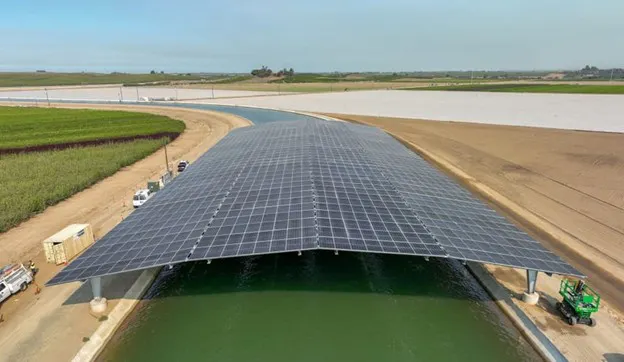
There are only a handful of such canal-covering projects in the world. The first ever one was completed in India in 2012. Not surprisingly, China has also toyed with the idea.
The California project is the second of its kind in the U.S. Given California has almost 4,000 miles of public water delivery canals, the state is no doubt dreaming of the potential to transform that real estate into a dual-use resource.
There’s just one small problem: the cost.
The Arizona project cost $5.65 million. The funds were provided by the U.S. Bureau of Reclamation through the Inflation Reduction Act, which at the time, allocated $25 million for canal-covering solar projects.
As for California, nothing comes cheap. The Nexus Project cost a staggering $20 million.
Let’s do the math.
At $20 million to build a 1.6-mile project, covering 4,000 miles of canals would cost in the neighborhood of $50 billion. Theoretically, the effort would produce around 12.5 gigawatts of power. That prices out at $4/watt. The Arizona project was slightly more expensive at $4.36 per watt.
Even if you believe canal project costs could be cut in half, it still comes to $2/watt. Utility-scale solar typically costs around $0.90 to $1.50 per watt.
However, there are some perks that come with that premium price.
Canal-covering systems provide the added advantage of reducing water evaporation. In areas where water is scarce, that’s a nice bonus.
The other benefit is that due to the natural cooling effects of the water, panel efficiency increases. The project in India saw output improve by 2.5 to 5%. The other output advantage is that panel performance didn’t appear to degrade over time. Typically, solar panels lose about 1% of their output per year.
These are nice value-adds, but the cost of building such systems isn’t likely to ever be competitive. Canal systems are basically massive canopy systems which require huge amounts of steel. And building systems over canals presents numerous additional construction challenges.
I give the project developers and “E” for effort and a “A” for creativity. However, they get an “F” for resource utilization.
As clever as the idea may be, the world cannot afford to allocate such significant financial resources to produce such little power.
#climatechange #solarpower #renewables #canalsolar