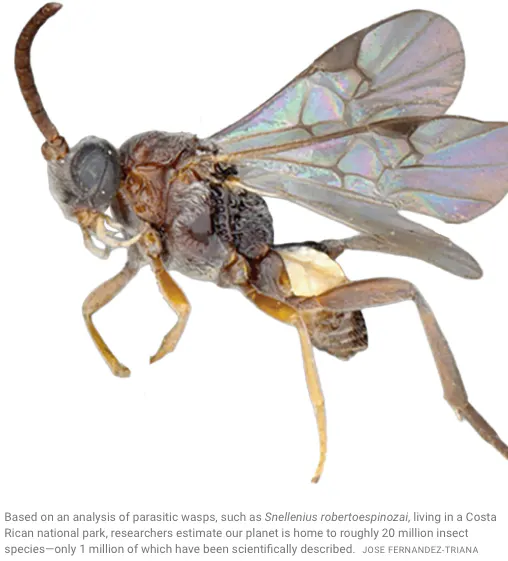
AAAS: "Scientists have only discovered a tiny fraction of living insect species."
From half-meter-long moths to fairy wasps smaller than sand grains, insects come in a stunning variety of shapes and sizes and constitute the most diverse animal group on Earth. "But the insect species discovered so far may represent just a fraction of the total crawling, flying, and burrowing around the planet, according to a new study published today in the Proceedings of the National Academy of Sciences." Using statistical methods borrowed from epidemiologists, a team of entomologists estimates there may be as many as 20 million insect species on our planet—more than three times the previous estimate.
"Over the past 3 centuries, biologists have described about 1 million insect species, but finding and describing them all would be a daunting—if not impossible—task." However, a subfamily of parasitoid wasps known as Microgastrinae, which infamously lay their eggs inside living caterpillars, are extremely well-studied. "Over the past several years, scientists conducting surveys of flying insects in the park have identified 388 species of Microgastrinae."
Independently, when scientists surveyed caterpillars that had been parasitized within the park, they identified only 889 wasp species. With almost no overlap, the mismatch between the 2 studies allowed a statistical estimate of a whopping 2394 Microgastrinae species. Applying this as a multiple to all 53,945 known insect species within Guanacaste suggests the park is actually home to 332,846 insect species, most of which have gone unobserved.
"The researchers then scaled this number globally using another diverse group of organisms: trees...[with] 1200 [to] 1500 tree species within Guanacaste and about 73,000 on Earth, meaning the park contains between 1.6% and 2.1% of global tree diversity." If the same percentage holds true for insects, then there’s anywhere between 13.3 million and 24.7 million insect species on Earth, with a safe middle-of-the-road estimate of 20.3 million species.
While you may think this epidemiological calculation represents biodiversity run riot, recall that many insect species are in decline from pesticides + habitat loss + climate change. Do not be sanguine.