


Energy production via hydrotreated vegetable oil (HVO) is essential to reducing the impacts of electric energy production on climate change. HVO is a renewable substitute for diesel fuel produced by treating waste vegetable oils, plant-based oils, and animal fats with hydrogen gas at high temperatures and pressures. The primary advantage is reduced carbon dioxide (CO2) production compared to burning other fuel sources. When the goal is optimizing CO2 emissions, HVO can be used in tandem with a variety of other energy production sources to significantly reduce the CO2 emissions of today while still meeting peak electricity demands.
HVO production provides the opportunity for cross-industry collaboration and repurposing of old infrastructure, which will also increase employment opportunities that cannot be replaced with AI. Another benefit of HVO is optimized long term energy storage, which will reduce the number of new solar panels, wind turbine generators, and storage batteries that are needed.
This article outlines the benefits of implementing hydrotreated vegetable oil into the United States’ energy production portfolio so that future energy needs can be met while reducing the CO2 emissions of today.
CO2 Emissions and Energy Production by Source
CO2 emissions vary with the technology used to produce energy. When burned, waste-based HVO produces a small amount per KWH (kilowatt hour). Plant-based HVO produces more CO2 emissions per KWH, but less than other fuels. Coal produces far more CO2 emissions than any other fuel.
CO2 emissions per KWH are listed in Table 1 for a variety of energy production sources. Values for solar panels, wind turbines, etc., include emissions during manufacture, installation, transportation, and maintenance.
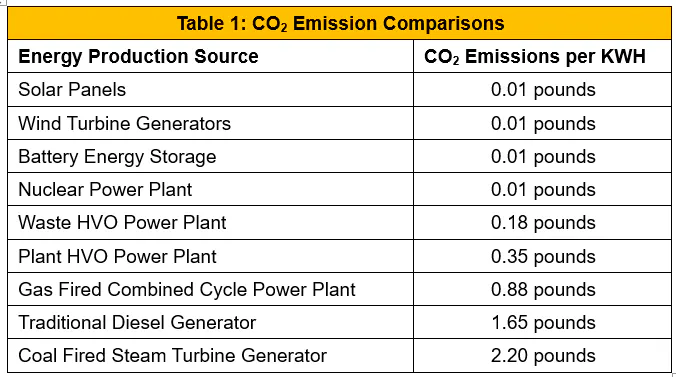
Table with a yellow header lists CO2 emissions per KWH a for a variety of energy production sources, including solar panels, wind turbines, nuclear, HVO, and several fossil fuels.
Optimizing Energy Production and CO2 Emissions
Electric utilities build systems to supply energy to every consumer during peak load conditions. Traditionally, the energy production sources listed in Table 1 were operated on a least cost basis. However, when considering the impact of electric energy production on CO2 emissions, other factors besides cost must be considered.
To reduce emissions, a variety of alternate energy production strategies can be used. Traditional CO2 emissions can mostly be attributed to the burning of fossil fuels for energy production. Energy production designed to produce minimal CO2 emissions would exclude gas and HVO production, relying primarily on solar, wind, and storage batteries. Optimized CO2 emissions, the ideal strategy for energy production, includes energy from all sources, at amounts that will limit CO2 emissions while producing enough energy to meet peak load demands. Three examples are illustrated in Table 2 for a grid with a peak load of 44,000 MW (megawatts). When emission goals are optimized, the quantity of energy production facilities can be similarly honed.
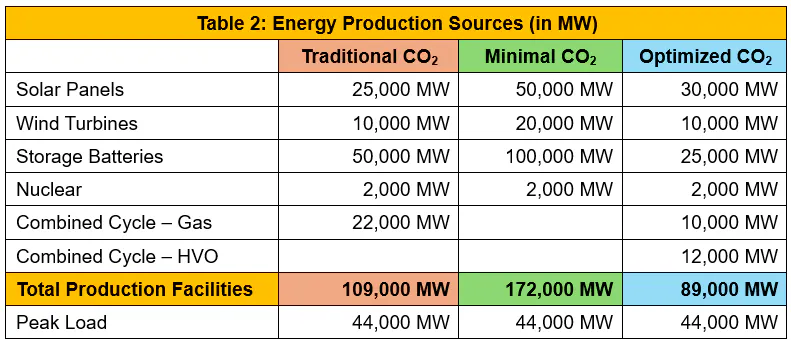
Table with a yellow header and color coded columns outlining the megawatt hours produced via traditional CO2 emission standards (red), minimal CO2 standards (green), and optimized CO2 standards (blue).
As solar panels and wind turbine generators are intermittent production sources, energy must be stored for use during nighttime and during low wind hours. When batteries are used to store energy, additional solar panels and wind turbine generators are needed to recharge batteries. Prescient’s analysis reveals that twice as many of energy production facilities (172,000 MW) are needed to supply 825,000 MWH of energy on a peak load day when emissions are minimized, while only 89,000 MW of energy production facilities are needed when emissions are optimized.
Daily CO2 Emissions
Calculating daily CO2 emissions is challenging because both emissions and energy consumption vary continuously. A good estimate can be developed by multiplying hourly KWH consumption and hourly CO2 emissions and adding the totals. The results of these calculations are presented in Table 3 for a peak load day in August and in Table 4 for a low load day in April. Table 4 includes a line item titled “Uncaptured Renewables,” which is the renewable energy that could be produced in April and stored for future use.
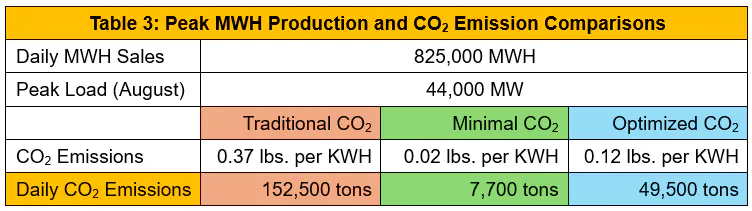
Table with a yellow header and color coded columns comparing peak megawatt hour production and CO2 emissions for traditional CO2 emission standards (red), minimal CO2 standards (green), and optimized CO2 standards (blue).
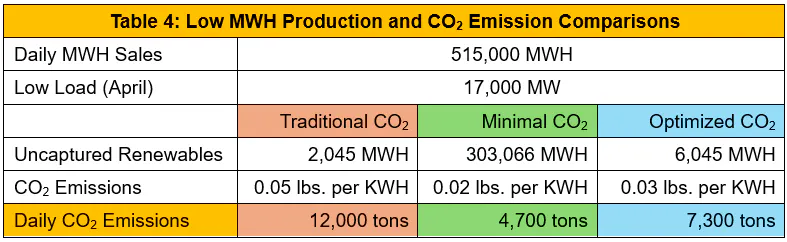
Table with a yellow header and color coded columns comparing low megawatt hour production and CO2 emissions for traditional CO2 emission standards (red), minimal CO2 standards (green), and optimized CO2 standards (blue).
On a yearly basis, HVO can reduce CO2 emissions by 66%, while relying on solar, wind, and batteries can reduce CO2 emissions by 94%. The tradeoff is that relying on solar, wind, and batteries will require many new transmission lines, substations, and other investments in the electric energy grid, while HVO requires minimal new investments.
Meeting Peak Electric Demand with Optimized CO2 Emissions
Coincident peak electricity demand for the contiguous United States reached a high of 759,180 MW on July 29, 2025. To meet this peak demand with a goal of optimized CO2 emissions, the number of energy production facilities can be significantly reduced when compared to those needed for minimal CO2 emissions. This is illustrated in Table 5.
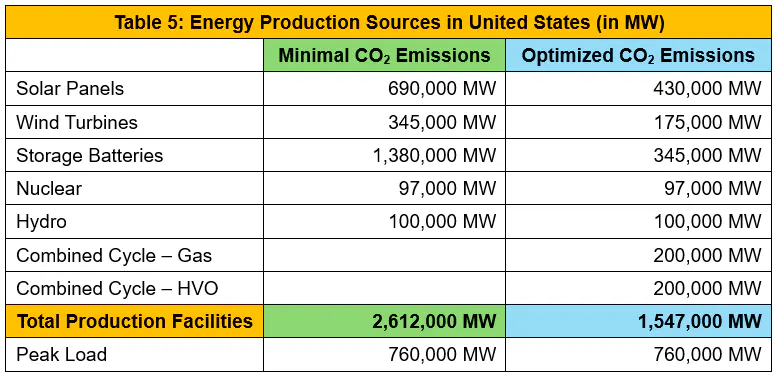
Table with a yellow header and color coded columns describes energy production in megawatts for minimal CO2 standards (green) and optimized CO2 standards (blue).
However, there is concern that the amount of HVO needed for optimized CO2 emissions is equal to 450% of the vegetable oil that would be produced by crushing the entire 2024 harvest, outlined below. Increasing yields, for example, from 50 bushels of soybeans to 75 bushels per acre, or doubling the acreage that is planted, will be needed to achieve the optimized emission goals. In addition, plant-based HVO can be supplemented with green diesel produced using animal tallow, and methane from regional landfills and cow manure digesters.
HVO Provides Cross-Industry Collaboration Opportunities
HVO production creates a new market for vegetable oil, which benefits farmers. In 2024, farmers in the United States produced 4.4 billion bushels of soybeans, 3.5 million tons of peanuts, 14.9 billion bushels of corn, and 4.8 billion pounds of canola. When crushed, 50% of the soybeans, peanuts, corn, and canola that were grown in 2024 could be converted to HVO and used to optimize CO2 emissions as outlined in Table 2.
New facilities will be needed for the production and storage of HVO. Tradespeople will benefit by constructing, operating, and maintaining mills, dry storage facilities, and oil storage facilities.
The repurposing of existing facilities will also provide construction and maintenance opportunities. For example, mills in Kansas and Nebraska can provide fuel for repurposed energy production facilities in Pennsylvania and Wyoming. Existing farm and rail facilities can be repurposed for creating and transporting HVO. The associated employment opportunities will require a human workforce, and therefore cannot be replaced by AI.
HVO As Energy Storage
When used for energy storage, HVO reduces the number of needed storage batteries. As most batteries are charged by solar panels, this also reduces the need for new solar panel installations. When used during a power outage as backup fuel, HVO is a more climate-friendly option than diesel and a more reliable option than solar powered batteries.
Solar panels will still be an important piece of the puzzle when optimizing CO2 emissions. However, when fewer new solar installations are needed to charge batteries, mining for lithium and other rare earth minerals can be reduced.
HVO Benefits Electric Utilities and the Climate
Hydrotreated vegetable oil is a more sustainable option for energy production than burning fossil fuels. When used in tandem with clean energy sources, HVO can provide more than enough energy for peak load days while significantly reducing CO2 emissions associated with energy production.
In addition, electric utilities will benefit as the need for new, costly, high voltage electric transmission lines will be significantly reduced. Consumers also benefit, as infrastructure costs are often passed on as rate increases. Development of new right of ways for transmission lines and pipelines will also be reduced, which reduces the need for deforestation.
In the race to reduce the most severe impacts of global climate change, HVO is a smart energy production opportunity across multiple industries.
Author’s Note:
Prescient’s team of subject matter experts independently researched electric utility load and operational data, marginal cost data; CO2 emissions, environmental factors (sunrise and sunset times, cloudiness, and wind speeds), harvest data, etc. and developed models that lead to the conclusions presented in this document.