


When discussing BESS safety, most attention is given to thermal runaway, fire suppression, flammable gas management, and explosion venting. Humidity and condensation, however, are often viewed as reliability concerns rather than safety-related issues.
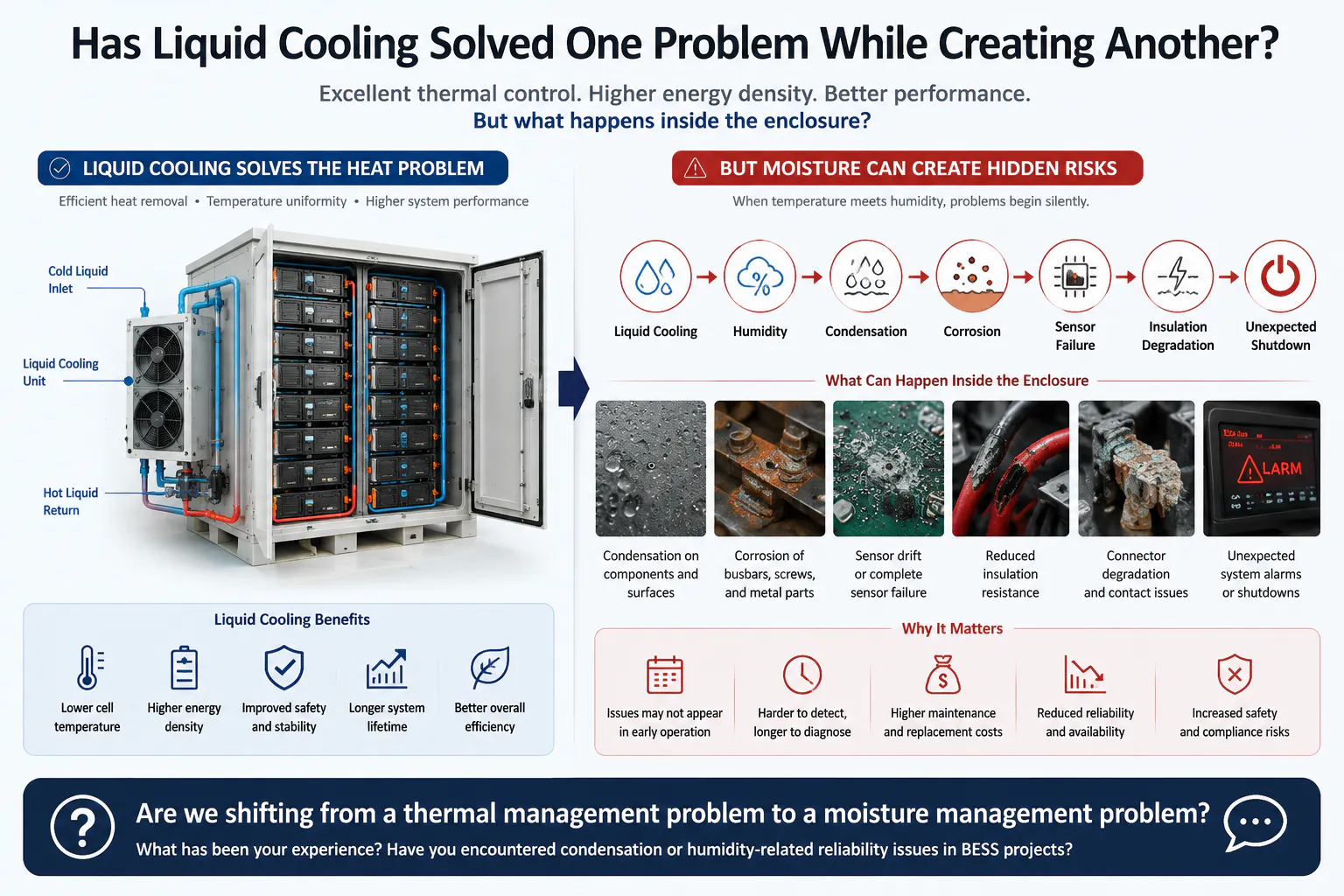
In reality, humidity itself does not directly cause a BESS explosion. An explosion typically occurs when flammable gases released during thermal runaway accumulate within an enclosure and are subsequently ignited by an ignition source.
From an engineering perspective, however, humidity and condensation can act as important risk amplifiers within the failure chain.
When enclosure humidity is high, or when equipment surfaces fall below the dew point due to ambient temperature fluctuations or operating conditions, condensation may form on busbars, electrical terminals, connectors, PCBs, and other critical components. This can reduce insulation resistance, increase leakage current, accelerate corrosion, and, under certain conditions, contribute to electrical arcing or short circuits.
While these mechanisms do not necessarily initiate thermal runaway, they can increase the likelihood of electrical failures that may eventually escalate into more serious safety events.
The risk progression can therefore be more accurately described as:
Humidity → Condensation → Electrical Degradation → Electrical Fault → Thermal Runaway → Flammable Gas Release → Ignition
For this reason, humidity management should not be considered solely a reliability issue. It is an important part of reducing the probability that an electrical fault will develop into a major safety incident.
As BESS continues to evolve toward higher energy densities, larger system capacities, and deployment in increasingly challenging environments, humidity management, dew point control, ventilation, gas detection, explosion venting, and thermal management should be treated as interconnected elements of an integrated safety strategy rather than independent design considerations.
#QuestionForGroup
I'm interested in hearing the community's perspective:
Do your BESS projects continuously monitor enclosure humidity or dew point? Or is moisture management still primarily addressed through HVAC system design?
#BESS #BatteryEnergyStorage #BatterySafety #ThermalRunaway #HumidityControl #Condensation #ElectricalEngineering #EnergyStorage