Introduction: Why Your Electricity Bill Is So High
For most industrial facilities in India, a troubling reality hides in plain sight: demand charges account for 25% of monthly electricity bills, depending on sector and location. Yet most facility managers focus exclusively on reducing consumption—a strategy that addresses only a fraction of the problem.
Here's why demand charges are so punishing: utilities don't charge you for how much electricity you consume. They charge you for the highest 15-minute power peak your facility draws in any billing period—regardless of whether that spike lasts seconds or hours.
A manufacturing plant consuming 500 kW on average but spiking to 1,500 kW for 20 minutes during equipment startup pays demand charges on 1,500 kW for the entire month. At typical rates of ₹200-₹1,500 per kW (varying by region and utility), that single peak can cost facilities ₹30,000 to ₹2.25 million monthly in demand charges alone—before accounting for base energy consumption.
Enter Battery Energy Storage Systems (BESS)—a proven, financially sound technology that flattens these peaks and recovers 30% of demand charges while simultaneously exploiting time-of-use pricing arbitrage. (Source)
This isn't theoretical. Across India, from cement manufacturers to data centers to hospitals, organizations are deploying BESS and realizing payback periods of 3-5 years. The economics are now undeniable.
Part 1: Understanding Demand Charges—Why Your Bill Looks Like This
The Mechanics of Demand Charges
Demand charges exist because utilities must maintain generation and transmission infrastructure capable of serving your facility's peak consumption. Whether you spike once monthly or continuously, the utility has invested in that infrastructure.
The formula is straightforward:
Maximum Demand (kW) × Demand Charge Rate (₹/kW) × 12 months = Annual Demand Charge Cost
Example from Delhi: A commercial facility with 100 kW peak demand at ₹450/kW/month pays ₹45,000 monthly in demand charges—₹540,000 annually—before consuming a single unit of additional electricity beyond the demand charge threshold.
The Problem: Demand Charges Are Inelastic
Unlike energy charges, which you can theoretically reduce by consuming less, demand charges penalize maximum usage, not average usage. This creates a counter intuitive problem: operational peaks caused by:
Equipment startup cycles
HVAC cooling loads during afternoon peaks
Simultaneous machinery operation
Shift changes
EV charging surges at data centers
...all contribute to a monthly demand charge that persists regardless of whether those peaks are daily occurrences or one-time spikes.
Result: A facility operating efficiently can still face massive demand charges due to unpredictable operational patterns.
Part 2: Introducing BESS—The Revenue Stream
Battery Energy Storage Systems tackle demand charges through three interconnected mechanisms:
Revenue Stream : Peak Shaving
How it works:
During off-peak hours (typically 11 PM - 6 AM), BESS charges from the grid at lower rates
Real-time monitoring identifies predictable peak demand windows
As the facility's consumption approaches its monthly peak threshold, BESS discharges stored energy
The facility's grid consumption is "capped"—it draws from BESS instead of the grid during vulnerable peak moments
Monthly demand charge is calculated on the shaved peak, not the original spike
Quantified Result:
A 1 MW manufacturing facility in Kearny Mesa, San Diego deployed a 1 MW / 4 MWh BESS system in 2019. Peak shaving alone delivered $554,000 in cumulative savings over five years—averaging $110,800 annually in demand charge reduction. This facility's peak consumption was predictable (equipment startup and HVAC cycling), making it ideal for peak shaving. (Source)
An Ontario-based facility with a 500 kW / 1,000 kWh system reduced coincident peak charges by $94,600 annually. (Source)
Why Peak Shaving Works:
Your operational schedule remains unchanged
BESS borrows power during peak windows, repaying during cheap hours
The facility operates identically; the utility bill shrinks
Payback period typically 3-5 years for facilities with demand charges exceeding ₹500,000 monthly
Part 2: Sector-Specific Economics
Manufacturing (Textiles, Steel, Chemicals)
Peak drivers: Equipment cycling, process startup, shift transitions
Typical monthly demand charges: ₹5,00,000 - ₹20,00,000
BESS deployment size: 250-500 kWh
Average payback: 3-4 years
Why they benefit: Manufacturing peaks are often predictable. A textile mill knows when looms power up; a steel facility knows when furnaces restart. BESS anticipates these peaks and shaves them systematically.
Data Centers
Peak drivers: Cooling loads during afternoon/evening, simultaneous rack activation
Typical monthly demand charges: ₹10,00,000 - ₹50,00,000
BESS deployment size: 500 kWh - 2 MWh
Average payback: 2-3 years
Why they benefit: Data centers operate 24/7 with extreme, predictable cooling loads. Peak afternoon cooling demands are relentless. BESS provides both demand charge savings and operational redundancy. (Source)
Hospitals & Healthcare
Peak drivers: HVAC, surgical suites, diagnostic equipment, sterilization
Unique advantage: Backup power = operational continuity (avoided downtime >> energy savings)
BESS deployment size: 250-500 kWh
Average payback: 3-5 years
Why they benefit: Hospitals have critical backup requirements. BESS satisfies this mandatory need while delivering energy arbitrage savings—effectively monetizing backup power. (Source)
EV Charging Infrastructure
Peak drivers: Simultaneous rapid charging sessions
Challenge: Ultra-high power demand in short windows
Advantage: BESS prevents grid strain charges and avoids costly infrastructure upgrades
BESS deployment size: 500 kWh - 2 MWh
Average payback: 3-4 years
Part 5: Implementation Framework—From Audit to Optimization
Successful BESS deployment follows a structured process:
Step 1: Load Profile Audit (4-6 weeks)
Install temporary metering to capture 15-minute interval consumption data for 30-90 days
Identify peak demand windows (timing and magnitude)
Map current demand charges as a % of total electricity bill
Document Time-of-Use rate structure from utility bill
Target: Facilities where demand charges exceed 30% of bills see fastest ROI
Step 2: Right-Sizing Calculation (2-3 weeks)
System capacity should cover 60-80% of peak demand, not 100%
Over-sizing increases costs without proportional benefit
Optimal system captures 60-70% peak shaving opportunity while staying cost-effective
Formula: Target capacity = (Monthly peak - 0.25 × average load) × 0.70
Step 3: Energy Management Software Deployment (4-8 weeks)
Real-time monitoring dashboard
Predictive algorithms identify demand patterns 24-48 hours ahead
Automatic charge/discharge optimization
Integration with utility ToU pricing schedules
Demand response capability for grid participation
Step 4: Continuous Monitoring & Optimization (ongoing)
Real-time monitoring ensures peak shaving algorithms perform as modeled
Quarterly reviews identify shifting opportunities
Software updates capture new arbitrage strategies
Annual audits validate ROI assumptions
Part 6: India-Specific Market Tailwinds
India's BESS market is experiencing unprecedented tailwinds:
Policy Support
Storage Obligation: National Framework mandates 4% storage by 2029-30 (Source)
VGF Support: ₹54,000 crore viability gap financing for 30 GWh capacity (Source)
ISTS Charge Waivers: Waived transmission charges for energy storage (Source)
Market Dynamics
CEA Projection: India will need 74 GW / 411 GWh capacity by 2032 (vs. 111 MW currently) (Source)
Utility Investments: Power Grid allocating ₹2,00,000 crore for transmission infrastructure (Source)
Corporate Adoption: Major players like Adani Green Energy, Waaree Energies, and Sterling & Wilson now deploying BESS alongside renewables (Source)
Cost Trajectory
Battery cell costs falling from ₹95/kWh (FY2025) to ₹68/kWh (FY2030) (Source)
Lithium-ion pack costs down 80% in one decade—continuing downward trend (Source)
Merchant BESS achieving 17% IRR in 2025—highest historical level (Source)
Emerging Revenue Streams
Day-ahead market (DAM) price volatility creating merchant BESS arbitrage opportunities
Frequency regulation and voltage support contracts from utilities
Demand response program participation
Grid services integration
Part 7: Beyond Cost Savings—Secondary Benefits
While ROI justifies BESS investment, secondary benefits often exceed direct cost savings:
1. Operational Resilience
During India's frequent load-shedding and grid instability events, BESS provides seamless backup power:
No switchover time (vs. 30-60 seconds for diesel generators)
No fuel logistics or storage requirements
Automatic activation during grid sags or frequency drops
Estimated avoided downtime cost: ₹10-25 lakh per incident for energy-intensive facilities
2. Regulatory Compliance
GRAP (Graded Response Action Plan): DG restrictions during high pollution eliminate generator-based backup; BESS becomes mandatory
ESG Requirements: Replacing diesel with BESS aligns with Scope 2 emissions reduction targets
Government contracts: Renewable energy requirements often include BESS penalties for non-compliance
3. Equipment Protection
Superior power quality eliminates voltage fluctuations that damage sensitive equipment
Reduces production defects caused by power quality issues
Eliminates harmonics and transients
Protects diagnostic equipment in hospitals, manufacturing controls, data center hardware
4. Sustainability Positioning
Demonstrates Net Zero commitment to stakeholders, investors, customers
Supports corporate renewable energy goals (24/7 clean power certification)
Reduces reliance on grid's fossil fuel-heavy evening peak hours
Conclusion: The Time Window Is Now
Battery costs continue their downward trajectory, but your electricity tariffs are rising. According to the Central Electricity Authority, India's power consumption is growing at 9% annually—exceeding supply growth. This demand-supply gap widens ToU pricing spreads, making the arbitrage opportunity larger today than it may be in the future relative to BESS costs.
For facilities facing demand charges exceeding ₹5 lakh monthly, the financial case is irrefutable:
Payback period: 3-5 years
Post-payback profitability: 10-20 years
Regulatory benefits: Immediate compliance positioning
Operational resilience: Grid outage protection
The question isn't whether to deploy BESS—it's when.
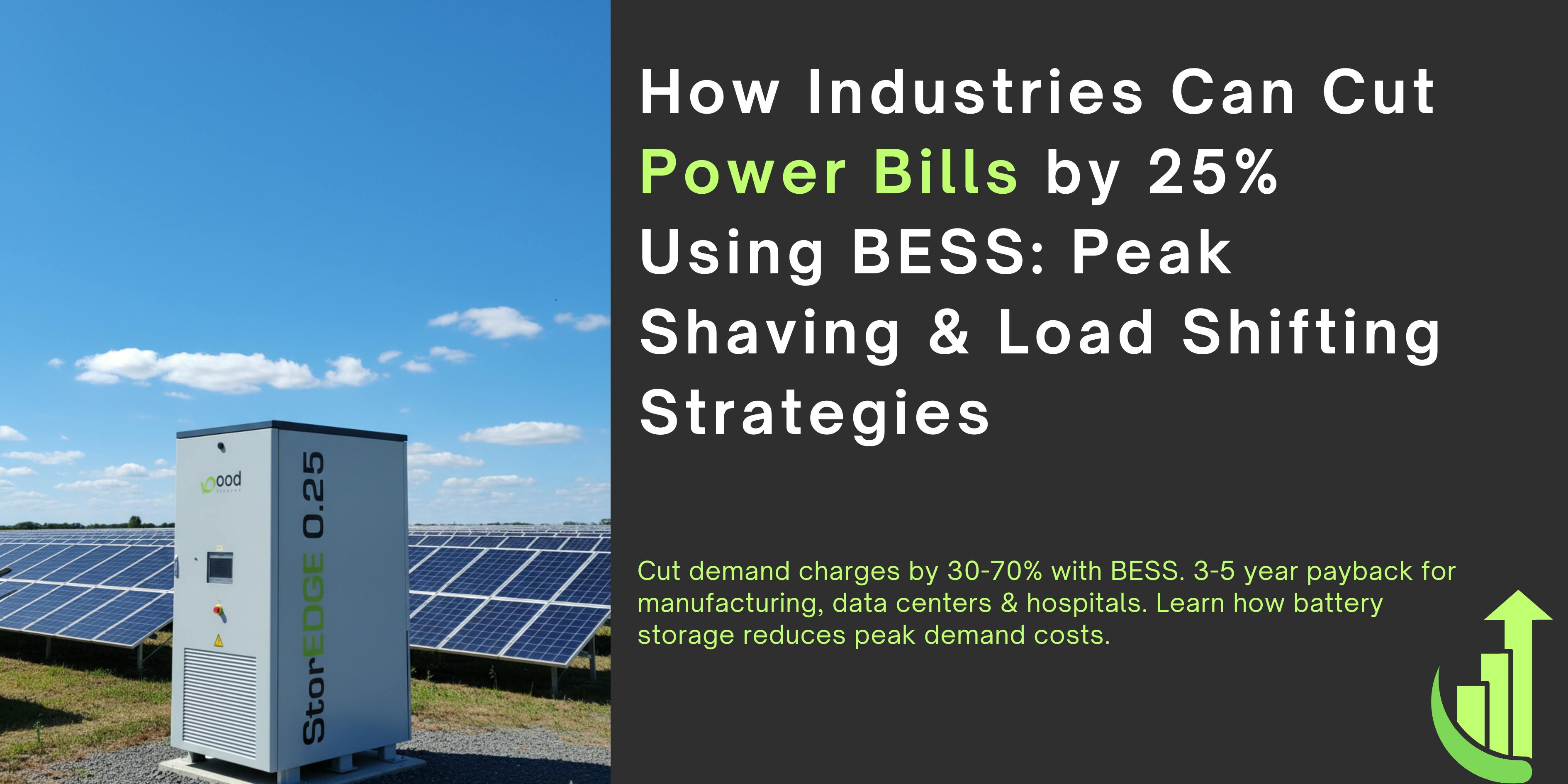
Solutions like Storedge0.25 are making it easier for organizations to implement intelligent energy storage systems that deliver both immediate economic benefits and long-term resilience. As India accelerates toward its 74 GW storage target by 2032, facilities deploying BESS today position themselves to capture maximum value while future-proofing against rising tariffs, increasing grid volatility, and regulatory pressures.
The window of maximum opportunity is now—before widespread adoption erodes the competitive advantage.