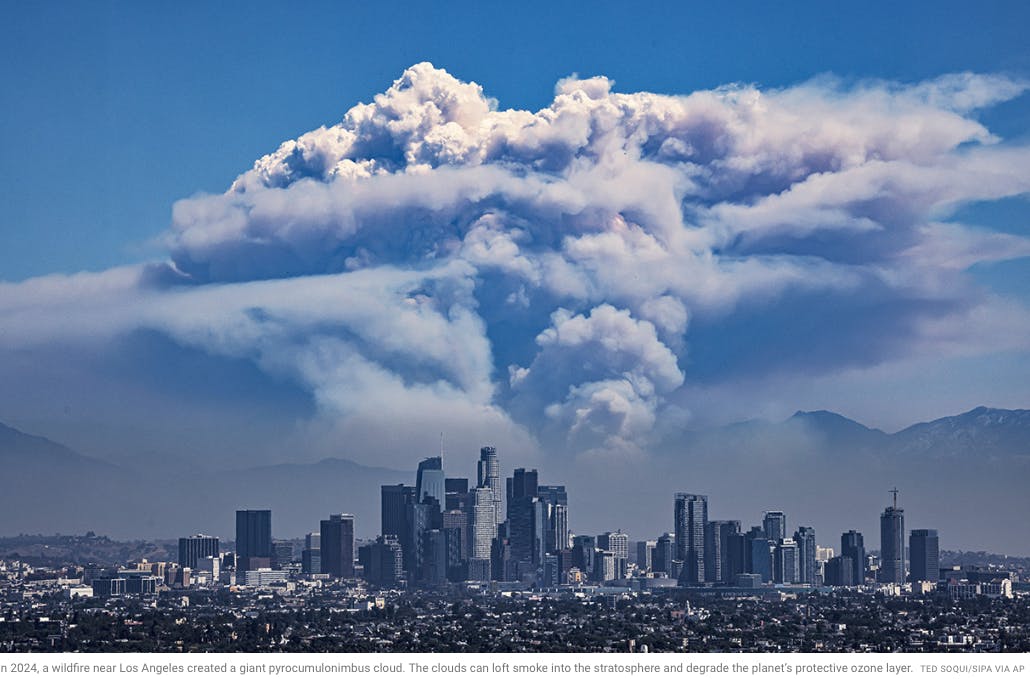
AAAS: “NASA greenlights two earth science missions, to researchers’ relief.” The photo shows the sort of phenomenon we desperately need to study. Fortunately, success followed after months of speculation that proposed White House cuts to NASA’s budget would mean the program would only fund a single mission. “Ross Salawitch, an atmospheric chemist at the University of Maryland, attributes the selection of both satellites to scientists’ lobbying efforts to maintain research funding.” Last month Congress passed a $7.25 B budget for NASA’s science programs for the current fiscal year—a 1.1% reduction from last year, rather than the 47% cut the White House requested.
“One of the missions, the Earth Dynamics Geodetic Explorer (EDGE), will map the elevation of the planet’s ice and land to within 3 cm on flat ground…a laser instrument on the satellite will measure height across five 120-m strips, allowing it to cover almost all of the planet’s surface more quickly than current instruments in orbit.” This will allow researchers to map the growth and harvesting of crops, the thickness of sea ice and ice sheets, and the canopies of forests before and after wildfires.
“The second mission, called the Stratosphere Troposphere Response using Infrared Vertically-resolved light Explorer (STRIVE), will target the upper atmosphere, between 5 and 50 kilometers above the surface.” STRIVE will look ‘sidelong,’ through the ‘limb’ of the atmosphere, to take a vertical profile of the temperature and chemistry of the upper troposphere + lower stratosphere with an infrared sensor, “It will collect more profiles of the atmosphere in 2 months than a comparable instrument now in orbit on NASA’s Aura satellite has collected in 2 decades.”
Earth-directed missions critically needed. Way to go, NASA.