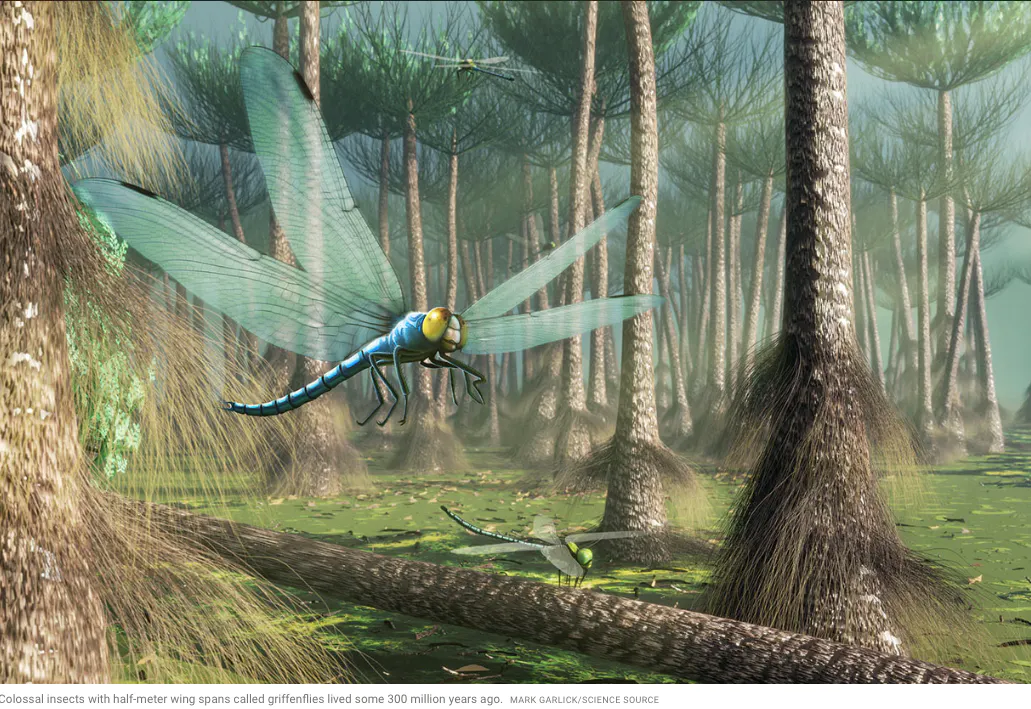
AAAS: “How did ancient bugs get so big? The prevailing theory may be wrong.” A new study suggests flying insect respiratory systems cannot explain ancient gigantism. Griffenflies were giant dragonflylike insects with half-meter wing spans, which buzzed through hot and swampy forests on the former supercontinent of Pangaea. Insects use slender, branching tubes called tracheoles to get oxygen into + carbon dioxide out of muscles + other insect organs by passive gradient-driven diffusion. “The atmosphere at the time held more oxygen than it does today, and the textbook hypothesis suggests these giant insects developed more respiratory tubes to deliver that gas to their muscles, enabling them to grow and grow.” And it is true that, “during the Carboniferous, 50-meter-tall mosses and other plant life pumped massive amounts of oxygen into the atmosphere…oxygen made up about 30% of Earth’s atmospheric air, compared with 21% today.
But a new analysis of the anatomy of insect flight muscles, recently published in Nature, argues past ferocious fliers didn’t incorporate oxygen into their muscles any more generously than their smaller counterparts do today. “To test the idea, Snelling and his colleagues looked closely at the tracheoles in flight muscles of 44 species of modern flying insects of various sizes across several orders, including beetles, wasps, and grasshoppers.” With high-powered electron microscopy, “they scanned and modeled the relationship between body size and the number of tracheoles across the insects, fleshing out how tracheolar volume scaled according to size.” They found that regardless of size, tracheoles made up less than 1% of the insects’ muscle volume. “Next, they extrapolated this relationship to a 300-million-year-old, 100-gram griffenfly known as Meganeuropsis permina, the largest insect ever documented. Just like modern insects, the researchers found, M. permina’s tracheoles would have constituted less than 1% of its muscles.”
Whatever the explanation of their gigantic size, I still would not want one landing on my back.