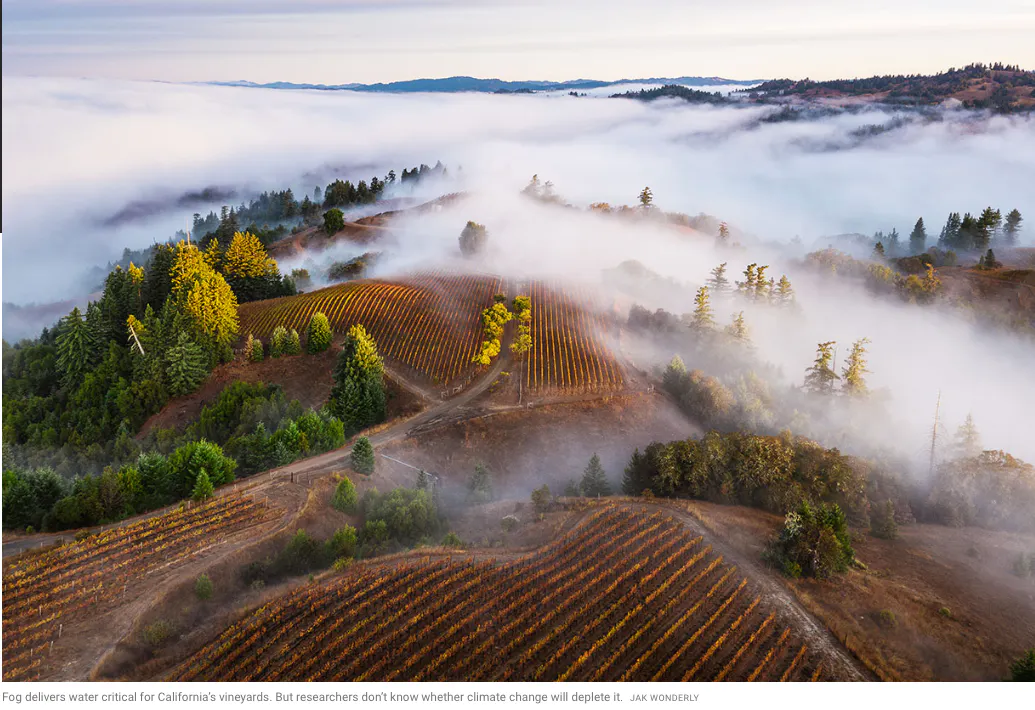
AAAS: "Fog is a vital water resource. Could it disappear in a warming world?" Unlike the vast decks of marine stratocumulus clouds—long a focus of climate research—coastal fog forms right at the surface and remains poorly represented in climate models. "Over the cold ocean, moist air cools into droplets around dust and airborne particles...as inland air warms and rises, it pulls the fog ashore." In "California’s famous redwood forests, fog can provide 40% of the ecosystem’s summertime water." In the Salinas Valley, nicknamed the “salad bowl of the world,” fog nourishes the cropland that generates more than half of the United States’s lettuce and one-quarter of its strawberries. "And in cities, fog can scavenge and carry off harmful pollutants such as nitric and sulfuric acids, soot, and trace metals." For millions living in the most populous U.S. state, the fog spawned where a cold ocean meets a Sun-warmed coast is like “natural air conditioning,” says Peter Weiss-Penzias, an atmospheric chemist at the University of California (UC), Santa Cruz.
“Fog has more or less been this underdog,” says Sara Baguskas, a biogeographer at San Francisco State University who notes that funders have long viewed it as too regional for big investments. "This month, Baguskas, Weiss-Penzias, and their colleagues will begin fieldwork on the $3.65 million Pacific Coastal Fog Research project, funded over 5 years by the Heising-Simons Foundation." Using fog collectors and climate models, the project will for the first time systematically measure coastal fog’s chemistry, ecological role, and response to warming. " Warming affects both the ocean and the land—and fog depends on the temperature contrast between the two. "In addition to computer screens [for modeling], the campaign will deploy mesh ones: fog collectors that face the wind and funnel fog into rain gauges."
These observations should interest California’s wine industry, where changes to water inputs can alter the flavor profile of grapes. "Ground station data are scarce, and satellite images can’t distinguish fog from other low-lying clouds."
So, the essence of wine + the quintessence of collaborative research.
Still think there should be a separate SCIENCE category for posts like this one.