Wikipedia: "Electricity sector in Brazil."
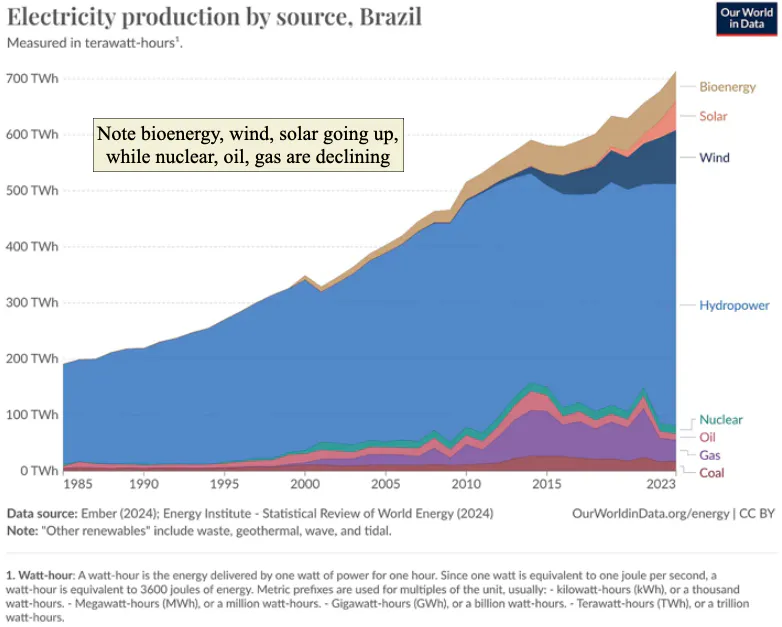
Brazil has the largest electricity sector in Latin America, + in 2024, Brazil added a substantial 10.9 GW of new power generation capacity, with a total installed capacity of 209 GW, of which nearly 85% was renewable. [Recall that a gigawatt or GW is equivalent to the instantaneous or power rating of a typical nuclear power plant.]. "The installed capacity grew from 11,000 MW in 1970 with an average yearly growth of 5.8% per year."
Impressively, Brazil has the largest capacity for water storage in the world, based largely on hydroelectricity generation capacity, which meets over 60% of its electricity demand. "The national grid runs at 60 Hz, just like in the US, and is powered 83% from renewable sources." This dependence on hydropower makes Brazil vulnerable to power supply shortages in drought years, as was demonstrated by the 2001–2002 energy crisis.
"In 2023, the output of Brazil's electricity system, serving over 88 million consumers, exceeded that of all other South American nations combined." Anticipated investments surpassing $100 billion by 2029 aim to expand utility-scale + distributed generation, alongside transmission + distribution projects. "The National Interconnected System (SIN) comprises the electricity companies in the South, South-East, Center-West, North-East and part of the North region." Only 3.4% of the country's electricity production is located outside the SIN, in small isolated systems located mainly in the Amazonian region.
Fascinating country in so many ways. From my background in infectious disease, problems with zika, dengue fever, malaria. But the specter of drought hangs over the Amazon + Brazil's power sector, as in many areas of the world. Since Brazil is about 92% tropical, it seems to me they should diversify further into solar + storage.