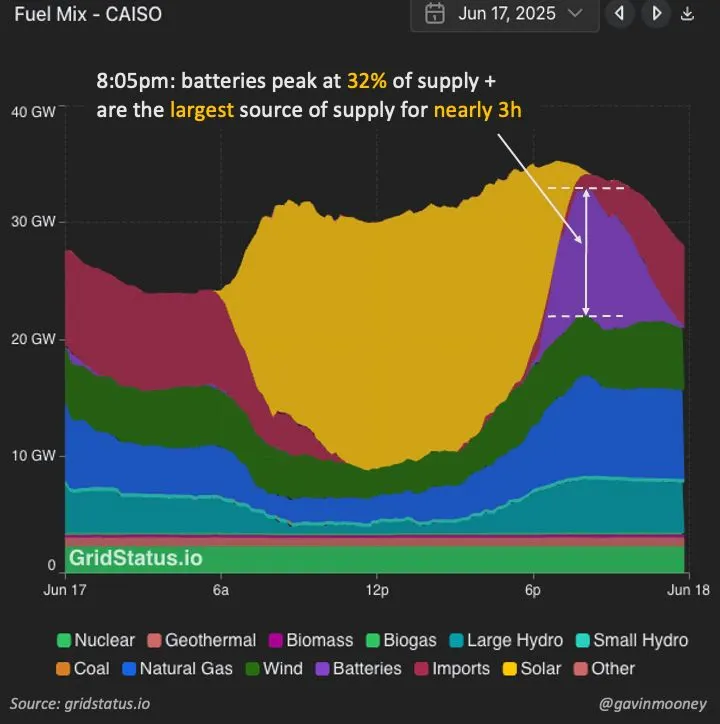
Batteries are starting to dominate the evening peak in California's grid, charging up with daytime solar then discharging as solar ramps down.
Two days ago they set a new output record of 10.4 GW, before breaking the record again yesterday, peaking at 10.9 GW. This represents a rapid progression - two years ago the record was less than 4 GW and five years ago it was less than 200 MW.
Significantly, while evening peak demand is now 10 GW higher than it was back in April, batteries are still reaching a share of supply above 30%. And they remained the largest source of supply from 7:00pm until 9:45pm.
As more and more battery storage enters the mix, batteries will continue to play an increasing role in the state's grid, and continue to break more records.
They are flexible and extremely quick to respond. By charging in the middle of the day they are soaking up excess solar and are then putting this to good use later, reducing the need for gas and imports in the nighttime hours.
From just 0.5 GW in 2018, by April 2025 California already had nearly 16 GW of battery storage capacity, with more on the way. While that may sound like a lot, there is still some way to go with the California Energy Commission estimating the state will need around 52 GW of battery storage to meet it's 2045 target of getting all its power from carbon-free sources.
Batteries will play an important role in the decarbonised grid of the future. As prices continue to fall we will see more and more batteries deployed, and are certainly seeing this happen in Australia - especially Western Australia.
We are just on the cusp of much more widespread adoption. Onwards and upwards!
Some other stats on California, courtesy of Mark Jacobson:
➡️ Two years ago year to date, fossil gas output on California's main grid was 93% higher than solar output.
➡️ In 2025, solar output has been 32% higher than gas output.
➡️ Gas output has dropped 41.4% and solar output has risen 50% in 2 years.
➡️ Battery output has also risen 215%.