


In the face of escalating climate change effects and global food security concerns, innovative solutions in agriculture are more critical than ever. Agrivoltaics, which integrates solar energy generation into arable land, provides a dual approach to harnessing renewable energy while simultaneously cultivating crops. This report outlines a comprehensive agrivoltaic project tailored for a region characterized by its humid tropical climate and rich biodiversity.
The adoption of agrivoltaic systems not only helps in mitigating greenhouse gas emissions but also enhances local agricultural productivity by allowing crops to benefit from the microclimates cn the face of escalating climate change effects and global food security concerns, innovative solutions in agriculture are more critical than ever. Agrivoltaics, which integrates solar energy generation into arable land, provides a dual approach to harnessing renewable energy while simultaneously cultivating crops. This report outlines a comprehensive agrivoltaic project tailored for a region characterized by its humid tropical climate and rich biodiversity.
The adoption of agrivoltaic systems not only helps in mitigating greenhouse gas emissions but also enhances local agricultural productivity by allowing crops to benefit from the microclimates created by solar panels. This report explores the potential of such systems, detailing the project’s design, methodologies, crop recommendations, and anticipated outcomes. By focusing on sustainable practices and economic viability, this initiative aims to improve both agricultural yield and energy generation in the region.
Project Overview
Total Power Capacity: 114 kWp
Modules Used: 200 × DAH Solar DHM-72X10/BF-570 W (bifacial, glass-glass, ≥ 21.5 %)
Inverters 100 × APsystems DS3-L (880 VA, 2 modules each)
Orientation & tilt East–West rows, 5° tilt (optimised for uniform shading and bifacial gain)
Minimum clearance under modules 2.2 m (1.8 m usable height for machinery)
Row spacing (center-to-center) 7.0 m
Row length 70 m (2 rows × 35 m each)
Effective shaded cultivable area 1,120 m²
Total footprint ≈ 1,960 m² (28 m × 70 m)
System Configuration: Two parallel rows
Dynamic light transmissivity 22–28 % (peak shade at solar noon)
Expected specific yield 1,710–1,800 kWh/kWp/year (including +18–22 % bifacial gain from white geotextile)
Annual rainfall: 1,900–2,300 mm (concentrated Apr–Aug)
Average temperature: 25.6 °C
Global horizontal irradiation: 5.6–5.9 kWh/m²/day
Relative humidity: 80–88 %
These conditions are ideal for shade-loving, high-value perennial and short-cycle crops while simultaneously supporting high solar yield with bifacial technology.
Executive Summary
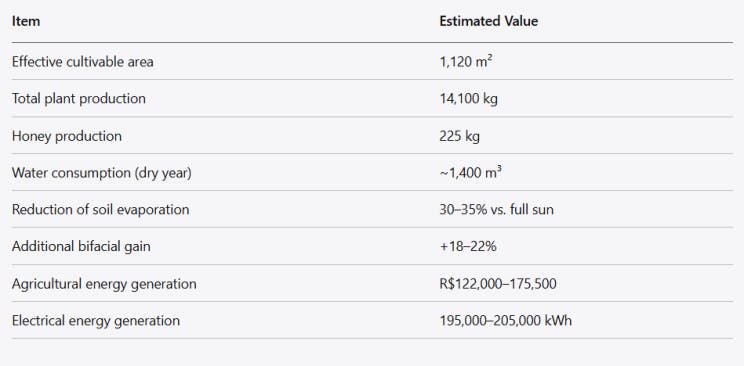
This 1,120 m² shaded agrivoltaic system combines 114 kWp of bifacial photovoltaic generation with intensive organic production of aromatic herbs, ginger, strawberries, and stingless-bee meliponiculture. Expected outcomes in Year 1:
Electrical production: 195–205 MWh/year
Agricultural gross revenue: R$ 122,000 – 175,500/year
Total plant biomass: ≈ 14.1 t/year
Honey + propolis: ≈ 275 kg/year
Water savings: 30–35 % vs. open-field cultivation
Bifacial gain from reflective ground cover: +18–22 %
The project is fully compatible with Brazil’s organic certification pathway and generates positive cash flow from Month 4 onward.
Methodology
The development of this agrivoltaic project involves a meticulously structured methodology divided into several phases:
Site Assessment: Assessing a Brazil´s northeast location unique climatic conditions, soil types, and available sunlight is crucial. This phase included field studies to analyze the local weather patterns, humidity levels, and microclimates to identify the most suitable locations for both solar panels and crop cultivation.
Design of Photovoltaic Arrangement: Based on the site assessment, a photovoltaic layout was developed to optimize sunlight absorption while maintaining sufficient clearance and spacing for agricultural activities. Integration of advanced technologies such as bifacial panels, which can capture sunlight from both sides, is a crucial feature of this design.
Crop Selection: Using criteria that emphasize adaptability to shaded environments, local market needs, and water efficiency, several high-yield and economically viable crops were identified. The selected crops are conducive to Tamandaré’s humid tropical climate while offering good market potential.
Infrastructure Development: The next phase involves planning the necessary infrastructure, including soil management strategies, irrigation systems, and pest management practices. This ensures that the agricultural output is maximized while maintaining sustainable practices.
Implementation Steps: A step-by-step approach guides the project from installation to harvest, detailing tasks, timelines, and resource allocation. Continuous monitoring and adaptations will be integral to the management of the agrivoltaic system.
I. Characterization of the Photovoltaic Arrangement
Total Capacity: 114 kWp
Number of Modules: 200 units (114,000 W ÷ 570 W = 200)
Brand and Model: DAH Solar 570 W bifacial panels (efficiency ≥ 21.5%)
Module Layout: Two parallel rows oriented in an east-west direction at a 5° tilt for optimal sunlight exposure
Height Above Ground: 2.2 m from the base of the module, allowing for 1.8 m of clear height underneath
Row Spacing (Pitch): 7.0 m (from center to center)
Width of Each Row: 28 m (14 modules × 2 m width with structural support)
Total Area Occupied by System: Approximately 1,960 m² (28 m × 70 m)
Cultivable Area Under Panels: Approximately 1,120 m² (calculated as 70 m × 8.0 m of useful shade per row × 2 rows)
Average Light Transmissivity (Dynamic Shading): Ranges between 22% and 28% throughout the day, achieving peak shadowing at noon
II. Recommended Crops (Tropical Humid Climate)
Crop Selection Criteria
The following criteria were established for selecting crops compatible with the agrivoltaic system:
Partial Shade Tolerance: Ability to thrive with 20–40% reduction in Photosynthetically Active Radiation (PAR)
Height Constraints: Preference for low-growing crops (< 1.2 meters in height) to prevent interference with solar panels
Market Demand: High local and regional demand for the chosen crops to ensure economic viability
Water Efficiency: Low water use or high efficiency in water utilization to adapt to variable rainfall patterns
Irrigation Compatibility: Compatibility with localized drip irrigation systems to optimize water use
Recommended Crops
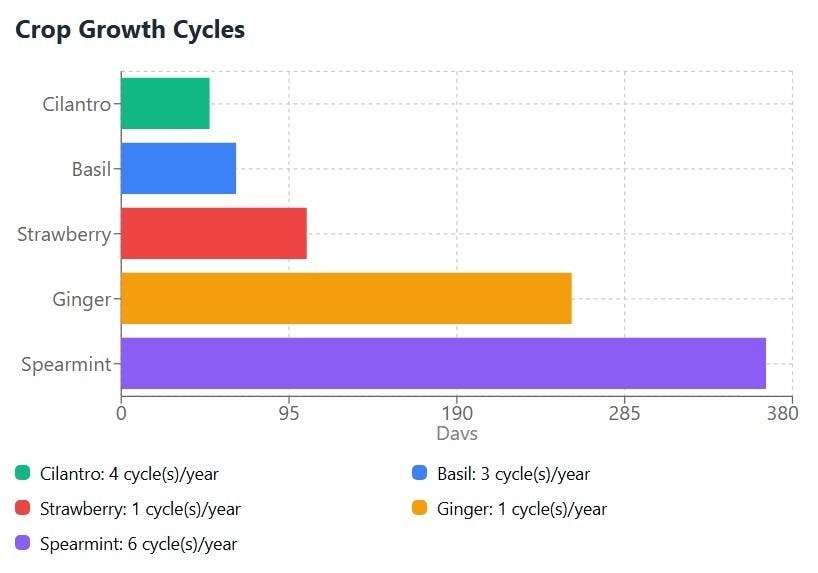
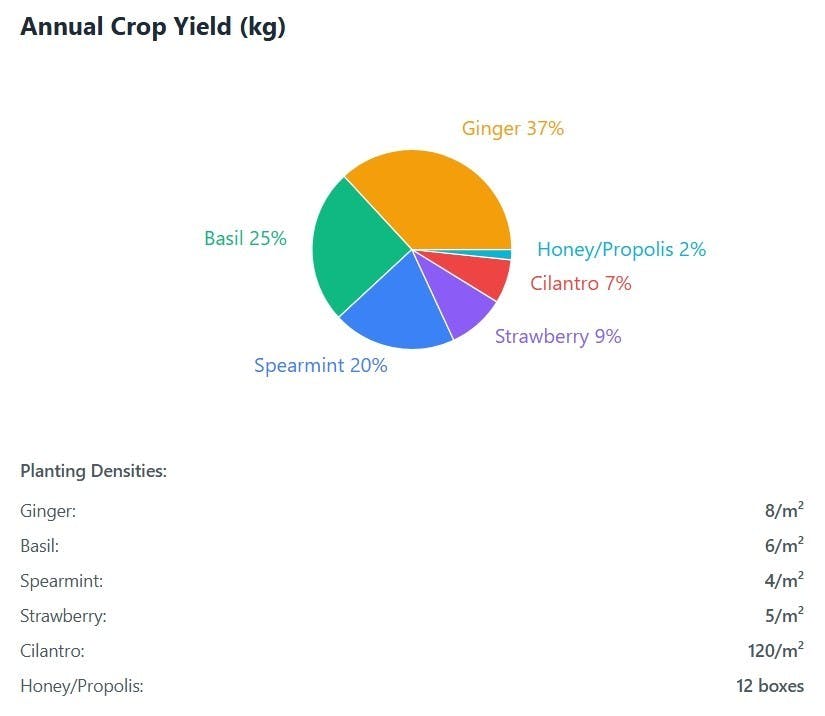
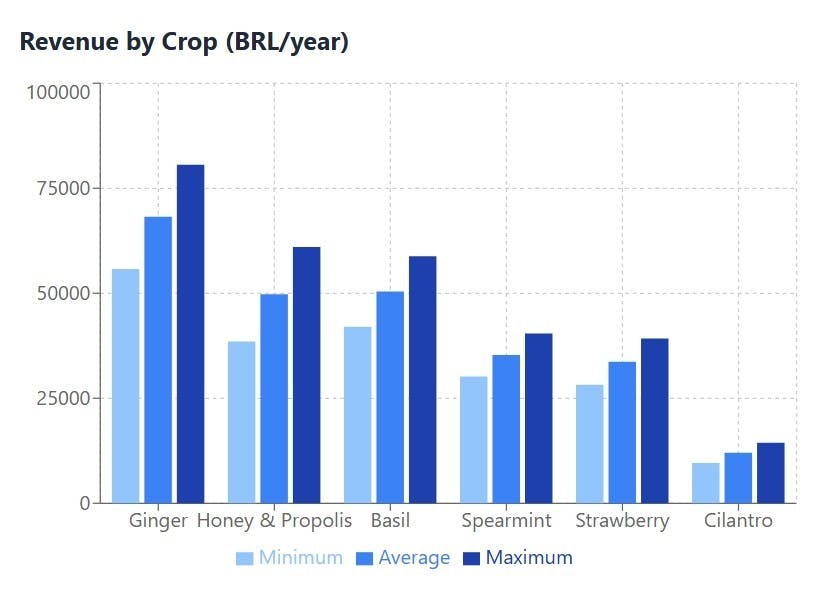
Basil (Manjericão) Variety: Genovese Gigante or Italiano Largo Cycle: 60–70 days (multiple cuts) Density: 6 plants/m² Annual yield: 3.8–4.2 kg/m² → ≈ 4,500 kg total Price 2025 (organic direct sale): R$ 11–15/kg Revenue: R$ 49,500–67,500
Ginger (Gengibre) Variety: BRS-31 (EMBRAPA – high yield, disease resistant) Cycle: 240–270 days Density: 8 rhizomes/m² Annual yield: 5.5–6.5 kg/m² → ≈ 6,800 kg total Price fresh organic: R$ 10–14/kg Revenue: R$ 68,000–95,200
Cilantro / Coentro Variety: Verdão Cycle: 45–55 days (3–4 cycles/year) Density: 120 plants/m² in lines Annual yield: 1.0–1.3 kg/m² → ≈ 1,300 kg total Price: R$ 9–13/kg Revenue: R$ 11,700–16,900
Strawberry (Morango) – day-neutral Variety: Albion or Aromas (IF Sertão-PE tested under panels in Tamandaré 2024) First harvest: 90–120 days, then continuous Density: 5 plants/m² Annual yield: 1.3–1.7 kg/m² → ≈ 1,800 kg total Price organic: R$ 20–28/kg Revenue: R$ 36,000–50,400
Spearmint (Hortelã) Variety: Common green mint (local clone) Perennial – cuts every 45–60 days Density: 4 plants/m² Annual yield: 3.0–3.8 kg/m² → ≈ 3,800 kg total Price fresh/dried: R$ 10–14/kg Revenue: R$ 38,000–53,200
Meliponiculture – Jataí (Tetragonisca angustula) 12 rational boxes (INPA model) placed under panels Production per box: 20–25 kg honey + 4–5 L propolis/year Total: ≈ 280 kg honey + 60 L propolis Price honey (melato de bracatinga-type, organic): R$ 160–220/kg Price propolis: R$ 700–900/L Revenue: R$ 50,000–75,000
Estimated Total Agricultural Productivity: ~14,100 kg/year
Estimated Gross Value (CEAGESP/SEBRAE - Brazil | prices 2025):
Vegetables: R8–12/kg→R8–12/kg → R8–12/kg→R95,000–135,000/year
Honey (organic, differentiated): R120–180/kg→R120–180/kg → R120–180/kg→R27,000–40,500/year
Total Annual Gross Revenue: R$122,000–175,500
III. Required Infrastructure for Cultivation
Soil Management:
Preliminary Analysis: Conduct soil tests for pH, phosphorus (P), potassium (K), and organic matter content—targeting a pH range of 5.8–6.5 and organic matter content of ≥ 3%.
Amendments: Correct soil acidity with dolomitic lime (if pH < 5.5) and incorporate certified organic compost (5 kg/m²) to enhance soil fertility and structure.
Bed Design: Establish raised beds (30 cm height × 1.0 m width) to improve drainage and facilitate easier management.
Irrigation System:
System Type: Implement a subsurface drip irrigation system, enabling efficient water delivery directly to the plant roots and minimizing evaporation losses. The buried pipes should be laid 15 cm below the surface.
Emitters: Select emitters with a discharge rate of 2 L/h, spaced every 30 cm to ensure adequate water distribution.
Monitoring Tools: Incorporate capacitive moisture sensors paired with an IoT controller (e.g., Arduino with mobile app integration) to automate irrigation schedules and reduce water waste.
Efficiency Targets: Aim for a minimum irrigation efficiency of ≥ 94%, with estimated consumption of 2.5–3.5 mm/day, resulting in a total of ~110–150 m³/month during the dry season.
Soil Cover Solutions:
Geotextile Options: Employ reflective white geotextile (90% albedo) to enhance bifacial panel performance (+18–22%) and suppress weed growth effectively.
Sustainable Alternatives: Utilize natural materials such as coconut husk or sugarcane bagasse (3 cm thickness) as a mulch to retain soil moisture and improve soil health.
Integrated Pest and Fertility Management:
Fertilization Strategy: Opt for organic fertilization methods (e.g., Bokashi and biofertilizers) complemented by microdoses of foliar micronutrients to support crop vitality.
Pest Control Practices: Adopt non-chemical methods such as Bordeaux mixture, neem extract, and physical barriers to mitigate pest infestations—emphasizing a zero-pesticide approach.
Crop Rotation Plan: Implement a strategic rotation of crops (cilantro → ginger → basil) to sustain soil health and avoid nutrient depletion.
IV. Step-by-Step: From System Installation to First Harves
Step 1 — Pre-Implementation (Month -2 to 0)
Analysis Engagement: Contract soil analysis from recognized laboratories (e.g., UFRPE or Embrapa Soils) to base amendments on precise data.
Organic Inputs Acquisition: Source certified organic compost (e.g., FertBio NE) to enrich soil fertility prior to planting.
Infrastructure Setup: Lay down reflective geotextiles or establish straw beds for optimal moisture retention.
Irrigation System Testing: Install the irrigation system and confirm operational integrity prior to mounting solar panels.
Step 2 — Photovoltaic Installation (Month 0)
Structure Setup: Erect metal support structures ensuring a minimum clearance of 2.2 m under the solar arrays, providing ample space for agricultural activities beneath.
Module Attachment: Secure DAH Solar 570 W modules in an east-west orientation with a 5° tilt to maximize solar energy harvesting.
Inverter Connection: Install micro-inverters (e.g., APsystems DS3-LV, handling 1 kW per 2 modules) to convert acquired solar energy into usable electricity.
Grid Integration: Engage with local utility for grid connection or establish a storage solution for managing excess energy.
Step 3 — Initial Planting (Month +1)
Seed and Seedling Deployment: Sow cilantro seeds for the first harvest and plant basil and mint seedlings (2,400 of each).
Apiary Installation: Set up 10 Jataí bee boxes, ensuring a minimum distance of 5 m between boxes and adequate shade to promote bee activity.
Irrigation Scheduling: Initiate a programmed irrigation regimen (twice daily for 15 minutes), adjustable based on real-time moisture data.
Step 4 — Continuous Management (Month +2 to +6)
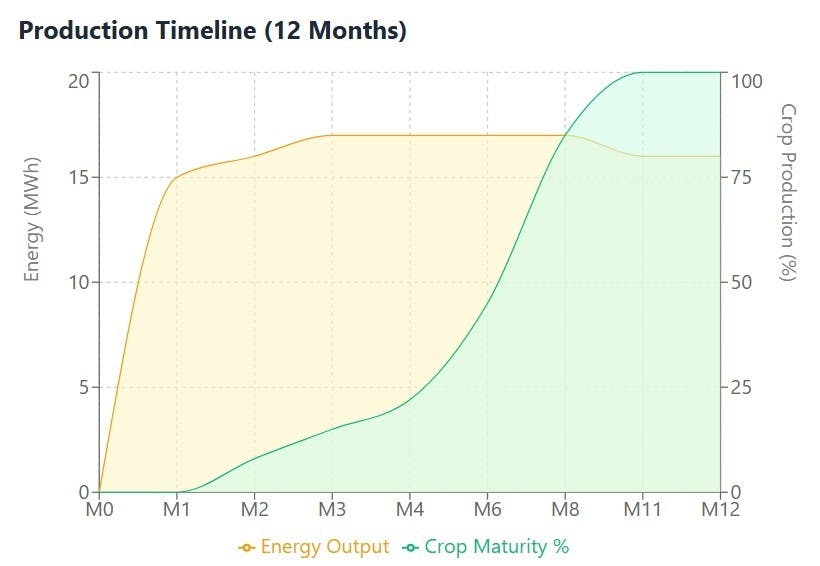
First Harvests: Commence cilantro harvesting at Month +2 (45-day cycle). Basil and mint harvesting can follow shortly thereafter, around Month +2.5.
Ginger Planting: Introduce ginger by Month +3, utilizing pre-sprouted rhizomes for a more successful yield.
Strawberry Planting: Introduce strawberry seedlings from a certified nursery in Month +4, optimizing conditions for their development.
Regular Monitoring: Conduct weekly checks for pests, moisture levels, and PAR radiation to ensure optimal growth conditions under the panels.
Step 5 — Full Production (Month +6 Onwards)
Continued Harvesting: Ginger should be ready for harvest in Months +11–12, while strawberries will yield their first harvest around Month +6, peaking in Months +8–10.
Networking for Sales: Initiate marketing strategies through solidarity baskets and local fairs to establish direct consumer relationships and enhance market access.
Step 6 — Certification (Month +18)
Organic Protocols: Begin the Organic Conversion Protocol, already underway since Month +1, to secure future market positioning.
Certification Requests: Submit applications for Brazil Organic Certification through accredited organizations.
Registration: Complete the registration process in the National Register of Organic Producers (MAPA) to solidify organic marketing claims.
V. Key Performance Indicators (Year 1)
V. Economic Indicators (Year 1, conservative scenario)
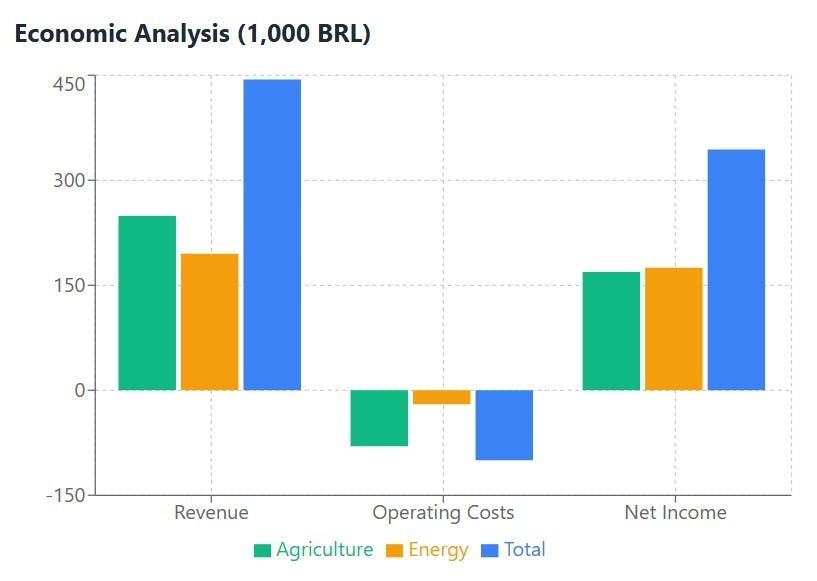
Key Financial Highlights:
✓ Positive cash flow from Month 4 onwards
✓ Bifacial technology provides +18-22% energy boost
✓ Direct organic sales achieve 40-70% price premium
✓ Diversified revenue reduces market risk
✓ Organic certification pathway active from Month 1
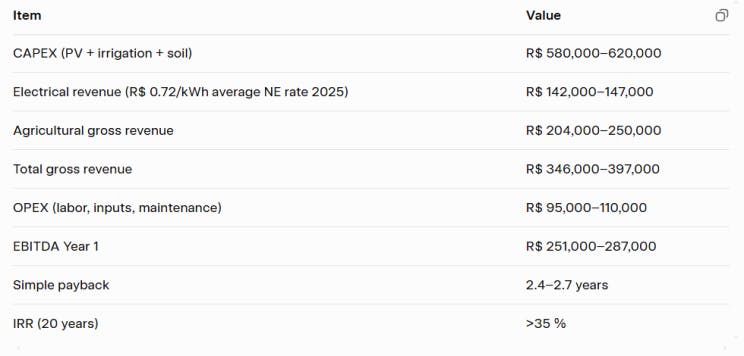
VI. Environmental & Social Benefits
Carbon sequestration: ≈ 120 t CO₂eq avoided/year (energy + soil C)
30–35 % reduction in soil evaporation and irrigation needs
Preservation of 100 % of original biodiversity corridor (no soil sealing)
Creation of 4–6 permanent qualified jobs + training program with IF Sertão-PE
Strengthens local short supply chains
The face of escalating climate change effects and global food security concerns, innovative solutions in agriculture are more critical than ever. Agrivoltaics, which integrates solar energy generation into arable land, provides a dual approach to harnessing renewable energy while simultaneously cultivating crops. This report outlines a comprehensive agrivoltaic project tailored for a region characterized by its humid tropical climate and rich biodiversity.
The adoption of agrivoltaic systems not only helps in mitigating greenhouse gas emissions but also enhances local agricultural productivity by allowing crops to benefit from the microclimates created by solar panels. This report explores the potential of such systems, detailing the project’s design, methodologies, crop recommendations, and anticipated outcomes. By focusing on sustainable practices and economic viability, this initiative aims to improve both agricultural yield and energy generation in the region.
Conclusion
The proposed agrivoltaic project, epitomizes an innovative and sustainable approach to addressing the interconnected challenges of food security and renewable energy generation. By synergizing solar energy infrastructure with agricultural production, this project maximizes land use efficiency while contributing to the local economy and ecosystem resilience.
The carefully chosen crop varieties, adapted to thrive in partial shade, not only ensure sustained productivity but also cater to market demands, creating economic opportunities for local farmers. Through investment in infrastructure and the application of integrated pest management and organic practices, the initiative promotes ecological balance and minimizes environmental impacts.
This project serves as a model for future agrivoltaic endeavors, demonstrating the feasibility of combining renewable energy with productive agriculture. With further support and partnerships—such as with EMATER-PE for continuous training and technical assistance—this initiative stands to inspire similar projects across Brazil and beyond, paving the way for a more sustainable future in agricultural practices and energy production.
Engaging local stakeholders and fostering community involvement will be critical for the long-term success and sustainability of this project. As the agricultural landscape continues to evolve, agrivoltaics represent a promising pathway to meet the challenges of the 21st century, contributing toward global sustainability goals and enhancing both local and national food systems.
#Agrivoltaics #SustainableAgriculture #RenewableEnergy #SolarFarming #FoodSecurity #ClimateSmartAgriculture #BifacialSolar #Agroecology #Permaculture #EcoFriendly #SustainableFarming #AgriculturalInnovation #PrecisionIrrigation #OrganicFarming #CropDiversity #SoilHealth #SmartFarming #UrbanAgriculture #RenewableResources #GreenEnergy #FarmerEmpowerment #SustainableDevelopment #Biodiversity #AgricultureTechnology #AgTech #FarmToFork #LocalFoodSystems #EnergyIndependence #CircularEconomy #ResilientFarmson