


𝗧𝗵𝗲 𝗶𝗱𝗲𝗮 𝗰𝗼𝘂𝗹𝗱 𝘀𝗼𝗹𝘃𝗲 𝘁𝗵𝗲 𝘁𝘂𝗿𝗯𝗶𝗻𝗲 𝗯𝗮𝗰𝗸𝗹𝗼𝗴 𝗱𝗶𝗹𝗲𝗺𝗺𝗮
A✌️428-word✌️2-minute✌️read
Is it possible to write about clean technology without mentioning data centers?
I suppose so, but you have to work at it.
Everyone that follows the space knows that data centers are expected to drive a massive spike in the demand for power.
The solar industry would like people to believe that solar can address this demand. The reality is that without storage capable of guaranteeing round-the-clock power, solar is a non-starter.
New nuclear power remains years away, and new nuclear technology - including SMRs - remain unproven.
That leaves natural gas as the obvious choice. Except that there are only three companies that make gas turbines, and they are reporting lengthy backlogs.
One of the manufacturers – GE Vernova – recently said there is an 80-gigawatt backlog that will take its manufacturing capacity out to 2029. The company is ramping capacity, but that process also takes time.
Enter the Boom Supersonic.
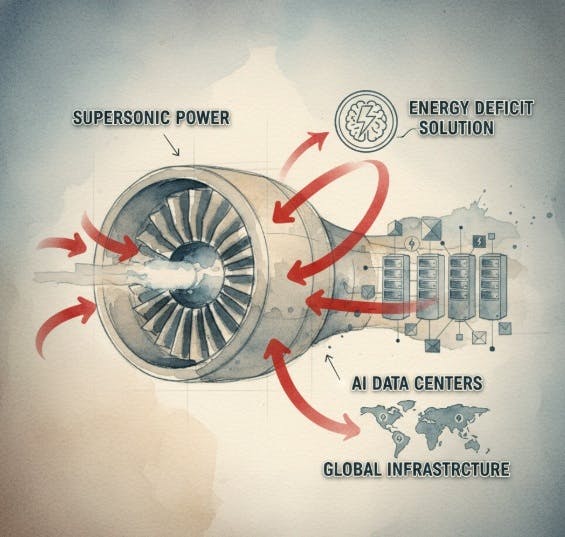
Its CEO Blake Scholl believes that four of his company’s Superpower turbines can replace seven legacy gas turbine units. Not only that, he points out that the company’s engines can generate power without requiring water for cooling.
Crazy idea?
No more crazy than installing a nuclear reactor in a 30-inch bore hole one mile deep in the ground.
The clean technology space is replete with crazy ideas. Despite the fact that the vast majority will fail, I applaud them all.
We need creative thinking to solve such a complex problem as climate change. And a tweak here or there, can sometimes turn a bad – or crazy – ideas into a good one.
Boom Supersonic already has a customer for its modified engines. Data center startup Crusoe plans to buy 29 of the 420-megawatt turbines for $1.25 billion. The hope is that these turbines will generate 1.21 gigawatts of power.
To fund its effort Boom has raised $300 million.
Neither the $300 million nor the order for 29 units is proof that the company will pull it off.
Further, its projected first delivery date of 2027 seems somewhat optimistic. It’s one thing to modify a jet engine to function as a gas turbine. That may be the easy part. The hard part may well be adequately testing it to ensure it can safely perform as expected over a prolonged period of time.
As with all such stories, I’ll make every effort to keep an eye on the company’s progress. Much to the chagrin of environmentalists, if successful, it will be a boom for natural gas.
#datacenters #AI #artificialintelligence #naturalgas #gasturbines #boomsupersonic
