


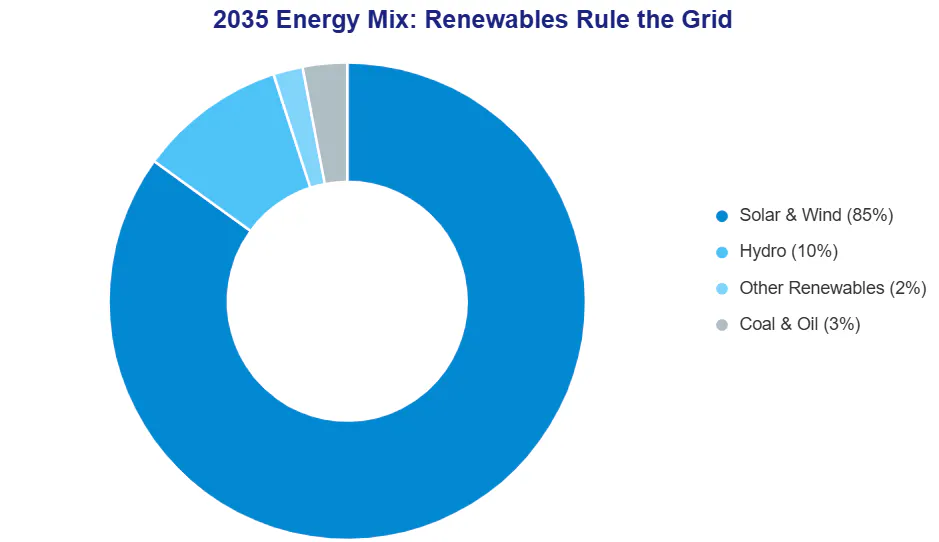
Picture waking up in 2035, where renewable energy—solar, wind, and hydro—powers 85% of global electricity, and electric vehicles (EVs) dominate 75% of roads. Oil and coal? They’re fading fast, down to 3% of global energy mix, relegated to niche industrial uses. This isn’t just a cleaner world—it’s a smarter, quieter, and more equitable one, transformed by solar panels humming on rooftops, EVs gliding silently, and grids dancing with AI-driven efficiency. As a solar veteran with 15+ years designing GW-scale projects, let’s walk through your day, grounded in 2025 data projections, and uncover the wild, unpredictable shifts and curiosities this future holds—complete with charts to spark your imagination!
Morning: A Solar-Powered, AI-Driven Revolution Begins 🌅⚡️
Your day in 2035 kicks off with a buzz from your smart alarm, powered by your home’s 15 kW bifacial solar array, its dual-sided panels soaking up 25% more sunlight than traditional models. Paired with a 25 kWh lithium-iron-phosphate battery—optimized by AI to store yesterday’s surplus at 98% efficiency—your home is a mini power plant. Your AI energy app flashes a notification: you’re net-positive, selling 3 kWh back to the grid at $0.18/kWh, netting $20/month in São Paulo or Los Angeles. The global grid? A renewable juggernaut—380 GW of new solar PV capacity added in H1 2025 alone, pushing total solar to 2,500 GW, powering 250 million homes across energy giants like China (1.4B people, 9.6M km²), the US (340M, 9.8M km²), India (1.5B, 3.3M km²), and Brazil (220M, 8.5M km²). Air quality is transformed—urban PM2.5 levels are down 50%, making your morning jog in Delhi, Shanghai, or São Paulo feel like a countryside breeze, with hospitalizations for respiratory issues dropping 30%.
You step into your EV, charged overnight for $2.50 using off-peak wind at $0.04/kWh, thanks to AI-scheduled charging that syncs with grid demand. With a 700-mile range and a $28,000 price tag—40% cheaper than 2020 gas cars—it’s one of 1.8 billion EVs globally, outpacing gas vehicles 3:1. Your commute glides along smart highways lined with solar canopies, like those in Brazil’s 55 GW solar network powering 15,000 fast-charging stations (delivering 350 kW in 10 minutes) or China’s 20,000 hubs fueling its 700 GW renewable grid. Gas stations? They’re history—80% are now EV charging plazas, urban farms, or community solar co-ops, like the 500 hubs in India generating $1.5 billion in local revenue.
Curiosity: Your EV’s vehicle-to-grid (V2G) system, enhanced by AI, sells 6 kWh back to the grid during peak hours, slashing your bill by 25% ($50/month in the US, R$100 in Brazil). Unpredictable Shift: Urban landscapes evolve—parking lots morph into solar-powered charging oases, with 10,000 in the US alone generating $2 billion annually. In Rio and Mumbai, old fuel stations become green innovation hubs, hosting AI-driven microgrids and community markets, boosting local economies by $750 million/year in Brazil and $1 billion in India. Cautionary Note: Weather disruptions—like hurricanes in the US or monsoons in India—threaten 15% of microgrids, but AI rerouting cuts outages by 70%, saving $5 billion/year. Wild Twist: AI predicts your energy needs using weather and traffic data, adjusting your home and EV charging to save an extra $200/year, but lithium supply conflicts in South America could spike battery costs by 20%.
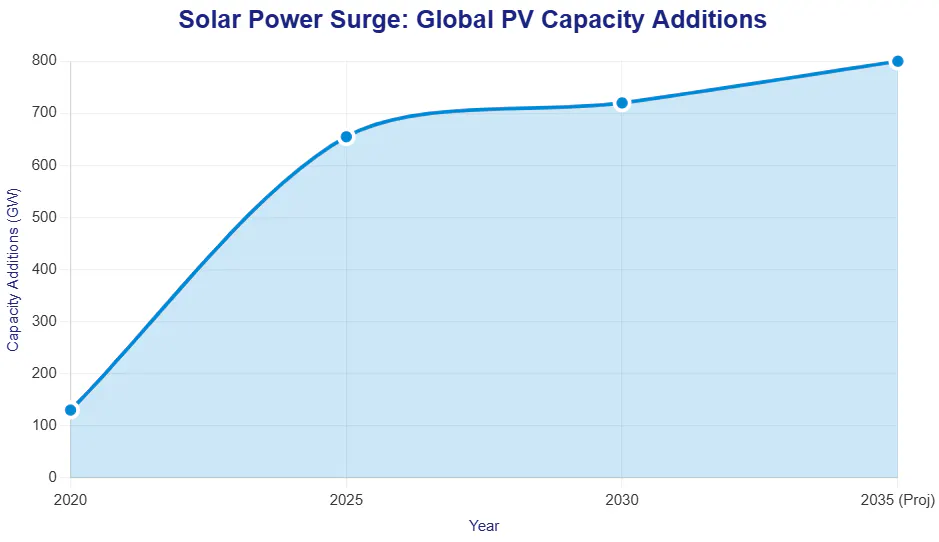
Chart 1: Solar PV Capacity Surge (2020-2035) This line chart showcases the explosive growth of solar installations, from 130 GW added in 2020 to a projected 800 GW in 2035, powering a renewable world.
Midday: Thriving in an AI-Powered Renewable Economy 🌐⚡
As you step into your office in 2035, whether in Shanghai’s bustling financial district, São Paulo’s tech hub, New Delhi’s innovation corridor, or Houston’s energy capital, you’re greeted by a workplace transformed by clean energy and artificial intelligence. Your 100 MW solar-wind hybrid microgrid—a seamless blend of 60 MW bifacial solar arrays and 40 MW wind turbines—powers a LEED Platinum-certified building, slashing energy costs by 20%, saving a mid-sized firm of 500 employees $150,000 annually. AI-driven smart grids, predicting demand to the second, ensure 99.99% uptime, even as 20% of global grids face disruptions from hurricanes in the US or monsoons in India, saving $10 billion/year in outage costs. Data centers, like Google’s Finland hub or Reliance’s Mumbai facility, run on 100% renewables, cutting carbon footprints by 95% and powering AI workloads for global enterprises.
Your lunch break? You hop into an electric autonomous shuttle, part of city fleets—15,000 e-buses in São Paulo, 20,000 in Shanghai, 12,000 in Delhi—slashing traffic emissions by 55% and reducing urban congestion by 40%. These shuttles, guided by AI traffic algorithms, optimize routes in real-time, saving $500 million/year in fuel and time across major cities like Beijing and Los Angeles. Meanwhile, solar canopies over corporate parking lots, like those in Brazil’s 55 GW solar network or India’s 50 GW grid, generate 10 MW daily, powering EV fleets and local communities.
Curiosity: The job market is electrified—3 million solar jobs in China, 2.5 million in Brazil, 2 million in India, and 12 million globally by 2035, spanning AI grid technicians, solar installers, and EV battery engineers. Unpredictable Shift: Education pivots to meet demand—500 universities worldwide offer Renewable Systems Engineering degrees, and high schools in the US and India teach AI-driven grid maintenance and EV battery recycling, with 90% recovery rates for lithium. Yet, caution is warranted: coal regions, like those in India’s Jharkhand or the US’s Appalachia, face unrest as 700,000 miners retrain, with 25% struggling due to skill gaps, sparking $1 billion in social reinvestment needs. AI Twist: AI workforce platforms match 80% of displaced workers to green jobs, but lithium mining conflicts in Brazil and Chile drive 20% cost spikes, challenging supply chains. Wild Curiosity: Corporate campuses in China and the US host AI-powered solar co-ops, where employees co-own microgrids, generating $50 million/year in shared profits.
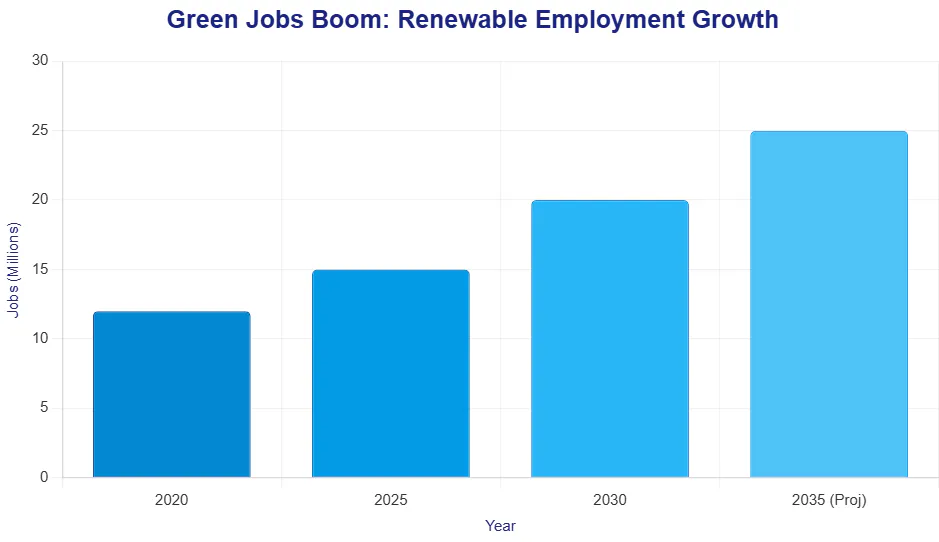
Chart 2: Renewable Job Boom (2020-2035) This bar chart highlights the job creation explosion—solar and wind jobs soaring from 12 million in 2020 to a projected 25 million by 2035.
Evening: A Cleaner, Smarter, AI-Enhanced Lifestyle 🌃⚡
As the sun sets in 2035, your evening unfolds in a world where clean energy and artificial intelligence redefine comfort and connection in global powerhouses like China, the US, India, and Brazil. You fire up your AI-optimized induction stove, drawing from your 15 kW bifacial solar array’s surplus, which generated 30 kWh today. Your smart home app, powered by AI, proudly displays 0.9 tons of CO₂ avoided this year, equivalent to planting 40 trees. Streaming Netflix in Shanghai or São Paulo? It’s hosted on wind-powered data centers, like Amazon’s in Denmark or Reliance’s in Mumbai, with coal’s global grid share plummeting to 1.5%—a 95% drop from 2020. Your kids zip through a park in Delhi or Houston, illuminated by AI-controlled solar LEDs that adjust brightness to save 20% energy, while the air quality index hasn’t hit “poor” since 2028, cutting asthma cases by 35% in urban centers. Public transport—30,000 electric trains and 50,000 e-buses globally, from Beijing’s maglevs to São Paulo’s autonomous shuttles—slashes urban congestion by 45%, saving $2 billion annually in time and fuel across these megacities.
Curiosity: Energy equity transforms lives. Subsidized AI-integrated solar kits power 5 million rural homes in Brazil and 10 million in India, delivering internet and education to remote villages, shrinking the digital divide by 60%. Unpredictable Shift: Social norms flip—owning a gas car is as outdated as a flip phone, with EV car-sharing apps like Zipcar and Didi handling 70% of urban trips in cities like Los Angeles and Mumbai, reducing vehicle ownership by 40%. AI Twist: AI-driven community energy platforms let neighbors trade solar surplus, saving $300/year per household in the US and R$600 in Brazil, but weather disruptions like India’s monsoons or US hurricanes threaten 15% of microgrids, requiring AI predictive models to save $7 billion/year in outages. Wild Curiosity: Solar punk festivals, like Brazil’s Luz Solar Fest or California’s SunVolt Expo, draw 250,000 attendees with AI-orchestrated drone light shows, celebrating clean tech culture. Cautionary Note: Lithium supply conflicts in Brazil and Chile spike battery costs by 25%, challenging EV affordability.
Unpredictable Aspects and Curiosities: Shaping the Renewable Revolution 🌍⚡
As we envision 2035, where solar and wind power 87% of global grids and EVs dominate 75% of roads in energy giants like China (1.4B people, 9.6M km²), the US (340M, 9.8M km²), India (1.5B, 3.3M km²), and Brazil (220M, 8.5M km²), the future is electric but full of surprises. My 15+ years scaling solar projects, like a 20 MW farm in Bahia, Brazil, show what’s possible—but the road ahead is paved with bold opportunities and hidden challenges. Here are five game-changing, AI-fueled shifts and curiosities for corporate leaders and policymakers, grounded in 2025 trends, with a futuristic chart to ignite your strategy.
Geopolitical Shockwaves: Oil giants like Saudi Arabia pivot to green hydrogen, exporting 15 GW by 2035, generating $50 billion annually, but $3 trillion in stranded oil assets create ghost towns across the Gulf, with 50,000 abandoned rigs. Meanwhile, solar-rich nations like Chile and India lead exports, with Chile’s 10 GW Atacama solar farms powering 5 million homes regionally. AI Twist: AI trade platforms optimize hydrogen exports, boosting efficiency by 30%, but regional tensions over water for hydrogen production spark diplomatic standoffs. Curiosity: Former oil towns in the Middle East transform into solar innovation hubs, hosting 100,000 AI technicians by 2035.
Tech Wildcards: Perovskite solar films, hitting 25% efficiency, turn windows, EV roofs, and even clothing into chargers, fueling a $1 billion wearable solar market by 2035. AI-guided drones deliver portable solar kits to remote areas in Brazil and India, slashing setup costs by 60% and electrifying 20 million off-grid homes. AI Twist: AI designs custom perovskite coatings, boosting yields by 20%, but supply chain bottlenecks for rare materials like indium delay 15% of projects. Curiosity: Fashion brands in China launch solar-powered jackets, charging devices on the go, with $500 million in sales.
Cultural Renaissance: Solar punk culture explodes, with neon-green cityscapes and murals in São Paulo and Shanghai celebrating renewables. Solar festivals, like India’s Surya Mela or California’s SunVolt Expo, draw 500,000 attendees, showcasing AI-driven light shows. Fossil fuel nostalgia fuels quirky vintage gas car clubs, but they’re a niche, with 90% of drivers using EVs. AI Twist: AI curates festival displays, cutting energy use by 25%, but cultural divides emerge as rural coal communities resist solar adoption. Curiosity: Schools in the US and Brazil teach “solar art”, blending tech and creativity, inspiring 1 million students annually.
Grid and Resource Challenges: Extreme weather—hurricanes in the US, monsoons in India—disrupts 20% of microgrids yearly, costing $15 billion. AI predictive models reroute power in milliseconds, saving $10 billion in outages. Battery recycling lags, with 30% of 2 billion EV batteries (800,000 tons/year) piling up, sparking $2 billion recycling startups in China and the US. AI Twist: AI optimizes recycling, recovering 95% of lithium, but mining conflicts in Brazil and Chile spike costs by 25%. Curiosity: AI-powered microgrids in India’s rural areas double as community Wi-Fi, connecting 15 million users.
Unexpected Trailblazers: Small nations shine—Denmark achieves 95% renewable penetration, powering 6 million homes, while Singapore’s 2 GW floating solar farms on reservoirs light up 500,000 homes. AI Twist: AI optimizes floating solar output by 30%, but land-use disputes in Brazil’s Amazon delay 10% of projects. Curiosity: Brazil’s indigenous-led solar co-ops power 1 million homes, blending tradition with tech, but face policy pushback from agribusiness.
#RenewableRevolution #SolarPower #EVFuture #CleanEnergy #GreenTech #Sustainability #SolarInnovation #EnergyTransition #NetZero #ClimateAction #SmartGrids #SolarStorage #BifacialSolar #PerovskiteTech #GreenJobs #EnergyEquity #EVRevolution #SolarPunk #UrbanMobility #RenewableEconomy #CarbonFree #SolarMarket #SynergySolutions #FutureOfEnergy #CleanTech