Homeowners and consultants alike deserve honesty from day one, which means acknowledging that solar isn’t a plug-and-play miracle.
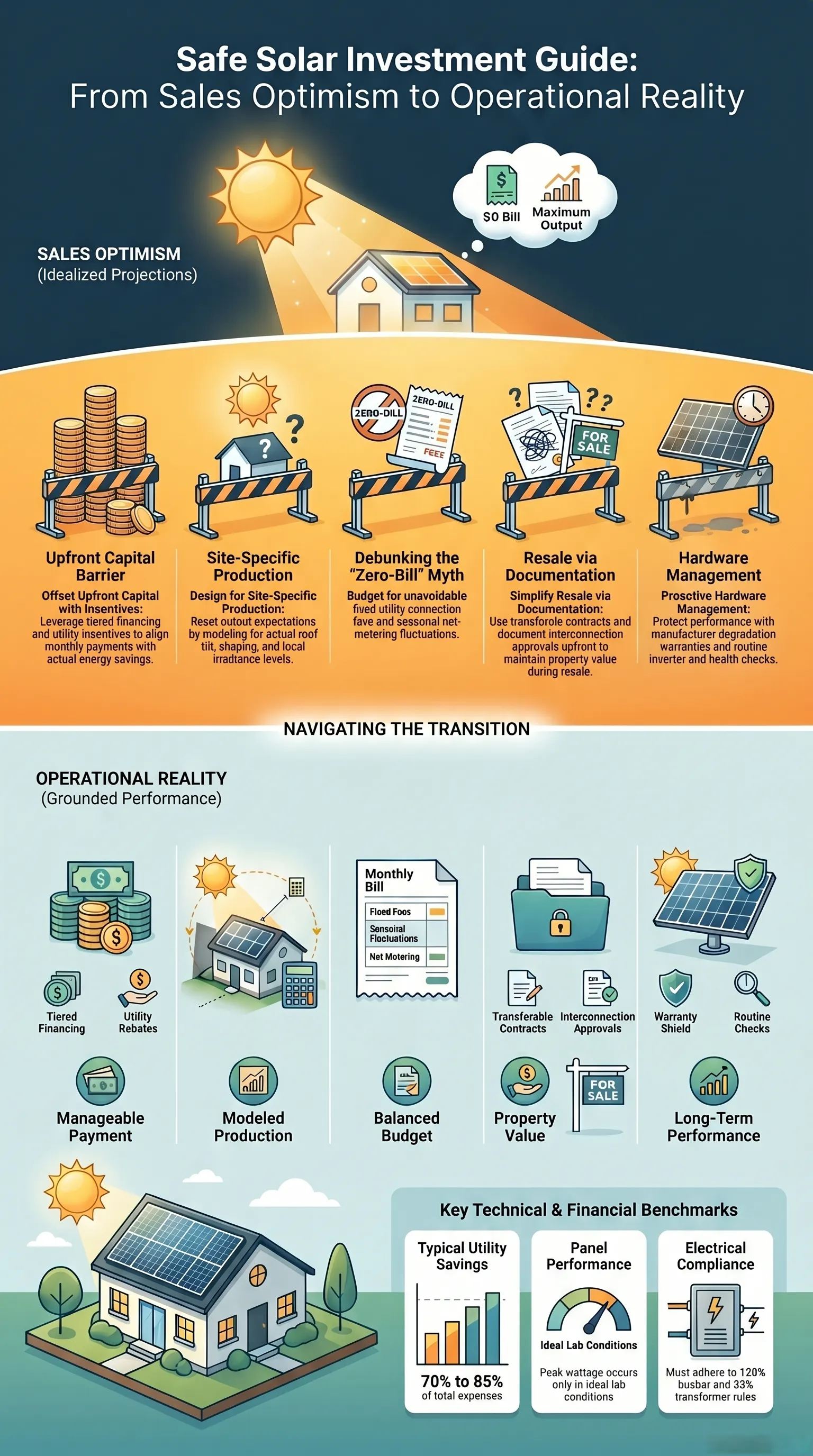
The five most common friction points are:
1 - steep upfront costs with uncertain payback timelines
2 - actual output that rarely matches a panel’s “rated” wattage
3 - unavoidable grid-tied fees that prevent true zero-dollar bills
4 - complex interconnection rules that complicate home resale
5 - long-term component degradation that demands proactive management.
But how to mitigate risks ?
> Offset upfront capital by leveraging tiered financing models, utility incentives, and power purchase agreements that align monthly payments with your actual energy savings.
> Reset production expectations by designing around site-specific irradiance, roof tilt, and shading remember, a 400W panel only hits that peak under ideal lab conditions, not on a cloudy Tuesday.
> Reframe the “zero bill” myth by budgeting for fixed utility connection fees and seasonal net-metering adjustments that naturally fluctuate with weather and wholesale rates.
> Simplify resale and code compliance by documenting your interconnection approvals upfront, mapping the 120% busbar and 33% transformer rules to your electrical panel, and structuring owned or transferable contracts that appraisers and buyers clearly understand.
> Protect your hardware with MPPT charge controllers, routine inverter health checks, and manufacturer degradation warranties that keep performance stable for decades.
I’ve watched too many projects lose momentum because the sales conversation prioritized optimism over operational reality. When consultants lead with transparent modeling—showing exactly where credits apply, where fixed charges remain, and how system limits interact with local grid policies—frustration evaporates before installation day.
By mapping out interconnection constraints, sizing systems to actual load profiles instead of theoretical maximums, and preparing homeowners for their first few billing cycles, we turn skeptical buyers into confident advocates who understand exactly what they’re investing in and why it still outperforms traditional utility dependency.
Solar remains one of the most reliable ways to lock in predictable energy costs and future-proof your property, but only when planned with eyes wide open. A system that consistently cuts 70% to 85% of your utility expenses while hedging against annual rate inflation is still a massive financial win.
If you’re evaluating solar for your home or guiding clients through the decision, focus on lifetime value, regulatory readiness, and realistic performance modeling.
#SolarEnergy #CleanEnergy #EnergyConsulting #HomeSolar #SolarROI #NetMetering #RenewableEnergy #EnergyTransition