


For over a century, grid operators have used an evolving set of technologies to manage power flows across the transmission system. From reactors and capacitors to phase-shifting transformers (PSTs) and, more recently, power-electronics-based devices, each generation of technology has expanded the tools available to grid operators as transmission networks have grown more complex.
As generation and load patterns become more variable, transmission operators are managing a wider range of power flow conditions. At the same time, utilities are looking for ways to maximize the use of existing transmission infrastructure, accelerate load connections, and enhance reliability and energy deliverability. These needs are driving growing interest in Advanced Power Flow Control (APFC) technologies, which use power electronics to dynamically direct electricity across the grid without relying solely on mechanical devices.
One Vermont station has become an important proving ground for demonstrating how APFC technologies could support the grid in years to come. In February 2021, a Phase Shifting Transformer (PST) at Vermont Electric Power Company’s (VELCO) Sandbar Station failed, disrupting a critical piece of Vermont's transmission infrastructure. To address the failure, a replacement was transported more than 60 miles to restore power-flow control. The failure exposed a broader concern: increasing mechanical tap changes driven by volatile power flows were placing additional stress on the transformer.
Rather than relying solely on a conventional replacement, VELCO began exploring whether advanced power electronics could reduce mechanical wear while providing more flexible management of power flows. VELCO collaborated with EPRI to coordinate federal funding and lead an independent assessment of the technology, and with Smart Wires to develop and evaluate a new approach through a demonstration project at the Sandbar Station.
Smart Wires’ SmartValve is a Modular Static Synchronous Series Compensator, or M-SSSC. Unlike a PST, which adjusts power flow through mechanical tap changes, the SmartValve uses power electronics to rapidly adjust the electrical characteristics of a transmission path, directing power toward or away from it. These devices are installed in transmission grids to optimize network flows, improve system visibility and controllability, and increase utilization of existing transmission assets.
VELCO is leading implementation of the project on its transmission system, while Smart Wires is providing the SmartValve technology. EPRI is leading the research and independent technical evaluation and was instrumental in securing federal support through the U.S. Department of Energy's Grid Resilience and Innovation Partnerships (GRIP) program. DOE is providing 50% of the project's total budget, matched by an equal cost-share from the project partners, to evaluate whether APFC technologies could both reduce stress on aging infrastructure and increase the transfer capability of the Vermont-New York transmission interface.
At Sandbar, the SmartValve will complement, rather than replace, the PST. The two technologies will work together, with the SmartValve providing dynamic power flow adjustments and the PST serving as the underlying mechanical control device. By allowing SmartValve to make more frequent dynamic power flow adjustments, the PST is expected to require fewer mechanical tap changes, reducing wear on the transformer. The configuration also provides a measure of resilience by maintaining some power flow control capability if the PST is unavailable.
For EPRI, the project is serving as a testbed for broader industry knowledge. Drawing on EPRI’s Grid-Enhancing Technologies for a Smart Energy Transition (GET SET) initiative, EPRI is evaluating the operational, economic, and reliability impacts of APFC technologies at scale, and how they can support a more flexible and efficient grid. EPRI is also conducting a comprehensive assessment of SmartValve's performance and durability on the VELCO system to help utilities better understand the technology's long-term value.
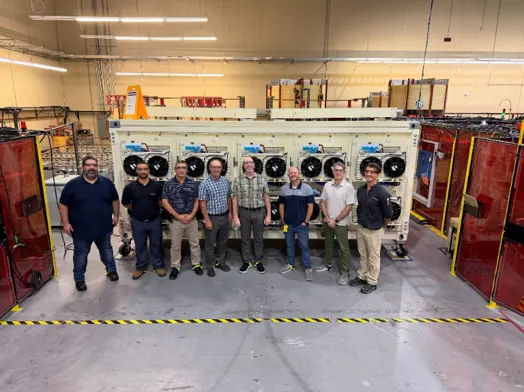
The project, which started in mid-2025, has reached several key milestones. Early-stage work included permitting, equipment procurement, engineering studies, and economic and technology evaluations. In August 2026, the project team participated in a Factory Acceptance Test (FAT) of the first of 12 SmartValve modules planned for Sandbar Station, a significant milestone ahead of delivery and installation. Site construction is scheduled for completion in May 2027, with commissioning and in-service testing to follow later that year.
The benefits of this research will extend beyond one Station. Researchers will evaluate whether improved control across the Vermont-New York transmission interface can reduce mechanical stress on the existing PST, increase usable transfer capability, strengthen system resilience, and enable more efficient use of existing transmission infrastructure. The findings will be shared through technical reports, workshops, and industry conferences to help other utilities weigh similar solutions with greater confidence.
As phase-shifting transformers and other aging transmission assets approach rehabilitation or replacement, utilities increasingly face decisions about whether conventional equipment remains the best solution or whether power-electronics-based technologies can provide additional flexibility. The Sandbar project will provide real-world operating experience and performance data to help inform those decisions.
Years after a single tap changer failed at a Vermont substation, that incident has become a broader industry case study of how traditional transmission equipment and advanced power electronics can work together. The lessons from the Sandbar project and the subsequent research aren’t just about replacing equipment. They are about rethinking how power flows are managed and using new technologies to build a more flexible and resilient transmission system.
Acknowledgment: This material is based upon work supported by the Department of Energy, Office of Electricity, under Award Number DE-GD0000897.
Disclaimer: This report was prepared as an account of work sponsored by an agency of the United States Government. Neither the United States Government nor any agency thereof, nor any of their employees, makes any warranty, express or implied, or assumes any legal liability or responsibility for the accuracy, completeness, or usefulness of any information, apparatus, product, or process disclosed, or represents that its use would not infringe privately owned rights. Reference herein to any specific commercial product, process, or service by trade name, trademark, manufacturer, or otherwise does not necessarily constitute or imply its endorsement, recommendation, or favoring by the United States Government or any agency thereof. The views and opinions of authors expressed herein do not necessarily state or reflect those of the United States Government or any agency thereof.