


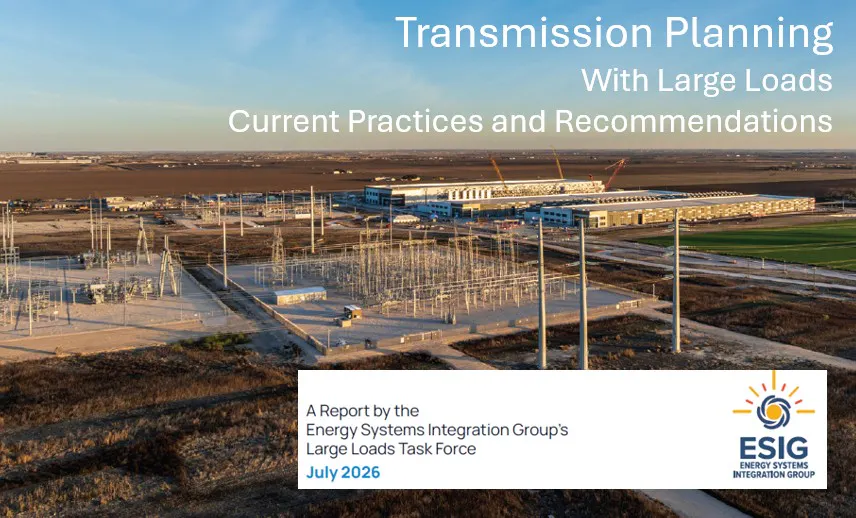
Every so often, our industry produces a report that does more than summarize current practices - it helps reshape the conversation. The Energy Systems Integration Group's (ESIG) newly released Transmission Planning with Large Loads: Current Practices and Recommendations is one of those publications. Developed by ESIG's Large Loads Task Force with contributions from utilities, regional transmission organizations, national laboratories, government agencies, consulting organizations, equipment manufacturers, and independent experts, the report provides a thoughtful roadmap for addressing one of the electric industry's most significant challenges: how to expand transmission capability quickly enough to support unprecedented growth in electricity demand while maintaining reliability and affordability.
The report deserves recognition because it does not advocate for a single technology or planning philosophy. Instead, it acknowledges that tomorrow's grid will require a combination of better planning, improved coordination, operational flexibility, advanced technologies, and long-term engineering discipline. In an industry where discussions often become polarized around individual solutions, this balanced perspective is both refreshing and important.
The timing could hardly be better.
Artificial intelligence, hyperscale data centers, advanced manufacturing, electrification, hydrogen production, and domestic industrial expansion are changing electricity demand faster than most planners imagined only a few years ago. Individual facilities requiring hundreds of megawatts - or even more than a gigawatt - are now becoming increasingly common. Meanwhile, the transmission projects needed to serve those customers often require seven to ten years to permit, design, and construct. That fundamental mismatch between customer expectations and infrastructure development timelines lies at the heart of the report's recommendations.
Perhaps the report's greatest contribution is that it recognizes the challenge is not simply one of building more transmission. Certainly, significant investments in new regional and interregional transmission will remain essential. However, the report repeatedly emphasizes something equally important: the infrastructure already in service must become substantially more productive. Existing transmission corridors, substations, and rights-of-way represent valuable assets whose capability can often be expanded far more quickly than entirely new transmission systems can be developed.
That observation resonates strongly with me because it reflects a broader engineering principle that extends well beyond transmission planning. Throughout my career, I've found that successful infrastructure projects rarely begin by asking, "What should we build?" Instead, they begin by asking, "How can we obtain more value from the assets we already have?" The report reaches a remarkably similar conclusion. Before defaulting to entirely new construction, planners should carefully evaluate opportunities to increase the productivity of the existing transmission system through improved planning practices, operational enhancements, Grid Enhancing Technologies (GETs), advanced transmission technologies, and other proven engineering solutions.
This concept might best be described as Infrastructure Productivity.
Historically, transmission planning focused primarily on maintaining reliability while accommodating relatively predictable growth. Today's environment demands something more. Transmission assets must not only remain reliable; they must also deliver greater capacity, greater flexibility, faster customer interconnections, improved resilience, and better long-term economic value. Measuring the productivity of existing infrastructure - how much additional capability can safely and economically be obtained from today's network - may become one of the defining engineering challenges of the coming decade.
Closely related is another recurring theme throughout the report: headroom. The authors emphasize that utilities should proactively identify and create transmission headroom rather than waiting for each successive customer request to expose the next system limitation. Headroom is no longer simply unused capacity. It represents planning flexibility, future opportunity, and the ability to respond quickly when new customers arrive. It also reflects an important change in planning philosophy - from reacting to demand toward preparing for it.
Equally compelling is the report's discussion of speed to power. Increasingly, large customers make investment decisions based on how quickly reliable electrical service can be provided. While new transmission infrastructure remains essential, projects measured in decades or even ten-year development cycles may not align with commercial realities. The report correctly recognizes that utilities need practical engineering solutions capable of expanding transmission capability within existing corridors while larger long-term investments continue through planning, permitting, and construction.
That observation naturally shifts the conversation from simply increasing transmission mileage to increasing deliverable capacity.
Deliverable capacity is ultimately what customers purchase. Whether achieved through new transmission lines, reconductoring, grid-enhancing technologies, operational improvements, flexible operating practices, or a combination of these approaches, the objective remains the same: safely delivering more reliable power to where it is needed. Focusing on deliverable capacity encourages planners to evaluate all practical engineering solutions rather than defaulting to traditional approaches.
Another aspect of the report I particularly appreciated is its discussion of Grid Enhancing Technologies and advanced transmission technologies. Rather than presenting these as alternatives to conventional transmission expansion, the report treats them as complementary engineering tools. Dynamic line ratings, topology optimization, advanced power flow controllers, remedial action schemes, high-performance conductors, and related technologies each contribute differently depending upon local system conditions and planning objectives. That is exactly how engineering decisions should be made - evaluating the complete toolbox rather than searching for a single universal solution.
As someone who has spent more than two decades working alongside utilities implementing advanced transmission technologies, I found this perspective particularly encouraging. At CTC Global, we have been fortunate to support utilities around the world as they increase transmission capacity using advanced ACCC® Conductors while minimizing environmental impacts and making productive use of existing infrastructure. More recently, innovations such as the GridVista™ System reflect another important trend highlighted throughout the report: combining physical infrastructure improvements with better operational visibility and system intelligence. Neither represents a complete solution by itself, but both contribute to the broader objective the report consistently emphasizes - making the existing grid more capable, more flexible, and better prepared for future growth.
Perhaps the report's most forward-looking recommendation is its embrace of scenario-based planning and least-regrets engineering. Rather than optimizing infrastructure solely for today's forecast, the authors encourage planners to evaluate multiple plausible futures and select investments that remain valuable regardless of how demand ultimately evolves. That philosophy closely mirrors sound engineering practice. The most successful infrastructure projects are rarely those optimized exclusively for current conditions. They are the projects that preserve flexibility, accommodate expansion, and continue delivering value as technologies, markets, and customer needs inevitably change.
I also appreciated that the report consistently avoids portraying technology as the primary answer. Technology certainly matters, but engineering judgment matters more. Better planning, improved coordination, common assumptions, integrated workflows, realistic scenarios, and collaborative decision-making ultimately determine whether individual technologies deliver their full value. That may be the report's most important lesson.
The electric power industry is entering what will likely become the largest transmission expansion in generations. Supporting artificial intelligence, advanced manufacturing, electrification, and domestic economic growth will require substantial investment, but equally important will be investing wisely. Success should not be measured simply by the number of miles of transmission constructed. It should be measured by how effectively those investments increase infrastructure productivity, deliver additional capacity, improve resilience, reduce environmental impacts, and prepare the grid for future generations of customers.
The ESIG report makes an important contribution by encouraging exactly that broader perspective. It reminds us that the future of transmission planning is not simply about building more - it is about engineering better.
CTC Global congratulates the Energy Systems Integration Group, the Large Loads Task Force, and the many contributors representing utilities, regional transmission organizations, national laboratories, consulting organizations, equipment manufacturers, government agencies, and industry experts who collaborated on this outstanding publication. Their work provides a valuable framework for one of the most important engineering conversations our industry will have over the coming decade, and we are proud that many of the advanced transmission solutions our industry has been developing and deploying already support the collaborative, forward-looking objectives outlined throughout this excellent report.