


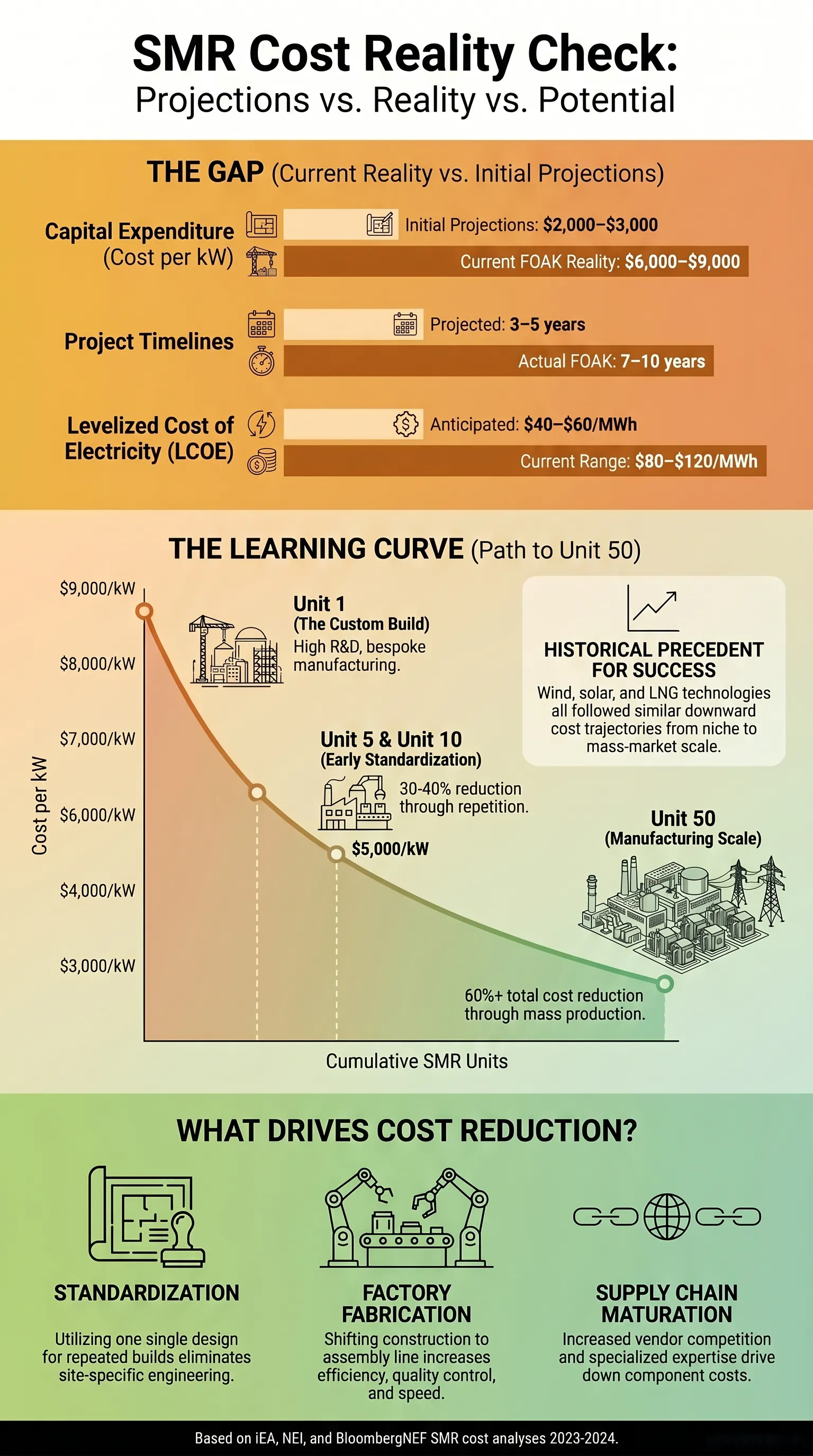
Let's address the elephant in the room: SMR cost projections haven't matched reality—yet. You've seen the headlines promising $2,000/kW and 5-year deployment timelines. Then came the reality checks: NuScale's project cancellations, rising cost estimates, and timelines stretching to 10+ years. It's frustrating, especially when clean energy can't wait. But here's what most analyses miss: every transformative technology follows a learning curve, and SMRs are still on the steep, expensive first steps. The question isn't whether the economics work—it's how we navigate the journey from prototype to production.
The gap between projection and reality comes down to three factors. First: First-of-a-Kind (FOAK) costs. Building the first SMR design means paying for licensing, supply chain development, and workforce training—all upfront expenses that won't recur. Second: economies of scale haven't kicked in yet. The promise of factory fabrication requires sustained demand to justify production lines, but we're still in custom-build territory. Third: regulatory pathways, while improving, add time and cost to early projects. Industry analysts from IEA to BloombergNEF acknowledge this "valley of death" between demonstration and deployment—but they also point to historical parallels in wind, solar, and LNG that eventually delivered dramatic cost reductions through standardization.
Transparency matters: we won't see $2,000/kW on Project One. Realistic estimates for early SMRs range from $6,000-$9,000/kW, with construction timelines of 7-10 years. But here's the critical distinction: these are FOAK projects. The learning curve analysis suggests that by the 10th unit, costs could drop 30-40%; by the 50th, we're looking at potential 60%+ reductions if manufacturing scales as planned. This isn't optimism—it's the pattern we've seen in aerospace, shipbuilding, and renewable energy. The key is sustained commitment: enough projects to move down the curve, supported by smart policies that share early-stage risk without distorting long-term markets.
So what should stakeholders believe? Expect early SMRs to be premium-priced clean firm power—valuable for grid reliability and industrial decarbonization, but not yet cost-competitive with mature technologies on price alone. The economic case strengthens when you factor in capacity value, grid services, and carbon reduction targets. Realistic expectations + transparent cost tracking + commitment to standardization = credible pathway to affordability. The savings aren't a promise; they're a projection based on proven industrial learning.
#SMR #NuclearEnergy #EnergyEconomics #CleanEnergy #LCOE #EnergyTransition #AdvancedNuclear #Decarbonization #EnergyPolicy #LearningCurve