The nuclear energy debate has a blind spot. And it has had it for fifty years.
While the industry argues about Hinkley Point C cost overruns, whether SMRs will ever reach commercial scale, and whether nuclear has a future at all — one reactor design has been operating reliably across seven countries on three continents, achieving capacity factors above 90%, running on natural uranium without any enrichment required, and refuelling at full power without shutdown.
It is called the CANDU Pressurised Heavy Water Reactor. And it barely features in mainstream nuclear energy discourse.
In Episode 07 of the Renewable Energy Mall & Engineering Review, I examine the CANDU PHWR with the rigour the technology deserves — and the honesty its limitations require.
Here is what the engineering actually shows:
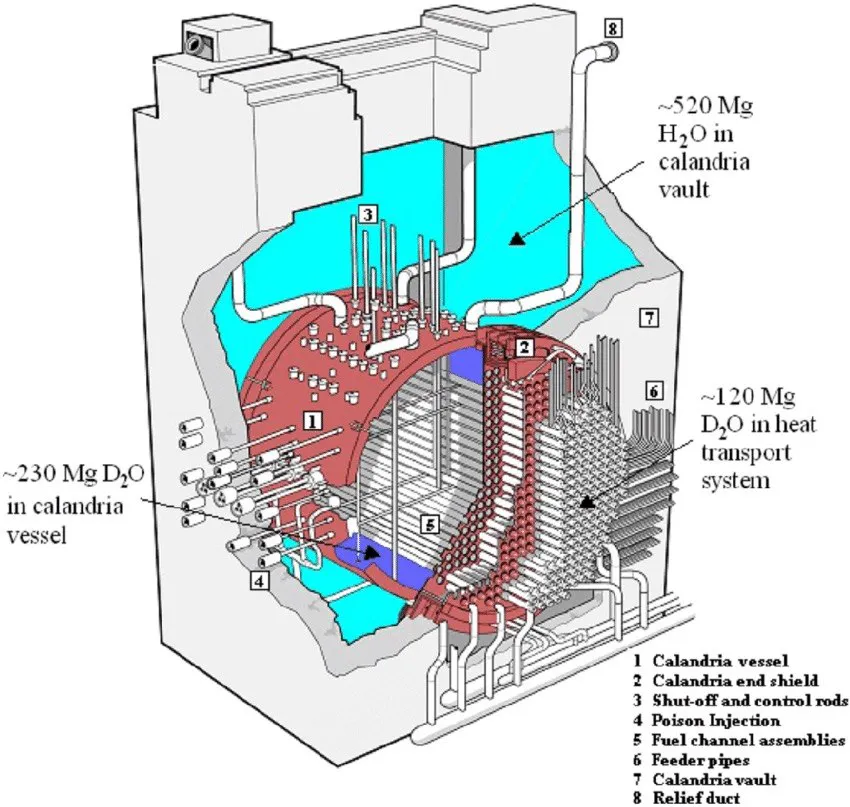
The CANDU makes a single foundational design choice that diverges from every conventional light water reactor: it uses heavy water — deuterium oxide — as both moderator and coolant. Deuterium absorbs neutrons far less readily than ordinary hydrogen, dramatically improving neutron economy. The consequence is fundamental. A CANDU achieves criticality using natural uranium at its naturally occurring 0.7% U-235 concentration, without enrichment. The moderator is enriched. The fuel is not. That inversion — enriching water instead of uranium — is the decision that gives the reactor its most distinctive properties.
On-power refuelling follows directly from the pressure tube architecture. Individual horizontal fuel channels can be disconnected, defuelled, and refuelled by remote-controlled fuelling machines while the reactor runs at full power. No shutdown. No planned outage. CANDU reactors have sustained load factors exceeding 90% over extended periods. Romania's Cernavodă Unit 1 has achieved some of the highest lifetime capacity factors of any reactor globally. Canada's Point Lepreau operated for over 894 continuous days on one occasion.
Fuel flexibility is the property that receives least attention and arguably deserves the most. A CANDU can run on natural uranium, slightly enriched uranium, recovered uranium from PWR spent fuel — which exits light water reactors at 0.8–0.9% U-235, still above natural levels — mixed oxide fuel, and thorium-uranium cycles. Approximately 4,000 MWe of conventional PWR capacity generates enough recoverable uranium to fuel 1,000 MWe of CANDU capacity. The CANDU can run on what light water reactors consider waste.
The limitations are real and stated honestly in the full article. Heavy water costs hundreds of dollars per kilogram. Spent fuel volumes per unit of electricity are higher than PWR. The positive void coefficient requires careful operational discipline and two independent shutdown systems. These are not trivial constraints. They do not, however, negate a fifty-year commercial operating record across Argentina, Canada, China, India, Romania, South Korea, and Pakistan.
The Africa dimension is where the strategic stakes become most acute. Africa holds 18% of global uranium reserves and imports essentially 100% of its enriched nuclear fuel. The CANDU is the only commercially mature reactor technology that closes that gap entirely — converting domestic uranium into domestic electricity without requiring enrichment facilities, Western fuel supply chains, or the geopolitical relationships that access to enriched fuel entails. Romania chose CANDU over Soviet reactor designs in the 1980s precisely as a statement of energy independence from Moscow. The geopolitical logic available to African nations considering nuclear is structurally identical. The technology that enables it is the one their nuclear planning conversations are barely including.
The episode also examines the global deployment record in detail — South Korea's use of CANDU experience to build sovereign nuclear industrial capability, Argentina's 25-year life extension of the Embalse plant demonstrating longevity economics, and India's fully independent PHWR programme as the clearest global demonstration of nuclear fuel sovereignty in practice.
The nuclear debate will not improve until the full landscape of commercially proven technology is honestly assessed. CANDU belongs in that assessment.
📖 Read the full analysis on Medium: 👉 https://donfackfortune.medium.com/the-reactor-the-nuclear-debate-forgot-what-the-candu-phwr-can-actually-do-39bed819af62
📩 Read on Substack: 👉 https://open.substack.com/pub/donfackfortune/p/the-reactor-the-nuclear-debate-forgot?r=7ivxz0&utm_campaign=post&utm_medium=web&showWelcomeOnShare=true
REM — Renewable Energy Mall & Engineering Review | Episode 07 Authored by Donfack Fortune — Mechanical Engineer & Energy Systems Analyst 🏢 Follow REM: https://www.linkedin.com/company/112016019