


For decades, "nuclear power" meant one thing: 600–1,600 MWe giants, built as custom mega-structures over 10+ years, with all the cost overruns and financing risk that come with a project of that scale.
Small Modular Reactors (SMRs) are rewriting that playbook.
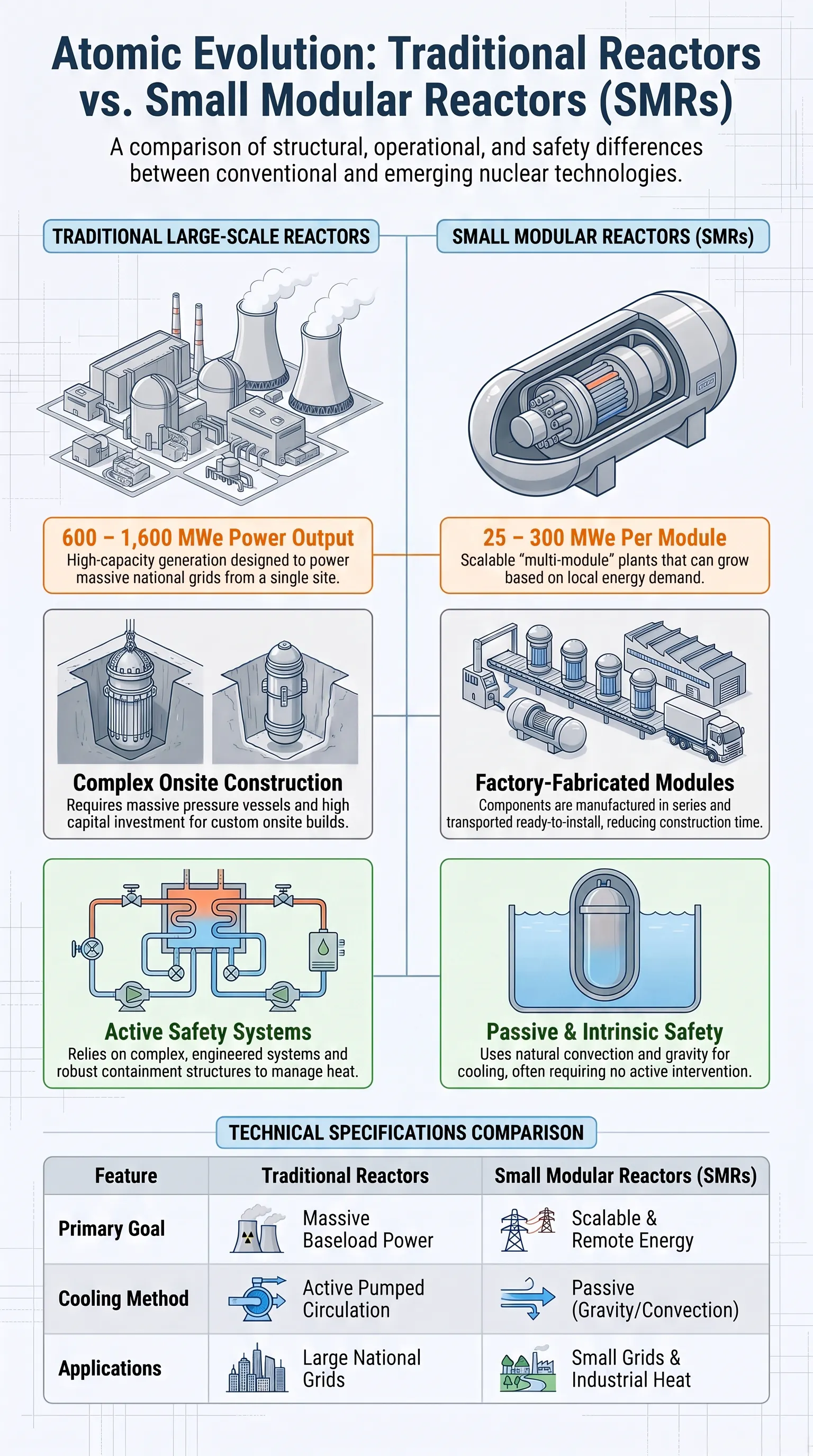
1. From civil engineering marathon to precision manufacturing
Traditional plants are one-off structures, built on-site over a decade — every delay compounds. SMRs (25–300 MWe) flip that: components are factory-built, then shipped for incremental assembly on-site — closer to aircraft manufacturing than power plant construction.
→ Learning curves replace one-off risk — the 10th unit beats the 1st
→ Capital isn't locked up for a decade before the first watt
→ Deployments scale with real demand, not gigawatt-scale assumptions
→ Nuclear becomes viable for grids that never justified a traditional plant
2. Safety by physics, not by procedure
Traditional plants rely on active systems — pumps, backup power, constant oversight — to keep the core cool. It works, but requires everything to work at once, as Fukushima made clear.
SMRs let physics do the job instead: natural convection and gravity-driven cooling let many designs shut down and cool themselves with zero external power or human intervention — a redesign of the risk model, and a direct answer to nuclear's public trust gap.
3. Where this actually matters: flexibility
Traditional plants will keep anchoring national grids — that baseload role isn't going anywhere. But SMRs reach places traditional nuclear never could:
→ Remote mining operations, far from transmission infrastructure → Off-grid islands currently dependent on diesel → Heavy industry needing constant, high-temperature process heat → Grids too small to absorb a gigawatt-scale asset without destabilizing them
Nuclear stops being an all-or-nothing bet and becomes a tool sized to the problem.
4. The honest caveats
First-of-a-kind costs are still high — economics only work once production scales. Regulation built for gigawatt plants is still catching up, and fuel supply chains (HALEU, for many designs) remain a bottleneck. Passive safety reduces risk; it doesn't remove the need for rigorous siting and waste oversight.
SMRs aren't a silver bullet — just a genuinely different tool than the reactors we've built for 60 years.
Bottom line: SMRs don't replace traditional nuclear or renewables — they fill the gap neither can reach: firm, clean power sized for remote grids and industrial heat, built to fail safely by default.
#NuclearEnergy #SmallModularReactors #SMR #CleanEnergy #EnergyTransition #NuclearPower #PassiveSafety #AdvancedNuclear #LowCarbonFuture #InnovationInEnergy