


TAE Fusion Lassos Trump Media Firm in $6 Billion Merger
TAE Fusion Lassos Trump Media Firm in $6 Billion Merger
Modelling A Star In A Jar – In Seconds at UKAEA
Rutherford Energy Ventures Partners with ORNL / DOE to Commercialize Fusion
TAE Fusion Lassos Trump Media Firm in $6 Billion Merger
Trump Media & Technology Group (TMTG) announced it will merge with TAE Technologies, a fusion power company, in a 100% stock transaction valued at $6 Billion. TMTG’s financial commitments and stock price are built on a foundation of the shifting fortunes of the crypto currency world. Conlfict of interest concerns revolve around the deal.
The combined company expects to site and commence construction of the first utility-scale fusion power plant in 2026. The target date for launching an operating 50 MWe fusion power plant is 2031. The firm declined to announced any non-binding MOUs with data centers or any other customers.
Like all other fusion startups globally, it has not yet achieved a net energy output that exceeds the energy input needed to drive the firm’s fusion design.
Competition is intense among the 53 fusion startups in the U.S., and from fusion centers of excellence in the U.K., Germany, and Japan as well as from private sector efforts in these countries.

Trump Media & Technology Group Corp. (TMTG) and TAE Technologies, Inc. announced the signing of a definitive merger agreement to combine in an all-stock transaction valued at more than $6 billion.
Upon closing, shareholders of each company will own approximately 50% of the combined company. The transaction values each share of TAE common stock at $53.89 per share. (Image: Google Gemini)
As part of the transaction, TMTG has agreed to provide up to $200 million of cash to TAE at signing and an additional $100 million is available upon initial filing of the Form S-4 with the SEC.
TAE said in its press statement it has raised more than $1.3 billion in private capital to date from Google, Chevron Technology Ventures, Goldman Sachs, Sumitomo Corporation of Americas, NEA, the visionary family offices of Addison Fischer, the Samberg Family, Charles R. Schwab, among others.
The transaction is expected to create one of the world’s first publicly traded fusion companies. Most other fusion developers are privately held. The deal combines TMTG’s access to capital and TAE’s fusion technology. The deal is an improbable and unanticipated lash up between TAE, a fusion energy start up and the “in your face” social media giant that includes President Trmup’s Truth Social platform. The THTG firm is funded by its higly volatile crypto currency business as well as by conventional investors.
In 2026, the combined company of THTG and TAE plans to site and begin construction on the world’s first relatively small utility-scale fusion power plant (50 MWe) trade named “Copernicus.” The focus is on developing infrastructure and fabrication of components and systems for the fusion energy machine.
Additional fusion power plants are planned by TAE and are expected to be 350–500 MWe range. TAE is expected to seek Power Purchase Agreements (PPAs) with major AI hyperscalers like Microsoft, Google, or Amazon within the next 12 months. TAE has declined to discuss any PPA deals that may be in the works.
Last July TAE and Google updated information on their working relationship. Google engineers worked onsite at TAE facilities to co-develop advanced plasma reconstruction algorithms, with the objective of significantly improved plasma lifetime and performance. However, this technical relationship does not include a deal for power via a PPA between TAE and Google for its data centers.
Google’s integration into TAE’s engineering teams has helped the company unlock a practical path to economic fusion and was instrumental in enabling the technical breakthrough that now paves the way for TAE’s next milestone: validating net energy capability in its Copernicus reactor. Google’s renewed commitment to TAE follows a thorough technical and commercial evaluation of TAE’s distinctive fusion approach.
Fusion Firms’ Investor Committments Ranked
In terms of the competition, TAE is ranked second behind Commonwealth Fusion which has raised over $2 billion and ahead of third ranked Helion which has raised $1 billion. It is unclear how much more money TAE will need to raise to build its first full scale fusion machine.

According to the 2025 annual report of the Fusion Industry Association, amounts needed to get to the first of a kind unit vary by design type and maturity of the technology as well as power outputs. There are about 50 different ways to produce fusion energy. In the U.S. there are startups for most of them. (Chart” Fusion Industry Association)
The median amount for 19 fusion of the larger developers was about $700M more that is needed to produce a working commercial scale prototype to generates more energy than it uses.
Risk Assessment – Competition, Scientific, and Business Risks
Competition to win the fusion race is intense. While TAE is in third place in terms money raised among the 53 fusion energy firms listed in the2025 annual report of the Fusion Industry Associaiton, the total amount of money raised by any of them is not a surrogate for technical progress. Competition with TAE to cross the finish line with net energy achieved is intense and any of of the other 52 U.S. based firms have the potential for a technical breakthrough that will set the rest of the pack back on their heels.
The competitive threat of a breakthrough isn’t limited to the U.S. In the U.K. the UKAEA has established a global center of excellence for fusion energy R&D at its Culham site near Oxford University. The facility is home to the UKAEA’s anchor fusion project, called the STEP Fusion Tokamak.
UK Industrial Fusion Solutions Ltd (UKIFS), a wholly owned subsidiary of the UK Atomic Energy Authority (UKAEA) Group, will lead the delivery of the STEP program to design and build the UK’s first prototype fusion energy plant. The UKAEA promotes the project by saying the STEP Fusion effort “is about more than tokamak technology — it’s a huge endeavour encompassing design, site development and construction, alongside supply chain logistics and industry.”
The UKAEA also announced this month, using the snappy slogoan of “modeling a star in a jar,” that an advanced AI tool has been developed by its scientists for simulating fusion plasma, supporting designs for fusion power plants.
However, based on the concept that if you can’t beat them, join them, TAE and the UKAEA in December partnered to commercialize advanced fusion technology. The new joint venture will develop neutral beams for fusion and accelerator innovations for non-fusion applications, creating high-skilled jobs and establishing a critical supply chain for fusion energy machines.
Germany has two important fusion projects. Scientific Amecian reported last July that breakthroughs from two rival experiments, Germany’s Wendelstein 7-X and the Joint European Torus, suggest the dream of controlled nuclear fusion may be within reach for one or both of them.
In Japan fusion energy start-up Helical Fusion, a small startup, achieve a key milestone toward commercial reactor. It completed a critical performance test of a high-temperature superconducting (HTS) coil, marking a major milestone toward realizing commercial nuclear fusion energy. Also, World Nuclear News reported Tokyo-based fusion company Helical Fusion has signed a power purchase agreement with Aoki Super Company, a major regional supermarket chain in central Japan. It is the the first fusion-energy PPA ever signed in Japan.
Japan-based Kyoto Fusioneering has begun testing a new hydrogen recovery system, a critical step toward solving one of the main challenges for commercial fusion energy: establishing a continuous fuel supply. Kyoto announced the release of its conceptual design on 11/26/25. Also in November, Kyoto announced announce that its joint venture with Canadian Nuclear Laboratories (CNL), Fusion Fuel Cycles Inc. (FFC), has begun construction of UNITY-2 — the world’s first integrated tritium fuel cycle system test facility capable of full-loop operations.
On the other hand, last September 12 Japanese firms invested in Commonwealth Fusion, a chief competitor to TAE. Competition from Japan isn’t limited to the private sector. The Japanese government has funded a fusion energy R&D program which it calls a “moonshot” effort to realize the early application of high-temperature superconductors to fusion reactors . The consortium of Japanese companies working to accelerate fusion development in the country is also collaborating with relevant govenerment agencies to develop a regulatory framework for fusion energy.
According to two expert assessments of China’s progress with fusion energy, China is making progress towards deploying fusion energy as a commercial offering at a significantly faster rate than the US or any other western nation.
In an April 2025 article in IEEE Spectrum, the assessment is that China is on the verge of surpassing the US in the quest for commercial nuclear fusion.
In a July 2025 article in MIT Technology Review a team of four experts in fusion science report that the nation is first in time to market with commercial fusion will achieve this outcome due to success in developing the complex supply chains and the ability to build fusion plants at a scale large enough to drive down economic costs.
The fusion field faces daunting scientific and business risks. Fusion faces significant hurdles in achieving “net energy gain” (Q>1) on a commercial scale. If the combined firm fails to deliver a reactor by the 2026–2027 target, it could make it difficult for other fusion startups to raise funds and could lead to regulatory crackdowns on these kinds of investments. If, on the other hand, the stock remains high, other private fusion competitors like Helion Energy or Commonwealth Fusion Systems may face pressure to go public before they are ready to give up large chunks of their expected equity to outside investors.
Linking scientific R&D to a stock influenced by political news cycles may lead to high volatility caused by popularity contests influencing stock prices unrelated to business value. Donald Trump is the majority owner of TMTG. Questions have been raised regarding potential conflicts of interest if the U.S. Department of Energy awards grants to the company.
Potential conflicts of interest could result in litigation or other forms of legal stumbling blocks. The New York Times wrote about in an editoral headlining the point that putting the president’s financial interests in competition with other energy companies over which his administration holds sway is major issue for the emerging field of fusion startups. Trunp hasn’t hesitated to insert himself in mega mergers including a recent effort to influence a deal involving the consolidation of movie production and streaming services firms.
“Mr. Trump’s stake in Trump Media, recently valued at $1.6 billion, is held in a trust managed by Donald Trump Jr., his eldest son. He will be on the boadd of the combined firm. Trump Media is the parent company of Truth Social, the struggling social-media platform. The merger would set Trump Media in a new strategic direction, while giving TAE a stock market listing as it continues to develop its nuclear fusion technology.”
Michl Binderbauer, chief executive of TAE, said in an interview (with the NYT) that he had struck the deal with Trump Media for “the capital available and the will to boldly deploy that on this project.”
The other side of the crypto coin for TAE is that if TMTG experiences unanticipated financial difficulties, it won’t have the cash to keep its commitments to pay TAE $300 million in expected cash to further develop its fusion business.
About TAE’s Fusion Device
According to a report by World Nuclear News, TAE’s approach to fusion combines advanced accelerator and plasma physics, and uses abundant, non-radioactive hydrogen-boron (p-B11) as a fuel source. The proprietary magnetic beam-driven field-reversed configuration (FRC) technology injects high-energy hydrogen atoms into the plasma to make the system more stable and better confined.

For a fusion machine to produce electricity, it must keep plasma steadily confined at fusion-relevant conditions. On TAE’s current fusion machine, eight powerful neutral beams are placed at precise angles to meet those requirements.
Inside each neutral beam canister, protons are accelerated and then combined with electrons to create a stream of neutral, high-energy hydrogen atoms (the ‘neutral beam’). Because the particles have no charge, they can bypass the fusion reactor’s magnetic field to provide heating, current drive and plasma stability. TAE is the first developer to use neutral beams for both FRC plasma formation and high-quality plasma sustainment – which it says results in a streamlined design that is smaller, more efficient and more cost-effective.
The same accelerator technology which produced TAE’s sophisticated neutral beam system for fusion has also been adapted for TAE’s medical technology subsidiary, TAE Life Sciences, to provide a non-invasive, targeted treatment for complex and often inoperable cancers.
TAE also has a partially-owned power subsidiary – TAE Power Solutions – which has developed innovative energy storage and power delivery systems to serve multiple industries, including AI data centers, industrial users, and electric vehicles.
& & &
Modelling A Star In A Jar – In Seconds
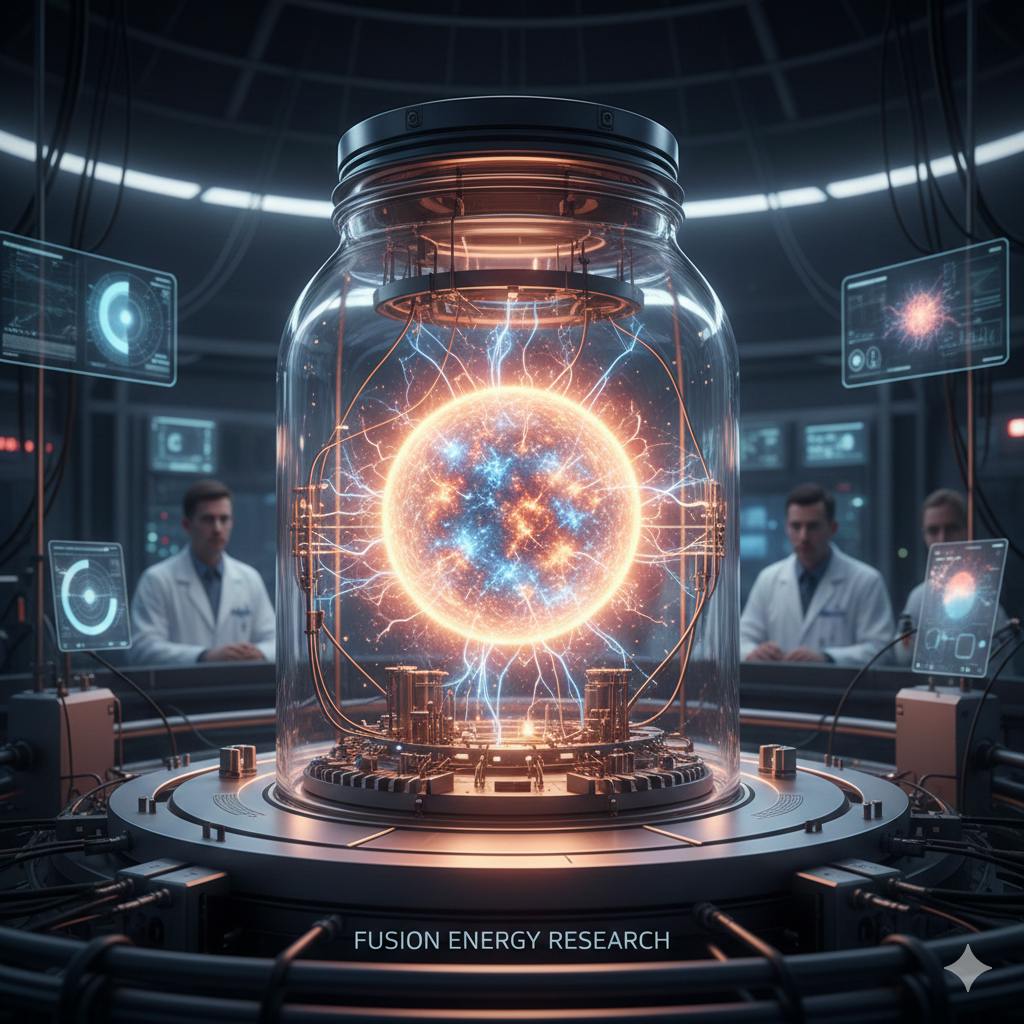
An advanced AI tool has been developeds for simulating fusion plasma, supporting designs for fusion power plants. ( ‘Star in a Jar’ image by Google Gemini)
Scientists at the UKAEA have developed an AI tool which can perform complex fusion plasma modelling in seconds rather than hours or days
Accurately modelling plasma turbulence is essential for the development of future fusion power plants. Traditional simulations were extremely slow and computationally expensive
Leveraging AI and supercomputing to model plasma turbulence faster, at a fraction of the cost, is an essential step towards fusion energy on the grid
The team of scientists from UK Atomic Energy Authority (UKAEA), the Johannes Kepler University (JKU) Linz, and Emmi AI, have developed an AI tool named GyroSwin, which can create simulations up to 1,000 times faster than traditional computational methods.
Computer scientists and fusion experts have developed an AI model capable of creating complex five-dimensional (5D) plasma turbulence simulations within seconds and at a fraction of previous costs. The team says this development is paving the way for faster and more accurate design of future fusion power plants.
However, to achieve fusion, machines need to confine plasma at extreme temperatures using powerful magnets. Managing turbulence within the plasma is a key fusion challenge so it needs to be accurately modelled. (Image: Google Gemini)
Plasma scientists rely on state-of-the-art numerical simulations, using five-dimensional (5D) gyrokinetics, which includes three spatial dimensions plus two additional dimensions which account for parallel and perpendicular velocity of particles within the plasma. This 5D approach requires immense supercomputing power. Traditional simulations are extremely slow and computationally expensive, significantly lengthening design and development cycles.
Previously, computation methods simulated a plasma by actively calculating the complex plasma dynamics. GyroSwin uses the latest AI methods to learn the 5D simulation dynamics and the resulting surrogate models can run in seconds, in contrast to the hours or even days for conventional simulations. This speed allows for much faster, more agile prediction of plasma turbulence, crucial for optimizing fusion machine designs.
Rob Akers, Director of Computing Programs at UKAEA said:
“Designing, developing, and operating a fusion power plant will involve millions of plasma simulations. Reducing runtimes from hours or days to minutes or seconds – while preserving sufficient accuracy – will be essential for making this challenge manageable.”
“Pioneering AI-based tools like GyroSwin therefore show great promise for being genuinely transformative around time-to-solution and cost. Processing 5D data has never previously been tackled by an AI surrogate model, and GyroSwin outperforms other AI methods it’s been compared against.”
This increased performance is made possible because GyroSwin preserves key physical information from a fusion plasma, including the length scale of fluctuations, and the sheared flows that can reduce turbulence. Akers nots there are all crucial to the physical interpretability of plasma simulations.
UKAEA will now research how GyroSwin’s advanced capability can be applied to next generation power plants such as the UK’s Spherical Tokamak for Energy Production (STEP), where millions of simulations will potentially be required to optimise plasma scenario designs with uncertainty quantification. As more complex physics is included for power plant conditions, simulations become even more lengthy, making faster plasma modelling essential.
This project was part-funded by the International Computing element of the UK Government’s Fusion Futures Program. Fusion Futures builds world-leading innovation to stimulate industry capacity through international collaboration and the development of future fusion power plants, while International Computing develops global computing collaborations to help design and deliver the commercial fusion era.
& & &
Rutherford Energy Ventures Partners with ORNL / DOE to Commercialize Fusion

Rutherford Energy Ventures and the U.S. Department of Energy are collaborating to pilot an innovative public-private partnership framework designed to accelerate the development of critical infrastructure and enabling technologies required for commercial fusion power.
The pilot will establish FULCRA (Fusion Upscaled Leveraged Consortia for Rapid Acceleration), with Oak Ridge National Laboratory (ORNL) serving as the site for an initial pilot program under this new form of collaboration.
According to the announcement, the U.S. fusion energy ecosystem has reached a pivotal moment. Private-sector developers have made substantial advances in plasma physics and key technologies, with more than $11 billion in private capital driving progress toward burning-plasma demonstrations and prototype systems.
However, fusion materials and nuclear technologies—including blanket systems, tritium handling, fuel cycle systems, radiation-hardened materials, and integrated component test facilities—remain insufficiently developed in part due to a lack of testing capabilities.
Without these capabilities, the fusion companies cannot validate commercial designs, qualify supply chains, or demonstrate reliability at scale. As competitors, including China, accelerate their national fusion infrastructure programs, DOE says immediate action is needed to close these technology gaps.
Rutherford said in its press statement, “FULCRA exemplifies a practical, results-oriented approach to building the infrastructure our fusion sector needs.”
Initial pilot program at ORNL
The pilot at ORNL will focus on mapping existing fusion-relevant infrastructure and designing the first Fulcrum consortium. REV will work with ORNL technical teams to evaluate operational frameworks and engage potential private-sector partners.
As the pilot progresses, the DOE and REV plan to refine the model for potential expansion to other national laboratories, with the aim of securing American leadership in the global fusion market against competitors such as China.
Scope of the Partnership
To solve these material challenges, FULCRA will establish specialized testing capabilities designated as “Fulcrums.” Each Fulcrum will target specific hurdles in fusion materials science and nuclear technology.
ORNL and REV will work with the DOE to addresses these gaps through a consortium model that strategically combines federal assets with private sector investment to accelerate technology readiness. The initiative is designed to address a specific “technology gaps” in the US fusion ecosystem.
To bridge these gaps, FULCRA has identified four key technology areas that require immediate development.
First, the partnership aims to develop radiation-hardened materials capable of withstanding the intense neutron bombardment and high temperatures within a fusion reactor for decades.
Second, it seeks to establish reliable methods for handling tritium fuel—a radioactive isotope of hydrogen—and “breeding” new tritium within the reactor blanket.
Third, the initiative also focuses on designing and testing integrated blanket systems, which form the internal layer that captures fusion energy as heat and generates new tritium.
Fourth, FULCRA intends to create the integrated component test facilities necessary to validate commercial designs, qualify supply chains, and demonstrate component reliability at an industrial scale.
“Achieving commercial fusion energy requires far more than advances in plasma science—it demands validated engineering solutions, qualified materials, and integrated industrial systems at scales never before demonstrated,” concluded Dr. Jean Paul Allain, Associate Director for Fusion Energy Sciences at the DOE.
“The private fusion sector has brought unprecedented momentum to plasma science, but experience in fusion nuclear environments represents the next critical step for the entire field,” added Prof. Dennis Whyte, Co-founder of REV and MIT Professor of Nuclear Science and Engineering.
“Every fusion company, regardless of its confinement approach, will not only need these technologies but also experience operating in this environment to achieve economic viability.”
# # #