


What they are SMRs are nuclear power reactors that are “small” (typically 10–300 MWe per unit, vs. 1,000–1,600 MWe for traditional large reactors) and built modularly in factories, then shipped and assembled on site like giant Lego blocks.
The three big ideas behind SMRs
Factory-built instead of site-built 70–90 % of the reactor is manufactured in controlled factory conditions (think shipyard or aircraft factory). Result: higher quality, shorter construction time (3–4 years vs. 8–12+ for big plants), and much lower cost overruns.
Smaller size = simpler & inherently safer Less fuel, smaller core → even in the worst imaginable accident, the amount of heat and radioactivity is far lower. Many designs can cool themselves passively for days or weeks using gravity and natural convection — no pumps, no external power, no operator action needed.
Modular & scalable Start with one or two modules for a remote mine or small island. Need more power later? Just truck/ship/barge in another identical module and plug it in.
1. What “Small” and “Modular” Actually Mean in Practice
Small: ≤ 300 MWe per module (most are 15–150 MWe). A single large traditional reactor = 4–10 SMRs.
Modular: 70–95 % of the plant leaves the factory essentially complete. You are literally shipping a finished nuclear steam supply system by truck, train, barge or even heavy-lift ship (think SPMT trailers you see carrying wind blades, but with a reactor inside).
2. The Five Real Reasons the Industry Is Betting Billions on SMRs
Construction disasters killed gigawatt projects Vogtle & VC Summer (US), Flamanville (France), Hinkley Point C (UK) → 2–4× budget overruns, 6–10 years late. SMRs move the risk from a muddy field to a controlled factory.
Financial markets hate 12-year, $15 bn bets Wall Street & private equity love 3–4 year projects they can finance in tranches. First-of-a-kind SMRs are already seeing Google, Microsoft, Equinor, and even Jeff Bezos writing checks.
You can’t put 1,200 MWe in 80 % of the places that need carbon-free power Most grids outside Europe/China/US simply can’t absorb a gigawatt in one chunk.
Passive = boringly safe Many SMRs can sit for 7–30 days with zero power, zero pumps, zero operator action and still stay cool using gravity and natural circulation.
Learning curves work again The 1970s–80s proved that building 100 identical large reactors drives costs down. We forgot that lesson. SMRs bring it back.
3. The Physics Tricks That Make SMRs Different
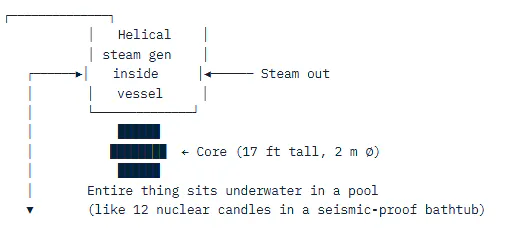
Integral primary circuit (NuScale, SMART, RITM): All steam generators inside the vessel → no large-break LOCA possible.
TRISO fuel (Xe-100, HTR-PM): Each particle is its own tiny containment. Tested to 1,800 °C without failure.
Natural circulation for life (many designs): Core at the bottom, steam generators/riser 15–30 m above → convection does the job forever.
Low pressure or no pressure (helium, sodium, lead, molten salt designs) → vessel ruptures don’t flash coolant to steam.
Load-following capable (Oklo, some molten-salt designs) → can ramp 100 % in <30 min → perfect for grids with lots of wind/solar.
4. Where SMRs Will Actually Win First (2025–2035)
Coal plant graveyards (U.S., Poland, Czech Republic, Indonesia)
Data-center microgrids (Microsoft already signed for 3 sites)
Arctic & remote mining (Canada, Australia, Greenland)
Island nations (Philippines 2028 feasibility, Caribbean SMR coalition)
Industrial process heat & hydrogen (Dow + X-energy, Constellation + hydrogen hubs)
5. The Real Remaining Hurdles (I’m not selling you a fairy tale)
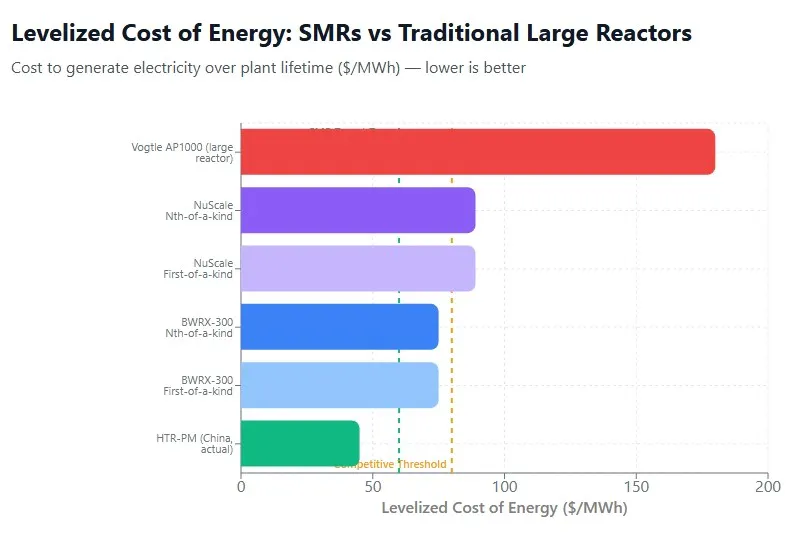
First-of-a-kind premium still exists (NuScale’s cost went from $55/MWh → $89/MWh when UAMPS numbers were updated).
Fuel fabrication for non-light-water designs is still scaling up.
Regulatory harmonization between countries is a nightmare.
Supply chain for HALEU (High-Assay Low-Enriched Uranium) is only now coming online (Centrus, Orano, Rosatom).
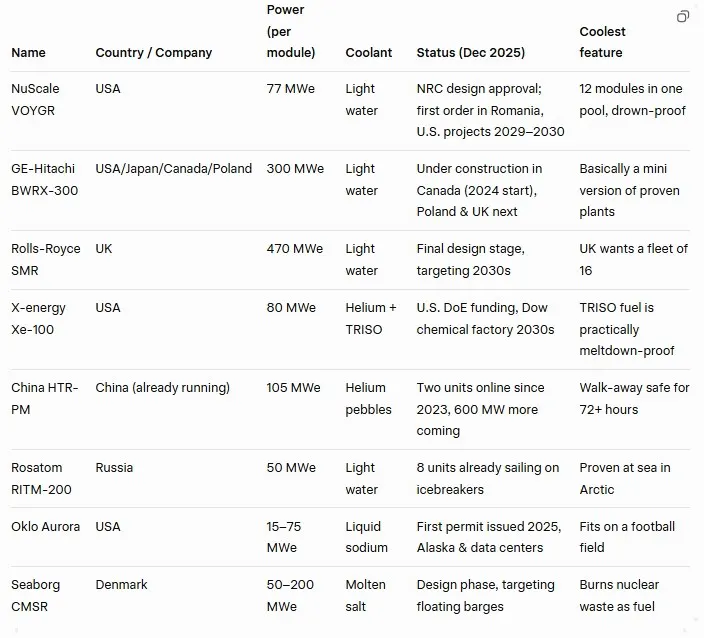
NuScale VOYGR – 77 MWe Integral PWR
GE-Hitachi BWRX-300 – The “simplest Gen-III+ on Earth”
No external pumps
No large pipes below core elevation
Only 8 isolation valves total (vs. 300+ in classic BWR)
Real photo of the 1:1 mockup in Warsaw
X-energy Xe-100 – Pebble-Bed TRISO Magic
Helium in → 750–950 °C out
60 cm fuel pebbles (golf-ball-sized TRISO particles inside)
One pebble = 15,000 TRISO kernels
Each kernel = uranium particle + 4 ceramic layers that survive 1,800 °C
Diagram: “What happens if you lose all cooling?” → Pebbles just sit there and glow, never melt
Oklo Aurora – Liquid Metal Fast Reactor in a Shipping Container
15 MWe version literally fits inside an A-frame building the size of a basketball court
Sodium-cooled, metallic fuel
Can load-follow from 0–100 % in <20 minutes → perfect for pairing with solar
Real photo of the 1:3 scale prototype running in Idaho
China HTR-PM – The One That’s Already Running
Two 250 MWt reactors feeding one 210 MWe turbine
Side-by-side pebble spheres (graphite balls the size of billiard balls)
Outlet temperature 950 °C → ready for hydrogen or process heat
Drone photo of Shidaowan site, December 2023 – both units glowing at night
Seaborg CMSR – The Waste-Burning Floating Power Barge
Molten salt fuel (liquid at 700 °C)
No high pressure
Burns spent nuclear fuel from traditional reactors
Artist render + real molten-salt test loop in Copenhagen
6. Cost Evolution
✅ HTR-PM (OPERATING) - $45/MWh Already at target. China built two units, learned fast, costs stabilized. This is the proof-of-concept the West is chasing.
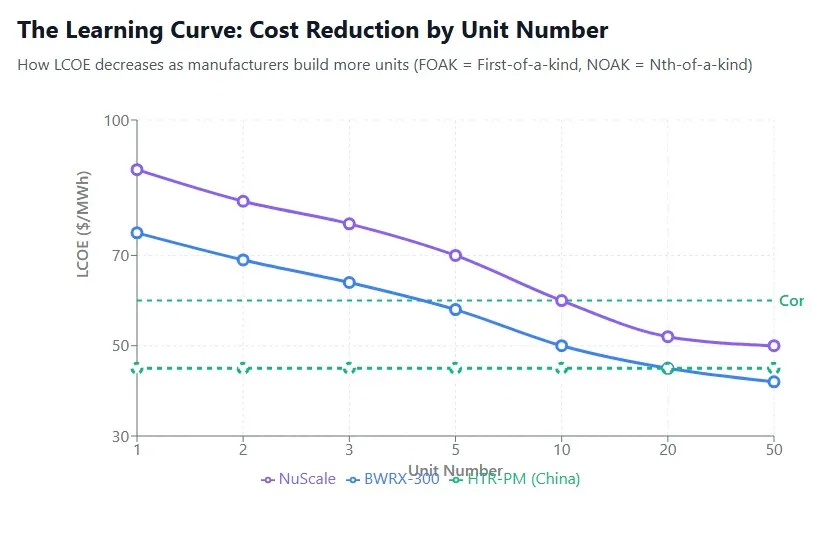
📉 SMR TARGET (2030s) - $40-55/MWh NuScale & BWRX-300 target 40-44% cost reduction by unit #10-20 through factory production, supply chain maturity, and regulatory learning.
💀 VOGTLE AP1000 - $180+/MWh $35 billion total. 14 years late. Killed the U.S. large reactor industry. This is what SMRs are designed NOT to become.
📐 The Math Behind the Curve:
Learning rate assumptions: ~15% cost reduction per doubling of cumulative units for SMRs (vs ~5% for traditional large reactors). By unit #10, costs drop 30-35%. By unit #20, costs drop 40-45%. China's HTR-PM started lower and stayed flat because they built with manufacturing efficiency from day one. Western designs start higher but have steeper learning curves as factory production scales.
Data sources: NuScale Power LCOE analysis (2022), GE-Hitachi BWRX-300 economic assessments, China National Nuclear Corporation HTR-PM operational data, Vogtle Units 3&4 final cost reports, U.S. EIA electricity generation cost database
Bottom Line
We are no longer debating IF SMRs will be built — the first three designs are already in concrete or water. The question is now: which ones will dominate the 2030s the way French PWRs dominated the 1980s.
My personal bet? A three-way split:
Light-water SMRs for OECD countries that love familiarity
High-temperature gas for industry & hydrogen
Fast-spectrum metal/salt for waste-burning and ultimate fuel efficiency.
Where they actually make the most sense (not everywhere!)
Remote communities & mines (Canada, Alaska, Australia)
Islands & small countries (Indonesia, Philippines, Caribbean)
Industrial heat & hydrogen production
Replacing coal plants on the exact same site (coal-to-nuclear)
Data centers & AI factories that need 100–500 MW 24/7 with zero carbon
Military bases & desalination plants
Bottom line SMRs are not a magic bullet that will replace every gigawatt reactor tomorrow, but they are the first nuclear technology in 40 years that can be:
Built on time and budget (finally)
Placed where big plants can’t go
Financed by private money (many projects now have Google, Microsoft, Equinor, etc. as customers)
2025–2035 will be the decade we find out if the promises hold. The first concrete is already being poured.
The Economics That Actually Matter
For Investors
SMR: $500M-2B per unit, 3-4 year payback horizon, proven at scale in China.
Large reactor: $10-35B, 10-15+ year build, massive execution risk. Only governments can stomach this.
For Utilities
SMR: Start with 50 MW, add 200 MW later. Match capacity to demand growth. Manageable financing.
Large reactor: 1,000+ MW or nothing. Hope demand grows into it. Bet the company.
For Climate
SMR: Deployable by 2027-2030 at scale. Manufacturing ramp similar to wind turbines. Can make 50+ per year.
Large reactor: 5-10 globally per decade if we're lucky. Too slow, too expensive, too risky for 2050 targets.
Data sources: IAEA Advanced Reactors Information System (ARIS), U.S. NRC licensing database, World Nuclear Association SMR tracker, company announcements and regulatory filings (2024-2025)
#SMR #SmallModularReactors #NuclearEnergy #AdvancedNuclear #CleanEnergy #EnergyTransition #NetZero #NuclearRenaissance #HTRPM #NuScale #BWRX300 #Xe100 #Oklo #MoltenSalt #TRISO #NuclearInnovation #ClimateTech #FutureOfPower #CarbonFree #GenIV #Energy2025 #NuclearComeback #SMRsAreHere #CoalToNuclear #DataCenterPower #HydrogenEconomy #ArcticEnergy