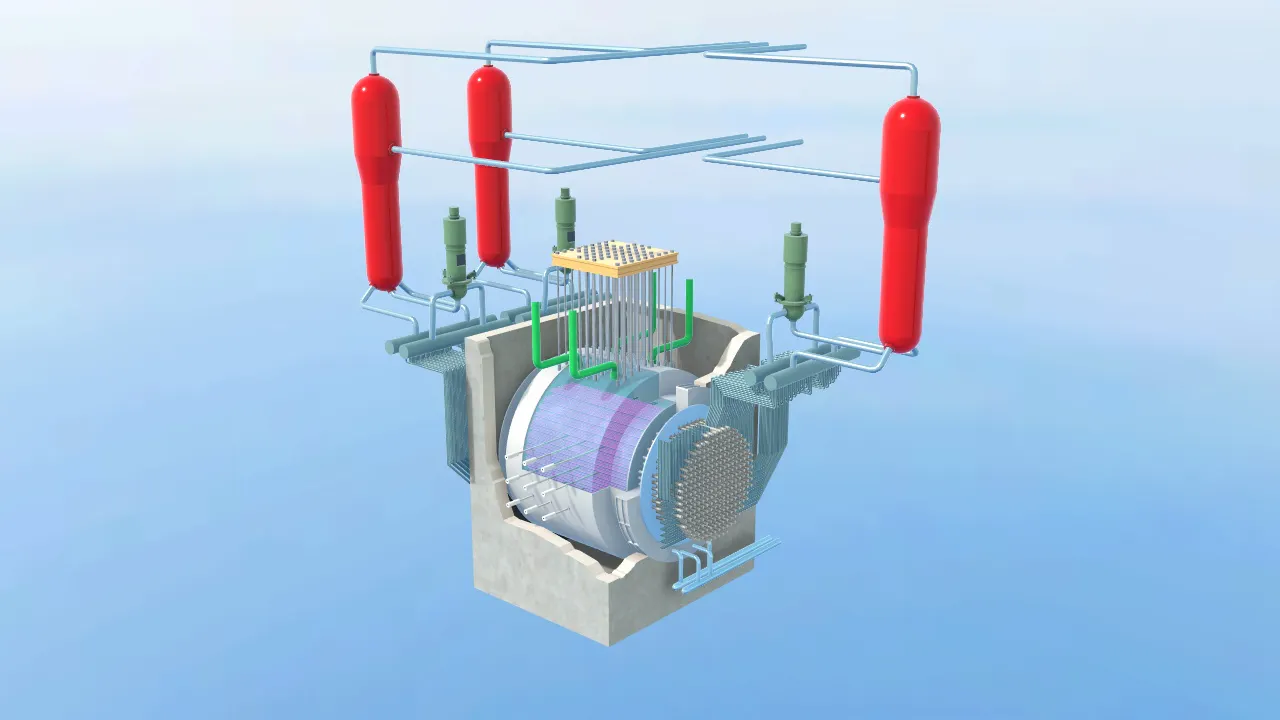
The market edition of Episode 07 of the Renewable Energy Mall & Engineering Review examined the CANDU Pressurised Heavy Water Reactor from a strategic and operational perspective — its fifty-year commercial record, its fuel sovereignty proposition, and its underrepresentation in Africa's nuclear planning conversations.
The Technical Edition now follows. Its purpose is different: to show practitioners why the CANDU behaves the way it does, grounded in the nuclear physics and engineering data that the market edition described in qualitative terms.
The foundational number is 0.00052 barns.
That is deuterium's thermal neutron absorption cross-section. Hydrogen's equivalent figure is 0.332 barns — a ratio of approximately 640. This is not an approximation. It is measured nuclear data, and it is the single physical fact from which the entire CANDU architecture logically follows.
The moderating ratio of heavy water — the ratio of slowing power to absorption cross-section, the key figure of merit for any moderator — is approximately 5,800. Ordinary water's moderating ratio is approximately 70. That 83-fold advantage in neutron economy is why a CANDU core can sustain a chain reaction with natural uranium at its naturally occurring 0.72% U-235 concentration. The moderator is enriched. The fuel is not. This inversion is not a design preference — it is the only rational conclusion the neutron cross-section data supports.
The architecture section works through the CANDU core layer by layer: the calandria vessel operating at near-atmospheric pressure and approximately 70°C; the CO₂ annulus thermally isolating the cold moderator from the pressurised fuel channels at 10 MPa and 290–310°C; the pressure tubes containing 12 natural uranium fuel bundles each; and the two remotely operated fuelling machines that operate simultaneously on a single fuel channel at full reactor power. The technical edition explains why the CO₂ annulus monitoring is operationally significant — moisture ingress is an early indicator of pressure tube degradation — and why the absence of refuelling outages translates directly into 4–5 percentage points of additional annual capacity factor compared to PWR peers.
The void coefficient section is the most careful in the article, because this is the characteristic most frequently cited without adequate context. The CANDU positive void coefficient — approximately +15 to 20 milli-k on complete coolant voiding — is real, bounded, and compensated by two independent shutdown systems, each independently sufficient for full reactor shutdown. Shutdown System 1 uses gravity-actuated cadmium absorber rods falling into the calandria moderator within approximately two seconds. Shutdown System 2 injects concentrated gadolinium nitrate solution at high pressure directly into the low-pressure moderator, also within approximately two seconds. The two systems are independent in logic, activation signal, and physical hardware — meeting single-failure criteria independently. The article places the void coefficient in quantitative context: a PWR control rod ejection accident inserts several times more reactivity than full CANDU coolant voiding. The positive coefficient is a managed engineering trade-off, not a hidden risk, and fifty years of commercial operation across seven countries provides the validation record that any such claim requires.
The fuel cycle economics section quantifies what practitioners need in order to evaluate the CANDU proposition against PWR alternatives. Natural uranium fuel cycle cost is approximately 50% below an equivalent PWR cycle when procurement, fabrication, and spent fuel management are all included. At a slight enrichment of 0.9%, burnup doubles from approximately 7 MWd/kgU to approximately 14 MWd/kgU, spent fuel volumes fall by approximately 50%, and power output can increase by 15–18% through improved flux distribution — with fuel cycle costs falling a further 20–30% relative to the natural uranium baseline. The recovered uranium proposition is quantified: approximately 4,000 MWe of PWR capacity generates enough dischargeable uranium — at 0.8–0.9% U-235, above natural levels — to fuel approximately 1,000 MWe of CANDU capacity with no re-enrichment. For countries operating both reactor types, this creates a genuinely circular fuel economy with no parallel in the LWR world.
The Africa section adds three technically specific dimensions not addressed in the market edition: the thorium-232 neutron capture sequence and the equilibrium U-233 content achievable in a once-through thorium cycle; the practical pathway from uranium mine output to zircaloy-clad UO₂ bundle fabrication and why this process does not require enrichment infrastructure or classified manufacturing knowledge; and a worked example of the fuel cycle synergy available to Egypt if El Dabaa PWR spent fuel is eventually processed for use in a CANDU fleet, eliminating re-enrichment cost and reducing total spent fuel volumes for both reactor types.
The article concludes with a technical verdict: the CANDU's engineering identity rests on three quantitative foundations — a measured cross-section ratio, a pressure tube architecture whose geometry is determined by moderator physics, and a void coefficient whose magnitude and compensation are both specified and validated. None of these are claims requiring extraordinary confidence. They are engineering data, supported by a commercial operating record that the nuclear conversation would benefit from engaging more seriously.
📖 Read the full Technical Edition on Medium → https://donfackfortune.medium.com/inside-the-candu-phwr-neutrons-calandria-the-void-coefficient-and-what-the-fuel-cycle-numbers-098f0cb2150e
REM — Renewable Energy Mall & Engineering Review | Episode 07 Technical Edition Authored by Donfack Fortune — Mechanical Engineer & Energy Systems Analyst 🏢 Follow REM: https://www.linkedin.com/company/112016019