


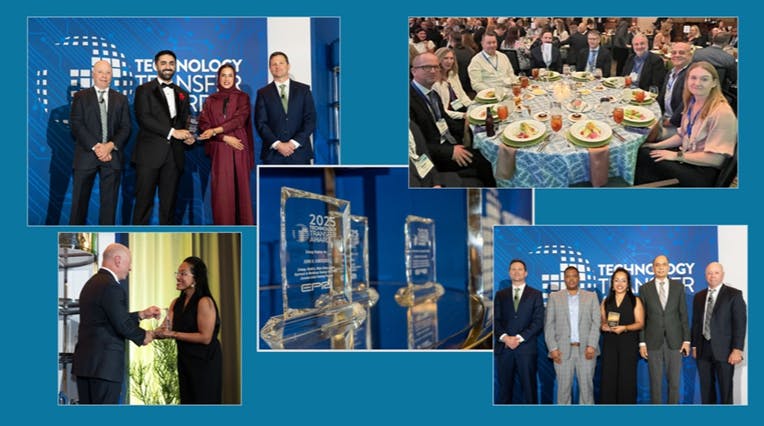
EPRI recently recognized 14 projects highlighting application of EPRI’s nuclear research for measurable improvements in safety, reliability, efficiency, cost performance, and regulatory confidence across the global nuclear fleet. The 2025 EPRI Nuclear Technology Transfer Awards were selected by the EPRI Nuclear Power Council Executive Committee out of a total of 118 nominations. Awards were presented at a ceremony in Phoenix on February 10 during EPRI’s Winter Nuclear Advisory Meeting.
Together, these winning projects demonstrate the value of collaboration and the successful transfer of research into impactful, operational practice with potential for application throughout the industry.
Vattenfall – First Qualified AI/ML Ultrasonic Inspection

At Ringhals Unit 3, Vattenfall completed the first fully qualified AI/ML-assisted ultrasonic inspection of reactor upper head penetrations using EPRI tools. The approach reduced data review effort by up to 95%, improved inspection consistency, and established a regulatory benchmark for future AI-enabled non-destructive evaluation.
Duke Energy – Enhancing Single Point Vulnerability Reliability

Duke Energy integrated EPRI’s Preventive Maintenance Basis Database (PMBD) API into its internal monitoring systems to address single point vulnerabilities (SPVs). The dynamic, automated approach improved preventive maintenance consistency, reduced unplanned trips, and strengthened safety margins, delivering an estimated $2.1 million in annual savings through avoided outages and labor efficiencies.
Électricité de France (EDF) – Non-Metallic Repairs for Spent Fuel Pool Leaks

EDF pioneered the use of non-metallic repair methods, supported by EPRI research, to mitigate spent fuel pool leaks across its nuclear fleet. The approach reduced radiological exposure, avoided underwater welding, and cut repair costs by a factor of 10 to 20 compared to traditional methods.
Constellation – Regulatory Relief for Boiling Water Reactor (BWR) Vessel Weld Inspections

Constellation became the first utility to secure U.S. Nuclear Regulatory Commission approval to eliminate challenging BWR reactor vessel circumferential weld inspections using EPRI’s updated technical basis. By applying modern fracture mechanics and probabilistic methods, the project delivered significant inspection cost savings while maintaining regulatory confidence and safety.
Entergy, NextEra Energy, and Vistra – Standardizing Initial Workforce Training

These utilities collaborated with EPRI to deploy the Common Initial Training (CIT) program, a standardized, web-based curriculum for new nuclear workers. The approach reduced instructor burden, accelerated qualification timelines, and improved workforce mobility across sites by ensuring consistent, high-quality foundational training.
Korea Hydro & Nuclear Power – Streamlining Steam Generator Eddy Current Inspections

Korea Hydro & Nuclear Power adopted EPRI’s Full System Equivalency methodology to simplify steam generator eddy current inspection validation. The standardized approach reduced inspection time, radiation exposure, and labor costs, delivering hundreds of thousands of dollars in annual savings.
DOE Hanford, Fluor, Central Plateau Cleanup Company and Liburdi Dimetrics – Autonomous Remote Welding

To safely close high-activity radioactive waste canisters, the Hanford team deployed a fully autonomous gas tungsten arc welding system based on EPRI research. The remote, code-compliant solution eliminated worker dose, reduced human variability, and is expected to save approximately $12 million over the project’s lifecycle.
China National Nuclear Power – Dispersant Technology for Steam Generator Fouling

China National Nuclear Power developed and deployed polyacrylic acid dispersant technology to reduce steam generator fouling at the Fuqing plant. Supported by EPRI guidance, the solution improved corrosion product management and is planned for deployment across more than 50 Pressurized Water Reactor (PWR) units.
Southern Nuclear – Risk-Informed Seismic Hazard Evaluation

Southern Nuclear applied EPRI guidance to assess updated seismic hazard data without rebuilding its full seismic probabilistic risk assessment. The graded approach preserved model integrity, supported regulatory confidence, and avoided up to $5 million in costs and two years of work.
Emirates Nuclear Energy Company (ENEC)– Counterfeit and Fraudulent Item Prevention

ENEC built a comprehensive counterfeit, fraudulent, and suspect item detection program using EPRI reliability guidance. The proactive approach strengthened supply chain oversight at the Barakah Nuclear Energy Plant, identifying and preventing potential risks before installation with zero safety-related failures.
Kairos Power – Accelerated Fuel Qualification for Advanced Reactors

Kairos Power leveraged EPRI’s TRISO fuel topical report to support NRC approval of its Hermes Test Reactor construction permit. By avoiding a traditional fuel qualification campaign, the company saved tens of millions of dollars and set a precedent for more efficient advanced reactor licensing pathways.
Paks Nuclear Power Plant – Equipment Reliability and Maintenance Optimization

Paks NPP implemented EPRI-supported equipment reliability processes, classifying approximately 450,000 components by criticality. The effort enabled targeted maintenance, reduced unnecessary tasks, and generated significant per-cycle cost savings while improving long-term operational efficiency.
Dominion Energy and AXPO Power – Rapid Phased Array UT for Vessel Welds


These utilities qualified and deployed a new phased array ultrasonic testing procedure for reactor vessel welds through EPRI’s NDE program. The innovation reduced inspection time from days to hours, improved flaw characterization, and delivered substantial cost and dose savings.
Ontario Power Generation and Conexus Nuclear – Multi-Unit Risk for CANDU Reactors

OPG and Conexus collaborated with EPRI to advance multi-unit nuclear risk assessment methods tailored to CANDU reactors. The enhanced framework improves modeling of tightly coupled units, strengthens regulatory alignment, and supports risk-informed decision-making at multi-unit sites worldwide.
EPRI congratulates the award winners and commends their leadership, innovation, and lasting contributions to progress across the nuclear industry.
Learn more about the awarded projects here: https://msites.epri.com/ms/sectors/044648/tta/2025