


This post is about the most expensive mistake the energy industry has made in the last 20 years and why it is now the single biggest obstacle to the AI-native grid:
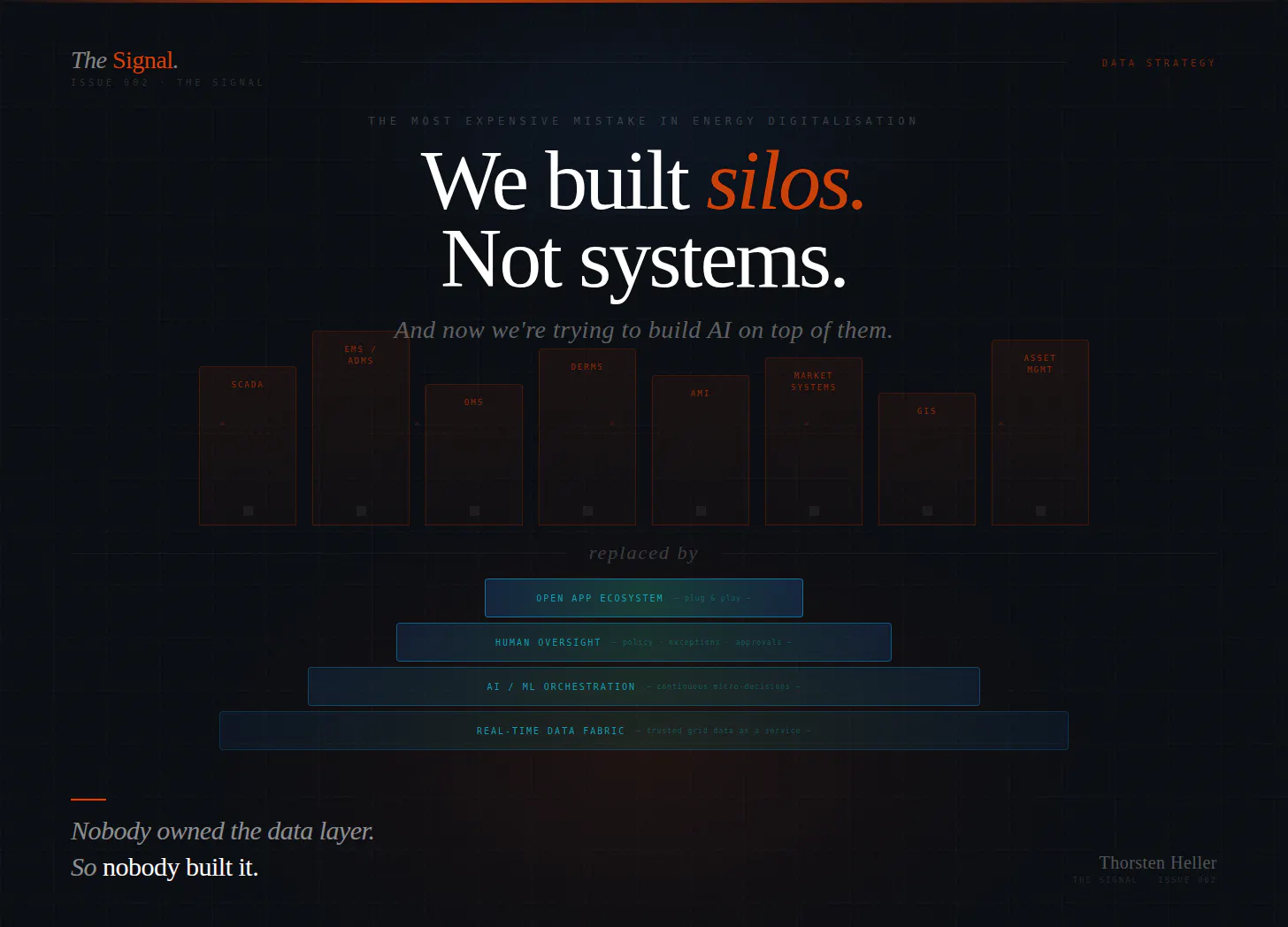
We built silos. When we should have built systems.
Let’s get into it.
Your Grid has more Data than ever
Your grid has more data than ever. But your operators are more blind than ever. How is that possible?
In the last decade, utilities have invested heavily in digitalisation. Smart meters by the million. IoT sensors across every asset. SCADA upgrades. Cloud migrations. Data lake projects. Advanced analytics platforms.
And yet I still sit across the table from grid operators who cannot answer basic questions in real time.
“Where is the fault right now?”
“How much available capacity do I have in the next 15 minutes?”
“What happens to network stability if I bring this renewable asset online?”
The data to answer those questions exists. It is being generated, somewhere in the system, right now. The problem is that it is trapped.
Trapped in SCADA. In the EMS. In the OMS. In the DERMS. In the market systems. In the AMI platform. In the asset management database. Each system a world unto itself, with its own data model, its own naming conventions, its own timestamp format, its own definition of what a “fault” or an “asset” or a “reading” actually means.
We didn’t build a digital grid. We built a digital archipelago.
Islands of data, separated by water, with no bridges between them.
And here is the irony that keeps me up at night: We are now trying to build AI on top of this archipelago.
We are pointing machine learning models at fragmented, inconsistent, latency-riddled operational data and expecting them to produce reliable, actionable grid intelligence. And when the outputs are wrong, or worse, when they are confidently wrong: we blame the AI.
The AI is not the problem. The data architecture is the problem. And it was a choice. Not an accident.
Every silo in your operational technology landscape was created deliberately. A vendor sold you a best-in-class solution for one specific problem. It solved that problem. It did not solve the problem of how its data would talk to the system you bought three years earlier from a different vendor with a different data model and a different integration philosophy.
Nobody owned the data layer. So nobody built it.
The result is what we have today: utilities managing the most complex distributed energy systems in history using a patchwork of disconnected tools that, in aggregate, produce more noise than signal.
This is not a technology problem. It is an architecture decision that was deferred for 20 years. And the bill is now due.
The good news is that the path forward is clear.
Not another application. Not another dashboard. Not another AI pilot running on the same broken foundation.
A data fabric. A unified semantic layer across the IT-OT boundary that gives every system, every operator, and every AI model access to the same trusted, contextualised, real-time view of the grid.
One source of truth. Not because we moved everything into one database. No, that ship has sailed. But because we built the layer that connects and contextualises what already exists.
The companies building that layer today are not just solving a technical problem. They are building the foundation that the AI-native grid runs on. Everything else is built on sand.
This post was adapted from my articles series about The AI-Native Grid or Agentic Grid. If you'd like deeper analysis on AI, data platforms, and the future of electric utilities, you can dive deeper on Substack.