


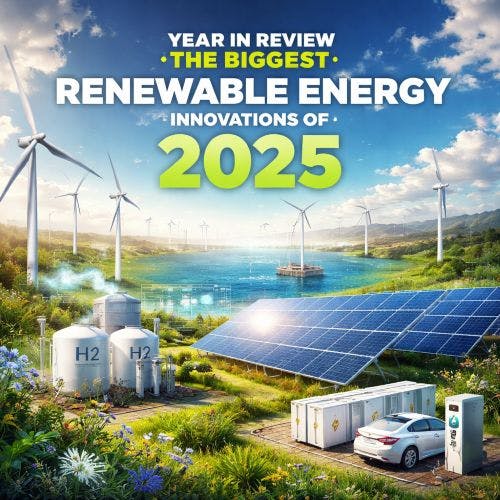
📘Why 2025 Was a Turning Point?
Renewable energy innovations in 2025 reached a point. Grid constraints, flexibility limits, and operational risk mattered as much as new capacity additions. While global decarbonization targets continued to drive deployment, real-world power systems revealed growing integration challenges.
More than 500 GW of new renewable capacity was added globally in the preceding year. Curtailment rates in several markets exceeded 10–15%. These rates underscore grid congestion and flexibility constraints (IEA¹). Solar and wind costs have declined by over 80% and 60%, respectively, since 2010. However, system complexity intensified. This is because renewables surpassed 30% of total electricity generation in multiple regions (IRENA²). Grid investment alone will exceed $470B in 2025, reflecting the scale of integration work now required.” (BloombergNEF)
As a result, renewable energy innovations in 2025 focused less on adding megawatts. They were more focused on enabling better-integrated renewables. This was achieved through AI-enabled grids, long-duration energy storage, advanced power electronics, green hydrogen, and smart, flexible buildings. This year marked the transition from scaling clean energy to making it reliable, resilient, and investable at scale.
Grid-Scale Innovation: Smarter, Faster, More Resilient Power Systems
Among these 2025 advances, grid-scale modernization emerged as a decisive enabler of high-renewable power systems. As variable renewables exceeded 30–40% of generation in multiple markets, utilities increasingly used digital intelligence and advanced power electronics to maintain reliability at lower system cost (U.S. DOE⁴). Integration pressures intensified as data-center electricity demand rises sharply this decade, forcing faster grid automation and planning upgrades (IEA¹).
AI-Driven Grid Optimization
Artificial intelligence is now embedded in real-time grid operations. AI-enabled platforms improved load and renewable forecasting accuracy to over 90–95%. This improvement enables dynamic dispatch and congestion management. It also enables optimized use of storage and flexible assets. Self-healing grid applications—using automated fault detection, isolation, and service restoration—reduced outage duration by 20–40% (U.S. DOE⁴), while predictive maintenance cut operating costs by 15–25%. For system operators, this shifted planning from static reserve margins to probabilistic, real-time risk management.
Digital Substations and Advanced Power Electronics
At the hardware level, digital substations, solid-state transformers, and advanced inverters became foundational to renewable energy innovations in 2025. Grid-forming inverters now provide synthetic inertia and voltage control, enabling renewable penetration beyond 70–80% in weak and islanded grids. This reduced reliance on synchronous generation not by substitution, but by functional replacement of inertia and voltage support.
Callout Box: Why Grid Intelligence Became as Important as Generation Capacity
By 2025, adding renewable megawatts without intelligent grid coordination increasingly lead to congestion, curtailment, and reliability risks. In power systems where renewables exceed 30–40% of generation, value shifts from capacity alone to real-time visibility, control, and flexibility.
Grid intelligence is enabled by AI, digital substations, and advanced inverters. It allows operators to forecast variability with 95% accuracy. It also optimizes dispatch and restores power 20–40% faster after faults. These capabilities reduce reserve margins, defer costly network upgrades, and unlock higher renewable penetration without compromising stability.
As a result, grid intelligence is no longer a supporting tool; it is core infrastructure, determining whether renewable energy investments deliver affordable, resilient, and bankable outcomes at scale.
Breakthroughs in Energy Storage and Flexibility
In 2025, energy storage shifted from a supporting role to a core pillar of power system reliability. As renewable penetration increased, flexibility—not just generation—became the decisive constraint on further decarbonization.
Long-Duration Energy Storage (LDES)
Long-duration energy storage moved beyond pilot status in 2025. Iron-air, thermal, compressed air, and gravity-based systems reached early commercial deployment. Unlike lithium-ion batteries, which typically provide 2–4 hours of discharge, LDES solutions now deliver 10–100+ hours of energy. This capability enables multi-day resilience. LDES is not designed for short-duration arbitrage; its value is multi-day adequacy and resilience during prolonged low-wind/low-solar periods.
Several utilities contracted LDES projects in the 100–300 MW range. They aim to enhance system reliability during prolonged low-wind or low-solar events. They also focus on reducing reliance on fossil peaking plants. LDES is not cost-competitive for intraday arbitrage but proved decisive for multi-day adequacy and extreme-weather resilience.
Hybrid Storage Architectures
Hybrid projects combining solar, wind, and storage became standard practice. Co-located assets reduced grid interconnection costs by up to 30%. They also improved capacity factors. Storage provided stacked services, including frequency regulation, operating reserves, and peak capacity. In some markets, revenue stacking improved project economics by 20–35% compared to single-service storage models.
Storage as Infrastructure, Not Just Assets
Increasingly, planners treated storage as infrastructure rather than merchant assets. Storage began appearing in transmission expansion plans, deferring network upgrades worth hundreds of millions of dollars. Regulatory reforms in 2025 further enabled revenue stacking. This unlocked investment at scale. It reinforced storage’s role as a long-term system asset.
Renewable Generation: Incremental Gains with Big System Impact
In this year’s innovations, generation technologies continued to advance. This progress was not achieved through dramatic cost breakthroughs. Instead, it was through performance, efficiency, and system integration improvements. These advancements delivered outsized impacts at scale.
Next-Generation Solar Technologies
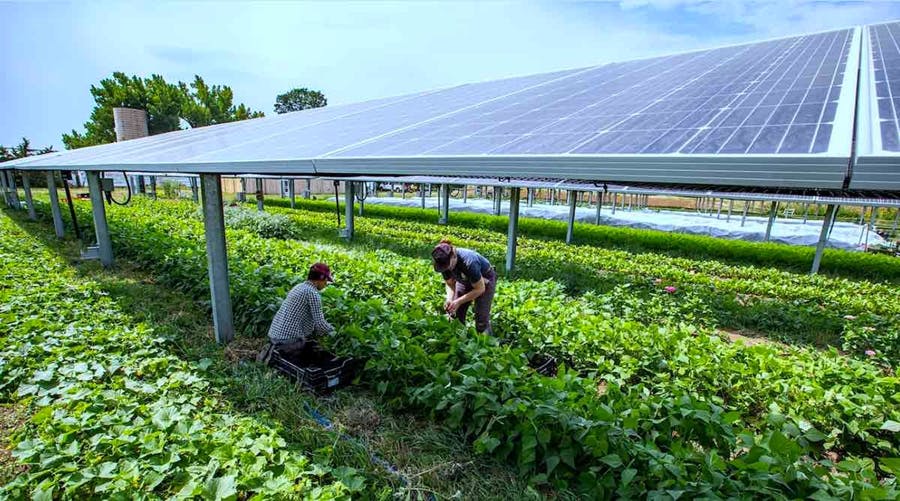
Solar innovation in 2025 focused on maximizing output per unit of land and infrastructure. Perovskite-silicon tandem cells achieved laboratory efficiencies above 30%. Early commercial modules exceeded 25%, boosting energy yield without proportional increases in cost. At the utility-scale, bifacial solar significantly increased annual generation. Single-axis tracking contributed to a 5–15% increase in generation. Meanwhile, agrivoltaics and floating solar projects expanded rapidly. Floating solar deployments surpassed 10 GW globally. These deployments reduced land constraints. They reduced water evaporation in reservoirs by up to 70%. As a result, they delivered both energy and environmental co-benefits.
Offshore and Advanced Wind Technologies
Wind power saw steady gains driven by scale and digital optimization. Floating offshore wind moved closer to commercial maturity, with individual projects exceeding 500 MW and unlocking previously inaccessible deep-water resources. Onshore, taller towers and larger rotors increased capacity factors by 10–20%. AI-optimized wind farm controls reduced wake losses and maintenance costs by 15–25%. Together, these advances reinforced wind’s role as a backbone of high-renewable power systems worldwide.
Green Hydrogen and Power-to-X: From Hype to Early Scale
Within renewable energy innovations 2025, the green hydrogen transition moved from a conceptual promise to early commercial deployment. This was particularly in sectors where direct electrification remains impractical. Despite progress, green hydrogen economics in 2025 remained highly sensitive to electricity prices below USD 30–40/MWh and sustained policy support.

Electrolyzer Cost and Efficiency Improvements
Electrolyzer technology advanced rapidly in 2025, narrowing the cost gap with fossil-based hydrogen. Alkaline electrolyzers achieved capital costs below USD 500/kW. PEM systems improved flexibility and load-following capability. They are well-suited for variable renewable integration.
Solid oxide electrolyzers (SOECs) reached electrical efficiencies above 80% (LHV basis) when operated at high temperatures. Increasingly, electrolyzers were deployed alongside curtailed wind and solar generation. They converted surplus electricity into hydrogen. This process reduced renewable curtailment by 5–10% in high-penetration systems, improving overall system economics.
Industrial Decarbonization Use Cases
Early-scale green hydrogen projects emerged in steelmaking, fertilizer production, shipping fuels, and sustainable aviation fuels. Several hydrogen-based steel plants reached capacities of 1–2 million tones per year. Ammonia projects exceeded 100–300 MW of electrolyzer capacity. E-fuels projects also surpassed this capacity.
The development of regional hydrogen hubs and export corridors indicates a significant shift. This shift is supported by public funding commitments exceeding USD 10–20 billion in leading markets. It signals a move toward integrated hydrogen value chains, positioning Power-to-X as a cornerstone of long-term industrial decarbonization.
Buildings & Demand-Side Innovation
In 2025, the demand side became a powerful lever for decarbonization. It also enhanced flexibility and resilience. This was especially true as electrification accelerated across buildings and cities. From a grid perspective, these buildings functioned as dispatchable flexibility resources rather than passive loads.
Smart, Adaptive, and Energy-Positive Buildings
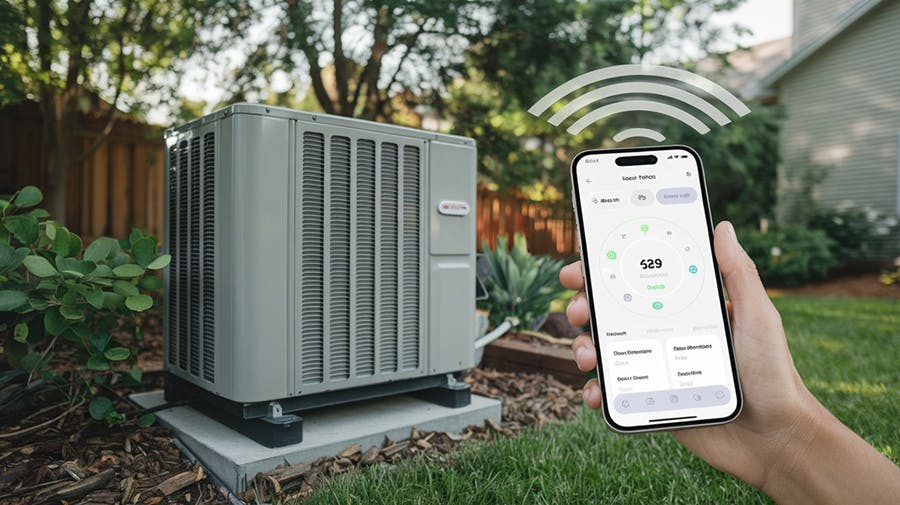
AI-enabled energy management systems moved from pilots to mainstream deployment. They are delivering 10–25% reductions in energy consumption. They also provide 15–30% peak-demand savings in commercial buildings. Advanced controls optimized heating, cooling, lighting, and EV charging in real time, responding to price signals and grid conditions.
Heat pump installations continued to grow rapidly. Global capacity additions exceeded 50 GWth annually. Meanwhile, thermal storage enabled load shifting at a fraction of the cost of batteries. Together, electrification and smart controls reduced operating costs by 20–40% and turned buildings into active grid participants.
District-Scale Solutions
At the urban scale, district cooling and heating systems powered by renewables expanded in dense cities and hot climates. They achieved 30–50% efficiency gains compared to conventional building-level systems. Meanwhile, urban microgrids and resilience hubs—often sized between 5 and 50 MW—boost energy security for critical facilities. These facilities include hospitals and emergency centers.
These systems demonstrated how coordinated demand-side innovation can unlock higher renewable penetration while strengthening climate resilience and affordability.
Digital Layer: AI, Blockchain, and Digital Twins
Digital technologies emerged in 2025 as the operational backbone for planning, dispatch, and market settlement. They enable power systems to operate efficiently. They also ensure transparency and lower risk (WEF⁵).
Digital Twins for Energy Assets and Systems
Digital twins—virtual replicas of physical assets and networks—became standard tools for utilities, developers, and system operators (WEF⁵). By simulating generation, storage, and grid behavior under thousands of scenarios, digital twins improved planning accuracy and reduced technical risk. Utilities deploying digital twins reported 10–20% reductions in lifecycle operating costs. They experienced 5–15% gains in asset performance. They also identified bottlenecks earlier, deferring capital upgrades worth hundreds of millions of dollars.
At the system scale, digital twins helped plan grids with renewable penetration of 50–70%. They optimized dispatch and maintenance schedules. These systems also strengthened resilience against extreme weather events.
Blockchain-Enabled Energy Markets
Blockchain applications matured in 2025, particularly in peer-to-peer energy trading, renewable energy certificates, and carbon accounting. Blockchain-based platforms enabled near-real-time settlement, cutting transaction costs by 30–50% compared to conventional market mechanisms. Several pilot markets facilitated trading across tens to hundreds of MW of distributed solar and storage assets. Immutable ledgers improved trust in renewable guarantees of origin. They also increased confidence in voluntary carbon markets—supporting transparent, auditable clean-energy transactions at scale.
Finance, Policy, and Market Innovation
In Renewable Energy Innovations 2025, progress was driven not only by technology. It was also driven by innovation in project financing. They were also driven by how projects were regulated and approved. As clean energy deployment accelerated, financial and institutional frameworks evolved to reduce risk, unlock capital, and shorten development timelines.
Blended finance reduces the cost of capital, not just risk
Blended finance structures—combining public funds, concessional loans, and private capital—played a critical role in mobilizing investment at scale. In 2025, these mechanisms helped crowd in private financing for renewable portfolios. These portfolios exceeded USD 100 billion (BloombergNEF³), lowering the cost of capital by 200–400 basis points. This improvement enhanced project bankability in emerging markets.
Risk-mitigation instruments, such as guarantees, first-loss tranches, and political risk insurance, played a crucial role. They supported utility-scale solar and wind projects in the 100–500 MW range. These instruments enabled the projects to reach financial close more quickly. They also reduced costs.
Carbon markets and climate-aligned disclosure
Carbon markets and climate-aligned disclosure frameworks also matured. Improved measurement, reporting, and verification enhanced market credibility. This credibility is supporting a voluntary carbon market projected to reach USD 1 trillion in value.
Faster permitting through digitalization
Meanwhile, digitalized permitting platforms reduced approval timelines by 30–60%, cutting development costs and accelerating renewable deployment. Together, these financial and policy innovations proved as consequential as technology breakthroughs in scaling the energy transition.
Callout Box: how projects are financed and approved mattered as much as the technologies themselves
By 2025, renewable energy success depended as much on how projects were financed and approved as on the technologies deployed. Even mature solutions like solar, wind, and storage faced delays. These delays were caused by permitting bottlenecks and grid interconnection backlogs. High financing costs also contributed to the delays. In response, blended finance structures, risk-mitigation instruments, and digital permitting platforms reduced project risk. They cut approval timelines by 30–60%. They also lowered the cost of capital by 200–400 basis points in many markets.
These institutional innovations unlocked utility-scale projects in the 100–500 MW range. They accelerated deployment in emerging economies. This demonstrates that scalable finance and streamlined approvals are now core enablers of the clean-energy transition. They are not secondary considerations.
What These Innovations Mean for 2026 and Beyond
Looking ahead, Renewable Energy Innovations 2025 provides a clear Roadmap for the next phase of the energy transition. This phase is defined by scale, integration, and resilience, rather than isolated technology breakthroughs.
Ready to scale are AI-driven grid management, utility-scale and long-duration energy storage, advanced solar and wind technologies, and smart buildings. These solutions are already being deployed across systems with a renewable penetration of 50–70%. They deliver 15–40% operational savings and defer grid investments worth billions of dollars globally. Investment momentum remains strong, with annual clean energy investment projected to exceed USD 2 trillion by 2026 (BloombergNEF³).
However, some innovations remain constrained. Green hydrogen and Power-to-X face ongoing challenges related to electrolyzer supply chains. Infrastructure buildout and policy certainty are also issues. Permitting and interconnection delays continue to slow project timelines in many markets.
Strategic focus areas for the years ahead are clear:
Top opportunities: Grid intelligence, long-duration storage, hybrid renewable projects, and demand-side flexibility
Key risks: Supply-chain concentration, skills shortages, and regulatory lag
Critical enablers: Stable policy frameworks, digitalized permitting, blended finance, and coordinated system planning
Success beyond 2025 will depend on translating innovation into coordinated, system-wide execution.
Conclusion: From Innovation to Impact
In retrospect, renewable energy innovations 2025 marked a decisive bridge between ambition and execution. The year showed that the energy transition is no longer limited by the absence of clean technologies. Instead, it is hindered by the ability to deploy them as coordinated systems. Record renewable capacity additions, falling technology costs, and rapid digitalization came together. This convergence taught us a clear lesson: isolated solutions are insufficient in high-renewable power systems.
The most impactful advances of 2025 were not singular breakthroughs. They were integrated combinations. AI-enabled grids were paired with storage. Advanced renewables were supported by power electronics. Demand-side flexibility was embedded within buildings and cities. This systems thinking proved essential as renewables surpassed 30–40% of generation in multiple markets. It required reliability, resilience, and flexibility alongside decarbonization.
Looking ahead, translating innovation into lasting impact will require coordinated action across technology, policy, and finance. Grid intelligence, storage, hydrogen, and digital platforms must be matched by streamlined permitting, blended finance, and regulatory reform. The success of the next phase of the energy transition will not depend on what technologies exist. It will be defined by how effectively they work together at scale.
📌Key Takeaways
2025 marked a structural shift in the energy transition, as renewable energy innovations moved from rapid capacity expansion to system-wide integration and optimization.
Grid intelligence became a critical infrastructure, with AI-driven forecasting, self-healing networks, and grid-forming inverters enabling renewable penetration beyond 70–80% in several systems.
Energy storage matured into a system asset, as long-duration storage and hybrid solar-wind-storage projects delivered multi-day resilience and improved project economics by up to 35%.
Engineering-driven performance improvements in solar and wind delivered an outsized impact, through higher efficiencies, floating solar, agrivoltaics, floating offshore wind, and AI-optimized operations.
Green hydrogen shifted from hype to early scale, with electrolyzer costs falling below USD 500/kW and industrial projects reaching hundreds of megawatts.
Buildings and cities emerged as flexibility hubs, cutting energy use by up to 25% and peak demand by 30% through AI controls, heat pumps, and district energy systems.
Finance, policy, and digital permitting proved as decisive as technology, reducing approval timelines by up to 60% and lowering the cost of capital by 200–400 basis points.
📣Call-To-Action
Stay ahead of the energy transition. Subscribe to EcoPowerHub for expert insights on renewable energy innovations, grid modernization, storage, hydrogen, and climate-aligned finance—delivered monthly with data-driven analysis and real-world case studies.
🔗Internal Links
· AI and Blockchain: The Digital Future of Energy Management
https://ecopowerhub.com/ai-and-blockchain-the-digital-future-of-energy-management/
· From Lithium-Ion to Hydrogen: The New Era of Energy Storage
https://ecopowerhub.com/from-lithium-ion-to-hydrogen-new-era-energy-storage/
· Unlock Tomorrow’s Energy: The New Wave of Renewable Innovation – Covers renewables including AI, grids, storage, and hydrogen
https://ecopowerhub.com/unlock-tomorrows-energy-the-new-wave-of-renewable-innovation/
🌍Key Online Resources
International Energy Agency (IEA) – Renewables & Power Systems
https://www.iea.org/topics/renewablesIRENA – World Energy Transitions Outlook & Statistics
https://www.irena.orgBloombergNEF – Energy Transition Investment Trends
https://about.bnef.comU.S. Department of Energy – Grid Modernization & Storage
https://www.energy.gov/oe/grid-modernizationWorld Economic Forum – AI and Energy Systems
https://www.weforum.org/topics/energy-transition