


Picture the electric grid as the invisible backbone of modern life: In the United States alone, power outages cost businesses and consumers up to $150 billion annually due to lost productivity and damaged goods. For over a century, the electric grid has powered homes, saved lives through critical medical systems, and fueled the growth of industries and economies. Today, however, the energy sector stands at a pivotal crossroads—one where leadership is more vital than ever. Industry leaders must navigate surging demand, the variability of renewable supply, and mounting climate challenges. The imperative for resilience and cost control creates an environment of uncertainty and noise. Simultaneously, the emergence of artificial intelligence (AI) presents a transformative opportunity for those willing to lead: AI can shift grid management from a reactive, manual process to a proactive, intelligent system, unlocking new efficiencies and growth. Yet, this transformation also demands visionary leadership, as AI’s enormous appetite for energy must be balanced with sustainability and innovation.
Grid Complexity Era:
Since the launch of ChatGPT, and now, gradually enterprise and businesses are adopting generative AI, agentic AI is used to get a meaningful result from their AI investments and improve skills within the enterprise solution. To facilitate the capability and scale of AI, there needs to be a growing supply of reliable energy. On one hand, the AI and LLM provide an opportunity to modernise legacy systems and agentic solutions, like a travel agent is utilizing the specific tools to provide travel solutions. On the other hand, it presents a challenge for the E&U industry on how to meet their energy demand with more renewable energy rather than traditional methodologies. According to industry analysts, AI technologies such as large language models (LLMs) and AI agents will contribute roughly 3-6% of total energy demand by 2030, with a 40% CAGR from 2025-2030. The growing deployment of ancillary devices, such as Power Electronic Converters and frequency regulation services, exacerbates this trend.
The increasing adoption of AI poses significant challenges for the electricity industry, especially the soaring energy demand required to power massive computing models. For leaders, containing operational costs while meeting this surging consumption has become a central concern. Balancing affordability, reliability, and sustainability is now a leadership imperative, particularly as electricity demand from data centers and machine learning workloads accelerates. Visionary leaders must foster collaboration across teams, invest in innovation, and create agile strategies that prepare their organizations for this unprecedented era of digital transformation.
Yet, AI also offers powerful opportunities to improve grid operations. For leaders, these technologies are essential tools to manage complexity, drive resilience, and unlock operational excellence. Advanced algorithms, LLMs, and specialized models can provide deep insights for planning, outage mitigation, and cost reduction—transforming grid management into a smarter, more proactive discipline. By championing GPU energy efficiency, investing in energy-optimized algorithms, and adopting innovative techniques, leaders can turn today’s challenges into tomorrow’s strengths. Success in this new era will require leaders to foster a culture of collaboration between people and technology, leveraging AI’s potential to build an agile, high-performing, and sustainable grid.
Evolution of a new Grid Operator:
Think about a scenario: The control room is dimly lit, illuminated by the glow of countless monitors. A low hum of machines fills the air and rows of screens flicker with ever-changing charts, numbers, and system alerts. In the background, the rhythmic beeping of alarms mixes with hushed voices and the faint tap-tap-tap from keyboards. The clock on the wall ticks urgently as storm warnings roll in and power demand surges. An operator sits at the helm, surrounded by this cascade of data, eyes darting between flashing screens. Every decision carries weight, especially on a major outage day when safety and reliability are paramount to success. In that high-stakes moment, the operator might feel a bead of sweat, uncertainty pressing in, not fully knowing whether they're making the right call for thousands, perhaps millions, of people. How invaluable would it be if a colleague could provide real-time clarity, helping to interpret the flood of raw information and support a critical decision? That is the power that LLM and AI agents, guided by human oversight, can now bring to the operator. There is no doubt that they offer greater memory capacity and a decision-making matrix, which is a perfect fit for such complex scenarios. As an architect, I’ll distribute it into three major components:
1. Investigator: Get Insights Quickly. AI as an investigator can traverse complex queries and organisational documents to produce relevant information the operator needs at the critical moment when they are making a decision about what action to take.
2. Advisor: Guided Decision Helper. AI as an advisor can utilise an agentic framework and gather all the statistics via a defined workflow to produce recommendations aligned with organisational policies.
3. Operator: Decision Maker. AI, as an operator, can take autonomous decisions based on the recommendations and insights presented. I am not advocating that it will execute from day one, but we can plan a gradual approach to reach the final stage.
This clear progression of AI maturity—from Investigator to Advisor to Operator—offers a roadmap for leadership development and operational excellence. By actively guiding teams through these stages, leaders can ensure the organization extracts maximum value from AI investments while fostering a culture of adaptability and innovation.
The vital components I envision for an impactful or effective orchestration require a deep domain understanding and an understanding of the operator’s situation in high-stakes conditions. As Agentic AI moves to the next ladder, we have the capability of the MCP (Model Context Protocol), LLMs, and well-defined APIs. These three components, working together, can create a holistic solution for the industry.
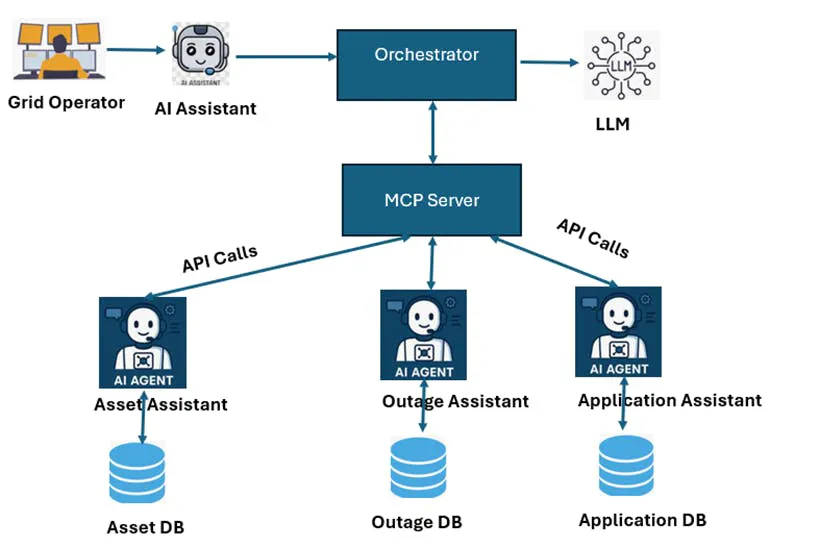
To anchor this in operational reality, consider a utility facing a severe windstorm that knocks out power in several neighbourhoods. The control room operator begins interacting with a natural-language chatbot, asking for details about the outage locations. The MCP client, which orchestrates the process, uses the LLM to understand intent, analyse incoming sensor and customer reports, and prioritise impacted zones. Then, through a defined API, MCP connects with the utility's Outage Management System and dispatch systems to initiate diagnostics on affected feeders. As the grids' smart reclosers and switches report their status, the orchestrator uses real-time data to generate recommendations for a self-healing response. The operator reviews the suggested switch operations—automatically derived through model-based reasoning—and, with a single approval, sends restoration commands to unaffected customers, significantly reducing downtime. This illustrates how MCP, LLMs, and APIs can unite to streamline complex grid recovery tasks and support decision-making in the field.
Think of a scenario, when an outage occurs, and an operator starts interacting with a chatbot to understand a situation for an outage at specific area. He provides a natural-language query to the system, where the MCP client or orchestrator understands the intent with the LLM and invokes an associated tool via a specific API provided by an MCP server, which can perform that operation. Please see the high-level diagram as follows:
Grid Operating Model:
We are adopting a new grid efficiency approach using modern utility software platforms such as ADMS (Advanced Distribution Management System), DERMS (Distributed Energy Resource Management System), and OMS (Outage Management System). As we move into the new era, these systems depend on high-quality input data to build accurate digital twins of the electric grid. The core of these systems is a sophisticated mathematical model with integrated physics, as taught by academics in higher education. The mathematical model integrates the physics of the grid (such as impedance, voltage, current and line connectivity) with its geographical details from geographic information systems (GIS). Ensuring that these digital representations mirror the actual grid is critical for safe and efficient operation.
AI has already proved that its probabilistic maths models are good to understand the intention, and using mathematics in semantic search by cosine similarity or any other mathematical calculation gives a boost to the industry to transform their business with these ground-breaking models capability to identify, and correct discrepancies between digital models and real-world grid behavior, minimizing the risk of errors propagating through critical utility systems. For example, cosine similarity allows the AI to efficiently match real-world observations with existing models, ensuring that potential mismatches or risks are flagged and addressed quickly. In simple terms, this means AI can help utilities spot problems earlier, fix inconsistencies faster, and ultimately keep the grid running more safely and reliably. Utility operators can utilise these training datasets -both labelled and non-label to enable AI systems to achieve near-human level capabilities to detect and remediate data abnormalities.
An architect can think of the use of GNN (Graphical Neural Network) to construct a dynamic and geometric representation of grid topology. There is a great proverb in English: “A picture is worth more than a 1000 words.” These graphical representations with neural capabilities not only produce graphics that an operator can understand better but also provide the capability to understand their connections and impacts through a complete graph. In this framework, nodes represent substations or transformers, and edges correspond to transmission lines. Unlike CNNs or RNNs, GNNs are designed to process irregular graph structures where connections are as important as the data points themselves. Imagine a scenario in which a GNN analyses data from a network of sensors within and around a power transformer in a substation to identify incipient faults (e.g., partial discharge, thermal faults) based on relationships across data streams.
Predictive Maintenance Modernisation:
Under any grid modernisation program, the primary focus took more attention about the right supply and demand that meet the grid requirements. On the flip side, it is very important to understand the current asset status. The asset is traded based on customer supply and demand, but it also needs to be ensured that it is performing as expected or requires immediate attention to operate safely, efficiently, and reliably. These grid subjects are subject to latent risks that precipitate failures due to corrosion, thermal fatigue, etc. AI could revolutionise asset management by transforming passive monitoring into active prognostication.
The effective use of AI to monitor grid elements will be impactful if we build virtual replicas of these assets and develop meaningful digital twins. This type of digital twin can simulate stress tests or any seismic events. These AI models run millions of simulations of how assets might perform under stress, maintenance gaps, and emergent events, providing strategic vantage points for utilities to act on.
Outage turns into Opportunities:
The biggest fear in a utility company arises when a major storm hits the city, resulting in a major outage and an SLA to restore it. On several occasions, we observe that the outage report systems come under stress due to a shift in data patterns. Think a system that receives 4-5 outages at any given time receives a record of 10,000 outages. In such a scenario, the AI can help with predictive maintenance and major predictions based on the historical data. For example, during Hurricane Ida in 2021, utility companies in Louisiana leveraged AI-powered outage analytics to prioritize restoration efforts and optimize crew dispatch. By using AI tools to process incoming damage reports and sensor data, they identified key outage clusters faster and were able to direct resources more effectively, significantly shortening customer downtime compared to earlier large-scale events. Similarly, during the 2020 wildfire season in California, AI-enabled situational awareness tools helped utilities anticipate outage areas and automate parts of grid reconfiguration, minimizing restoration times for affected communities. These real-world examples demonstrate that integrating AI-driven analytics into outage response isn't just a theoretical promise but a practical way to trim restoration times and support resilience. We already advocate that a large amount of data provides meaningful results from the LLM with the right context. It is a matter of thought process to design for greater agility and responsiveness, supporting both operational efficiency and the strategic transformation of future predictions.
Routine updates on infrastructure status can leverage AI’s pattern recognition. The CNN-based models, such as computer vision, can analyse drone footage to catalogue pole lean or insulator cracks and flag interventions before escalation using object detection models. The effective use of LiDAR in vegetation management to understand vegetation growth and predict its future is a use case where the industry can take an important step towards the next mission of grid reliability and the effective use of assets. Look at these statistics: Vegetation-related impacts to the power system account for more than 20% of U.S. power outages. It’s a human innovation and mind that can utilise the technology impactfully. In this natural ecosystem, everyone knows that a man utilises technology appropriately. The ancient man produced fire by friction between two stones, and we utilise this technology to make a lighter. It’s a duty of industry leaders and thoughtful architects to fit these components into the grid ecosystem and produce a better output not only for customers but also for our environments also.
Flexibility Forecasting:
The major challenge for the industry is accurate electricity demand forecasting. It’s not easy to predict the exact number of generators needed to produce electricity. It is always a probability based on historical projection that a customer or industry needs this amount of power. One of the major concerns for electric grid operators is balancing supply and demand, often in real time. The limited amount of generation, combined with high demand and supply due to climate change and other challenges, poses a significant risk to utility companies of not meeting customer requirements and to the grid. The more accurate the generation load forecasting based on the right parameters, the first touchpoint for most decision-making, while a grid operator is switching electricity from A point to B point, will be a meaningful decision.
The traditional methods can help in short-term forecasting where an algorithm used a most probable data and provides a better answer to the operator's questions. What expected supply should the utility worry about creating at a future time? The AI is moving ahead with time-series data, or the effective use of multivariate time-series data. The multivariate series can use weather patterns, economic indicators, and historical loads to extrapolate grid states hours or days ahead. In other words, the multivariate series or time series that can predict or probabilistically what’s next, the data is expecting, is quite possible with the new models or say a domain architect collaborates with the appropriate data science team to achieve that.
If you observe, the industry is gradually moving to a new challenge, which raises the question: Can the electric grid get some help from customer-owned devices such as thermostats, PV cells, generators, and energy storage? If you need to understand the term load flexibility in layman's terms, you’ll see it's a kind of scenario-based flexibility. We need to write a smart algorithm that can analyse grid stress and decide whether we can get the required electricity via these flexible devices, such as energy storage, to meet the demand. These flexibilities add an extra advantage to respond to the future energy demands of our AI data centres for future demands. Gradually, as we achieve more accurate results, I don’t see these days as very far off when these flexible devices will create a strong VPP (Virtual Power Plant) and be utilised to achieve more accurate results during peak hours in AI data centres. This would reduce energy costs for end customers and reduce grid stress. It is a prime duty of industry leaders, domain architects and data scientist team collaborate effectively to produce a great orchestration to achieve this end goal. AI could achieve this and much more if deployed to orchestrate energy exchange between generation devices and consumers.
As we stand at this crossroads, the call to leadership is clear: grid operators, utility executives, innovators, and technology partners must join forces to drive collaborative initiatives—such as joint pilot projects or industry-wide data-sharing consortiums—that explore the transformative impact of AI and flexible resources. By uniting around concrete next steps, leaders can accelerate innovation, share best practices, and deliver trusted, tangible solutions that benefit customers, the sector, and society at large. Now is the time for leaders to open the conversation and, together, shape the roadmap toward a smarter, more resilient grid.
Road Ahead for the Grid Modernisation:
This article does not suggest that AI is a cure-all, nor that it will replace the expertise of grid operators. Rather, leadership in the grid’s evolution is about adopting a sociotechnical approach—where people and technology collaborate, brainstorm, and plan together to build a smarter, more inclusive grid. Success will come from leaders who foster diverse teams, champion cross-disciplinary thinking, and empower both consumers and professionals to contribute to a vibrant energy ecosystem that serves society as a whole.
To shape the greatest possible future for the grid, leaders must unite people and technology, ensuring that intelligence and ingenuity keep the lights on for generations to come.
The electric grid’s future will be defined by its ability to anticipate, adapt, and optimize. With growth-minded leadership, curiosity, and collaboration among industry leaders, architects, and data scientists, the grid can reach its next level of potential. Teams ready to harness this opportunity will help usher in a new, brighter era for the industry.